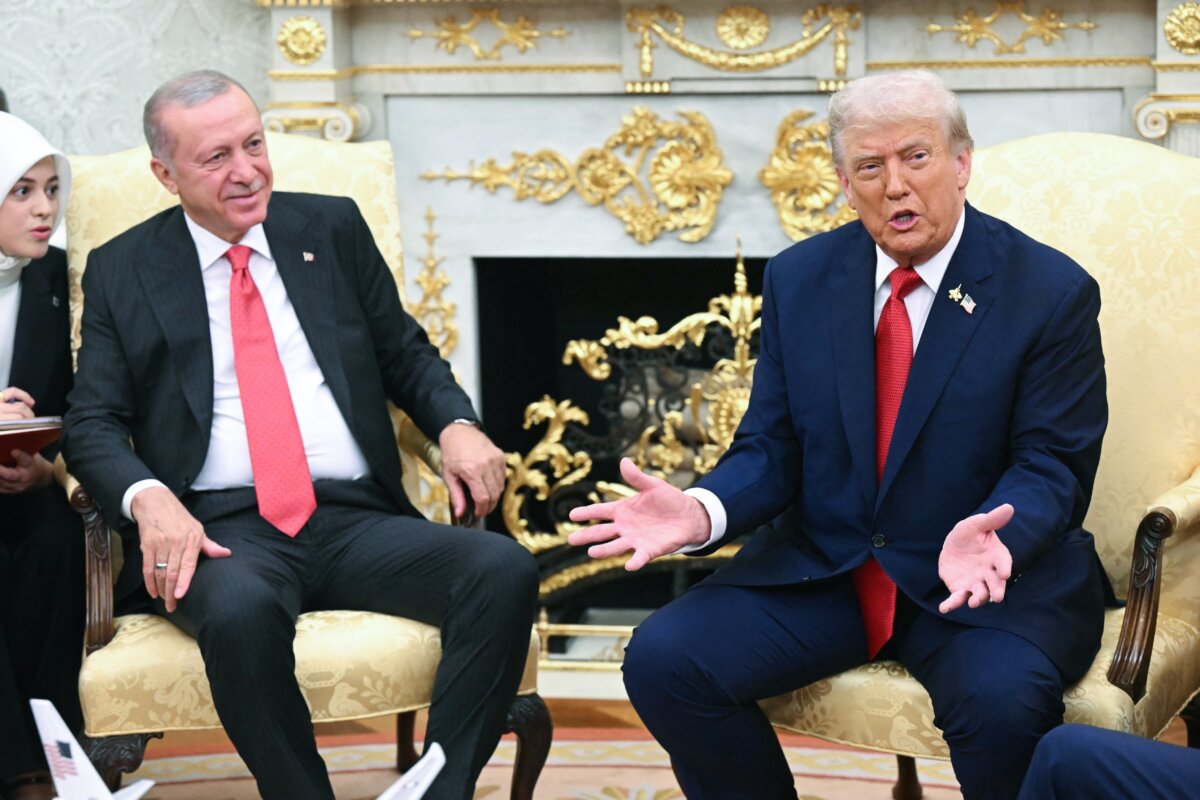

U.S. President Donald Trump hosted Turkish counterpart Recep Tayyip Erdogan at the White House on Sept. 25, where the two leaders spoke for more than two hours.
Although discussions were held largely behind closed doors, Tom Barrack, Washington’s envoy to Turkey, described the talks as “historic,” according to Turkish state-run news agency Anadolu Agency.
“It was better than great,” Barrack said after the meeting. “Two amazing leaders … had a real understanding and respect for each other.”
According to geopolitical analyst Ana Maria Evans, the meeting underlined the “critical geopolitical significance of Turkey, which sits at the crossroads of the Middle East, the Caucasus region, the Mediterranean, and the Black Sea.”
“As such, President Erdogan can play a pivotal role in Eurasian security and influence the geopolitics of the Middle East,” Evans, a professor at Lisbon’s Catholic University, told The Epoch Times.
At a joint press conference that preceded the talks, Trump highlighted his “very good relationship” with the Turkish leader.
“We’ve had tremendous relationships, both having to do with war and … trade. Today, we’re talking about both,” he said.
“I’d like to have him stop buying oil from Russia while Russia continues this rampage against Ukraine.”
Erdogan, for his part, said that, under Trump, U.S.–Turkey relations had been brought to a “different level.”
After the talks concluded, Trump described them as “very conclusive.”
Asked whether he thought Ankara would stop buying Russian oil, the U.S. president said, “I believe [Erdogan] will stop it … because he can buy it from a lot of other people.”
Speaking to journalists on his return flight to Turkey, Erdogan did not mention the issue of Russian oil.
According to Ilhan Uzgel, foreign-policy coordinator for the Republican People’s Party, Turkey’s main opposition party, such a request by Trump would put Erdogan “in a difficult position.”
“If Turkey continues buying Russian oil, this will anger Trump,” Uzgel told The Epoch Times. “But if it stops, this will cause serious frictions with Russia, with which Turkey has already signed purchase agreements.”
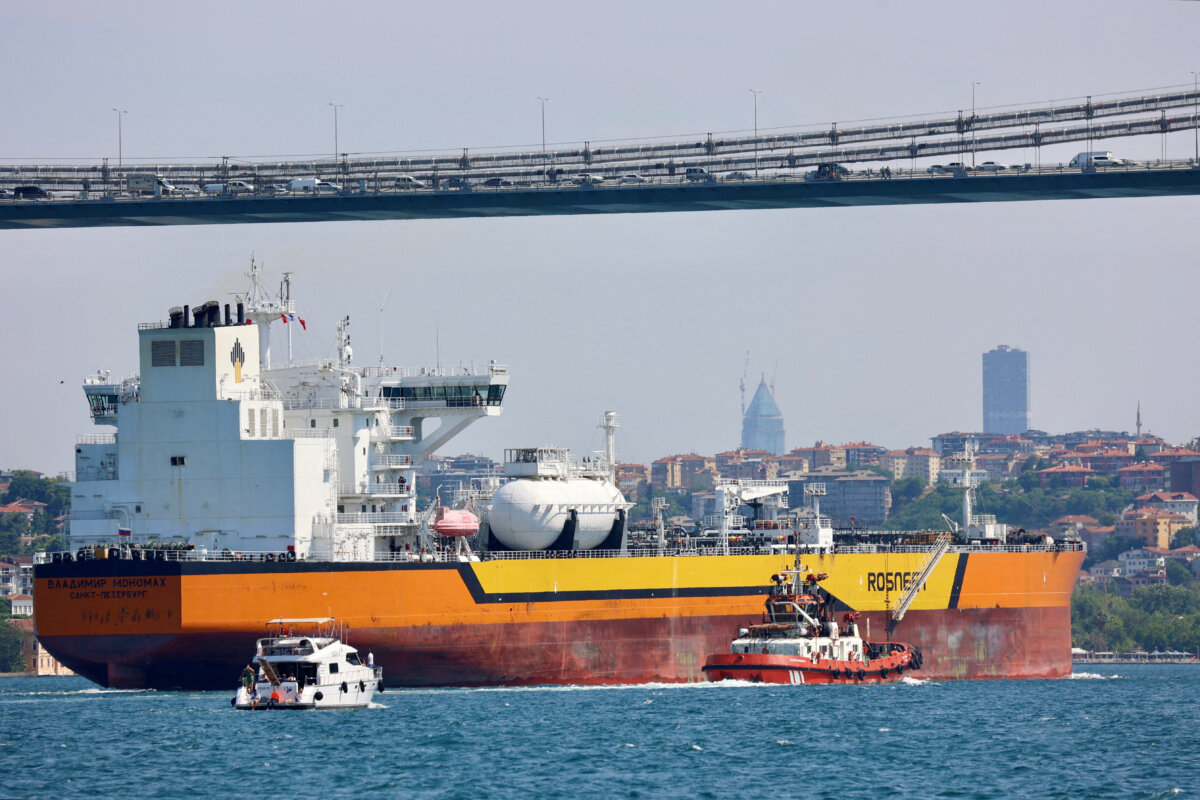
“Turkey desperately needs cheap energy because inflation is already high,” he said, noting that Turkey depends on Russian oil for roughly 40 percent of its energy needs.
Evans agreed.
“It’s not very likely that Turkey can—in the short run—switch the infrastructure, logistics, and binding contracts that are involved in its current dependency on Russia for energy,” she said.
Such a transition would likely remain out of the question “until an equivalent—or cheaper—alternative source of energy can be provided,” she said.
“Energy supplies are critical to military, industrial, civil, and security operational capacity, and therefore take primacy in foreign policy choices,” Evans said.
“This is a reality that Turkey cannot escape.”
A day after the Trump–Erdogan meeting, a Kremlin spokesman said “trade and economic cooperation” between Moscow and Ankara remained ongoing.
Turkey, he said, is a sovereign state that decides for itself in which areas to cooperate with Russia.
According to LSEG, a global financial data provider, Turkey currently represents the second-largest buyer of seaborne Urals Russian crude oil after India.
F-35s Still Up in the Air
Under the previous U.S. administration, Washington’s relations with Turkey—a longstanding NATO member—were frequently strained.
This was largely due to Ankara’s disinclination to support Western sanctions on Russia, with which it maintains extensive trade relations.
Bilateral ties were also rocky during Trump’s first term in the White House.
In 2020, Washington imposed sanctions on Turkey’s defense industry after Ankara purchased S-400 advanced missile-defense systems from Russia.
Under the sanctions, Turkey was expelled from a U.S. program to jointly manufacture F-35 fighter aircraft, a number of which it had hoped to eventually purchase.
Washington also suspended a planned multibillion-dollar agreement with Turkey for the purchase of 100 U.S.-made F-16s.
In the run-up to this week’s Trump–Erdogan meeting, speculation was rife that the sanctions might be lifted, allowing Turkey to purchase the aircraft.
“Trump has hinted that the U.S. might consider ending Turkey’s suspension from the F-35 program in return for complying with his request that Turkey stop buying fossil fuels from Russia,” Evans said.
At the press conference held just before the meeting, Trump noted that Turkey still wanted to buy “F-16s, F-35s, and some other things.”
“[Erdogan] needs certain things and we need certain things,” Trump said.
After the meeting, however, the Turkish leader said nothing about the sanctions or the desired military aircraft.
“There still appears to be no clear agreement regarding the delivery of F-35s to Turkey because of the [Countering America’s Adversaries Through Sanctions Act] sanctions,” Uzgel said.
Lifting the sanctions, Uzgel said, requires approval from the U.S. Congress, which, he said, will not happen “anytime soon.”
“Both leaders have promised to ‘work on it,’ but there has still been no open pledge from Trump,” he said. “So the F-35 issue remains in limbo.”
Nevertheless, on Sept. 26, Turkish Airlines, the national carrier, announced plans to buy 225 U.S.-made passenger jets—including 75 Boeing 787s—for its fleet.
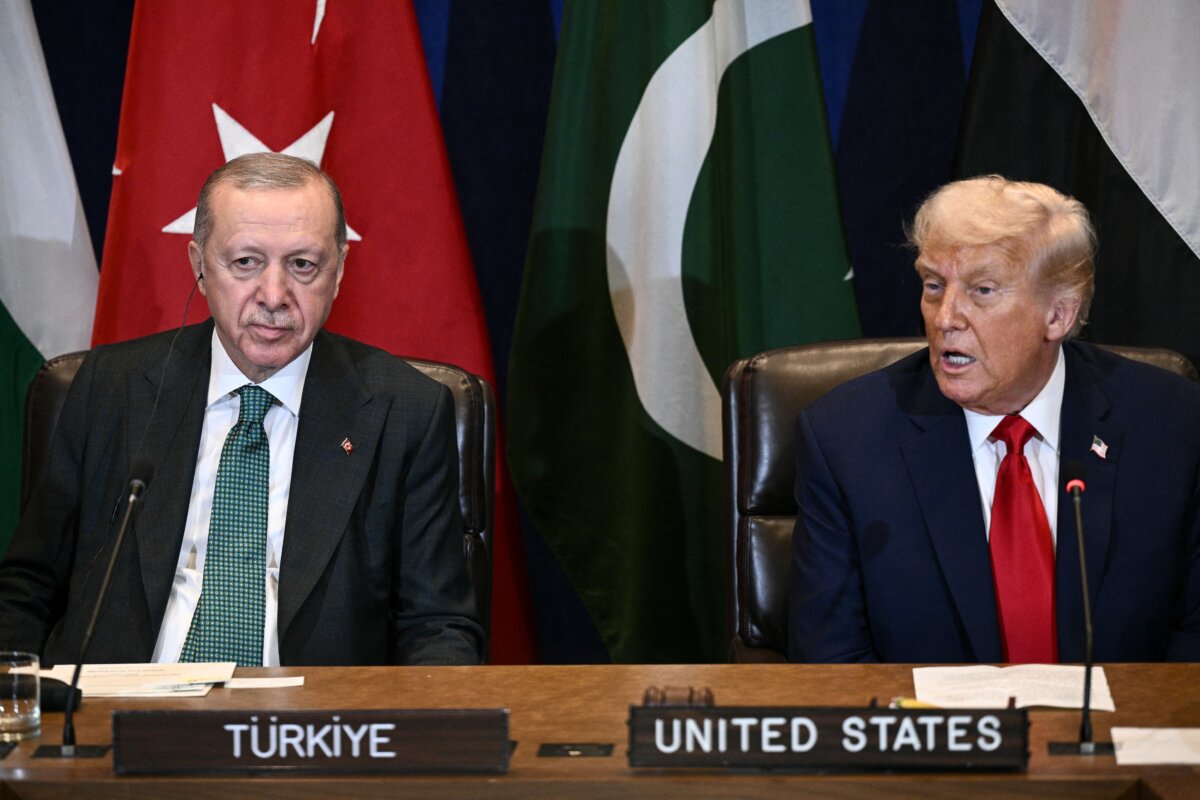 U.S. President Donald Trump, alongside Turkey’s President Recep Tayyip Erdogan (L), speaks during a multilateral meeting to discuss the situation in Gaza, on the sidelines of the U.N. General Assembly in New York City on Sept. 23, 2025. (Brendan Smialowski/AFP via Getty Images)
‘Shared Understanding’ on Gaza
Addressing reporters after the meeting, Erdogan said it was “impossible to resolve every issue in a single meeting.”
“However, this meeting has led to meaningful progress on many issues,” he added, according to a transcript released by his office.
Erdogan said that he and Trump had discussed means of enhancing bilateral trade, for which the two sides have set an annual target of $100 billion.
He also said he and Trump had a “shared understanding” on how to achieve a cease-fire in Gaza, which has been a war zone since the Hamas terrorist group attacked Israel on Oct. 7, 2023.
“We explained [at the White House meeting] how to first achieve a cease-fire in Gaza,” Erdogan said, according to state-run news agency Anadolu Agency.
“There was a shared understanding on this. Mr. Trump is also aware that things cannot continue this way.”
Two days before the meeting, both leaders were in New York City, where they took part in a meeting on Gaza held on the sidelines of the U.N. General Assembly.
The event was also attended by leaders of several regional states, including Egypt, Qatar, Saudi Arabia, Jordan, and the United Arab Emirates.
At the meeting, Trump presented a 21-point Middle East peace plan, the details of which have yet to be made public.
According to Uzgel, it remains unclear what kind of “understanding” was reached between the U.S. and Turkish leaders regarding the situation in Gaza.
“I don’t think any concrete decisions were made about Gaza at the Erdogan–Trump meeting,” he said.
“The United States is preparing a peace plan, but Turkey wasn’t involved in drafting it.”
Reuters contributed to this report.
 Friends Read Free
Copy
Facebook
Tweet
Friends Read Free
Copy
Facebook
Tweet