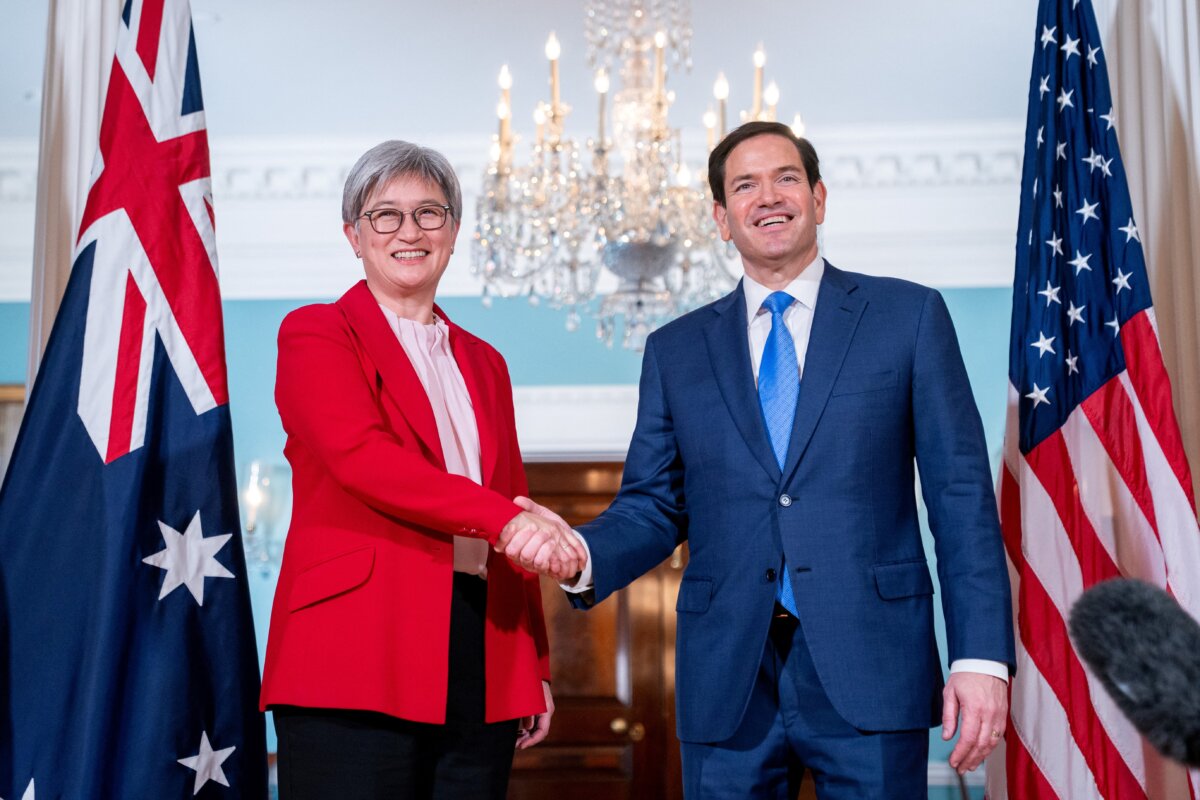

Australia’s Foreign Minister Penny Wong says U.S. President Donald Trump has “the greatest chance of any political leader” to broker a ceasefire deal in Gaza, just as Australia joined 28 nations condemning Israel for blocking humanitarian aid to Palestinians.
Wong acknowledged the central role the United States played, despite its firm backing of Israel, in an interview with Sky News Australia.
Her comments came amid rising global pressure on Tel Aviv, following the deaths of more than 800 Palestinians in recent months—many of them while seeking aid from distribution centres.
Greens Senator Mehreen Faruqi took the issue into Parliament holding up a sign that read, “Sanction Israel,” during the governor-general’s speech amid the official opening of the 48th parliament. Protests demanding sanctions on Israel also continued.
Walking Between China-US Relations
Asked whether Prime Minister Anthony Albanese was walking a tightrope between Beijing and Washington, Wong said, “I think diplomacy is often a tightrope.”
She said the government’s approach would focus on advancing Australia’s interests “in all circumstances,” adding, “That has to be the job of Prime Minister Albanese. That has to be my job.”
Wong acknowledged that while the United States remained Australia’s principal strategic and investment partner, while China was the largest trading destination.
“We will continue to work with the United States in terms of our closer military arrangements … just as we have always done,” she said.
Describing Australia’s approach to Beijing, she reiterated, “Cooperate where we can, disagree where we must, and engage in the national interest.”
Asked where Australia disagrees with China, she cited human rights and international law, particularly the U.N. Convention on the Law of the Sea.
“China seeks to become a predominant power in our region. Australia wants a balance where no country dominates, and no country is dominated,” she said.
Wong also rejected claims of hypocrisy for criticising the former Coalition government’s strained relationship with China while Albanese struggles to secure direct contact with U.S. President Trump.
“They always seek to create domestic politics in circumstances where you really need to be adult and mature and navigate a diplomatic relationship,” she said.
AUKUS a ‘Win-Win-Win’
Wong also backed the AUKUS pact between Australia, the United States, and UK, while sidestepping questions on whether Australia should meet higher defence spending expectations from the Trump administration.
“AUKUS is a win for the United States, which gets more maintenance days and investments into its industrial base … It’s a win for Australia, because we gain a capability that enables us to contribute to the strategic balance,” Wong said.
While acknowledging that Trump may reshape America’s global role, Wong insisted Australia could adapt, “We should have confidence in our capacity to navigate our relationship with the United States and all the ways in which we seek to advance Australian power in our region.”
The government has faced concerted criticism from the opposition for not being able to secure a meeting with President Trump.
Last week Shadow Defence Minister Angus Taylor urged Albanese not to neglect Australia’s relationship with the United States, warning it has been left idle too long.
“After over 250 days of this new U.S. administration, we should have seen a face-to-face meeting between the prime minister and the president of the United States and we should be seeing relationship-building and work going on with the U.S. around the AUKUS alliance, around our strategic alliance more broadly,” Taylor told ABC’s 7:30.
 Friends Read Free
Copy
Facebook
Tweet
Friends Read Free
Copy
Facebook
Tweet