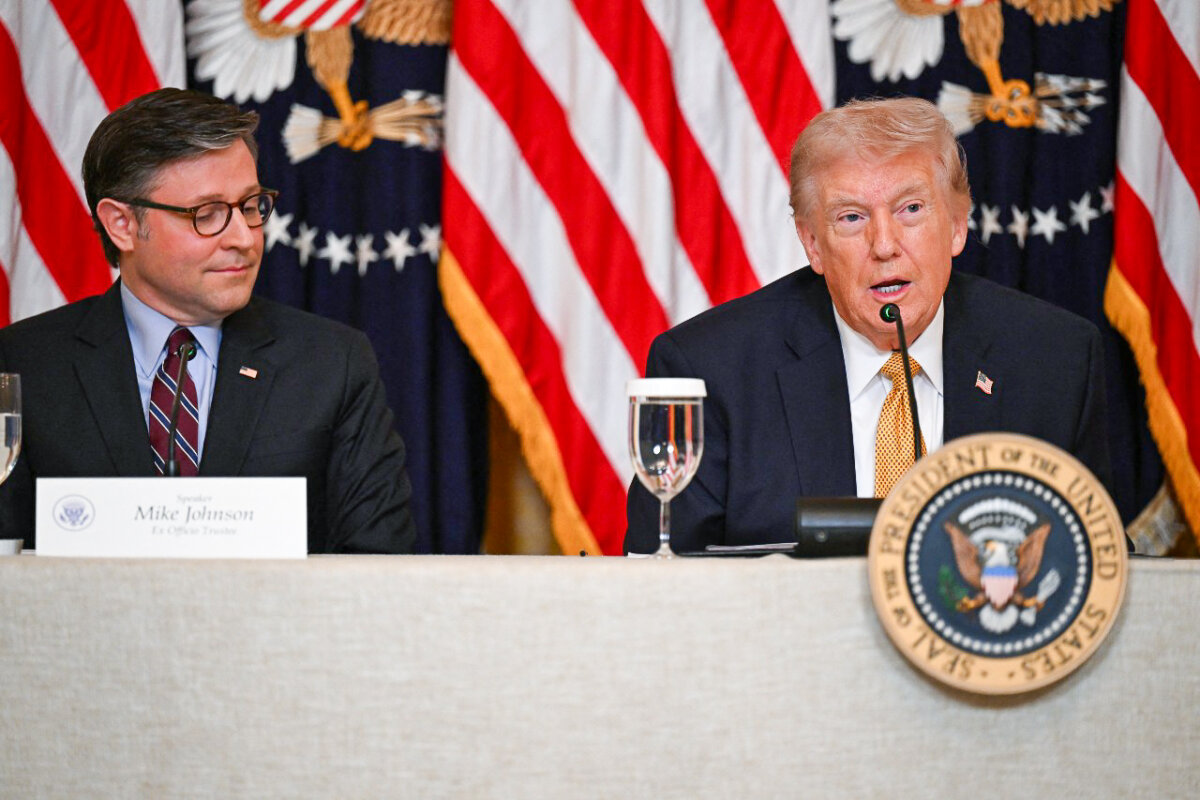
President Donald Trump said on March 16 that several nations will send warships to join the U.S. Navy in escorting commercial ships through the Strait of Hormuz but expressed disappointment that several key NATO “big boys,” notably the UK and Germany, have not responded to his call for a joint operation.
“Numerous countries have told me they’re on the way,” he said at a Kennedy Center luncheon. “Some are very enthusiastic about it. Some are in countries that we’ve helped for many, many years.”
The president said UK Prime Minister Keir Starmer had denied his request that the UK send two aircraft carriers to the Arabian Sea or eastern Mediterranean.
French President Emmanuel Macron has been more cooperative, he said, and has dispatched an aircraft carrier to the eastern Mediterranean. This has allowed the USS Gerald Ford to join the USS Abraham Lincoln in the Arabian Sea to focus on the strait.
“I have spoken to him,” Trump said. “He’s been, on a scale of zero to 10, I’d say he’s been an eight.”
When asked what countries have committed ships, the president said, “I’d rather not say yet, but we’ll be announcing [details soon].”
“I have to tell you, we have some that are really enthusiastic,” he said. “They’re coming already. They’ve already started to get there. You know, takes a little while to get there.”
The bottom line, he said, is that the United States could do it itself.
“We don’t need anybody,” Trump said. “We’re the strongest nation in the world. We have the strongest military by far in the world. But it’s interesting. I’m almost doing it in some cases, not because we need them, but because I want to find out how they react.
“I’ve been saying for years that if we ever did need them, they won’t be there, not all of them, but they won’t be there.”
Trump said on March 15 that he had asked seven countries that depend heavily on the waterway to help secure it, after earlier naming China, France, Japan, South Korea, and the UK as nations he hoped would deploy ships to augment U.S. forces in the Arabian Sea.
The president said the United States imports little crude oil from the Persian Gulf. The nations he requested send warships to police the waterway “get much more” of their oil from the region, he said.
Japan gets 95 percent, China gets 90 percent, South Korea gets 35 percent, and “many of the Europeans get quite a bit,” Trump said.
“So we want them to come and help us with the trade,” he said.
Japanese Prime Minister Sanae Takaichi is scheduled to visit Washington to meet with Trump on March 19.
Germany, Spain, and Italy are among NATO allies that immediately rebuffed the president’s call for assistance in keeping the strait open.
German Defense Minister Boris Pistorius said more warships would not secure the strait, questioning what “a handful or two handfuls of European frigates” could do “that the powerful U.S. Navy cannot do.”
“Neither the United States nor Israel consulted us before the war, and … Washington explicitly stated at the outset of the war that European assistance was neither necessary nor desired,” German government spokesperson Stefan Kornelius said on March 16 in Berlin.
“This is not our war, we have not started it.”
Italian Deputy Prime Minister Matteo Salvini told reporters on March 16 in Milan, “Italy is not at war with anyone and sending military ships in a war zone would mean entering the war.”
Denmark and the UK have not denied Trump’s request. Both nations said they are considering participating in a joint operation in the Arabian Sea. The U.S. president criticized the hesitancy in the UK’s response.
“[Starmer] yesterday told me, ‘I’m meeting with my team’ to make a [decision], and I said, ‘You don’t need to meet … the team,'” Trump said. “‘You’re the prime minister. You can make your own. Why do you have to meet with your team to find out whether or not you’re going to send some mine-sweepers to us or to send boats?’”
The president acknowledged that while the United States and Israeli air forces have “already taken care of Iran” militarily, the threat to the narrow waterway linking the Arabian Sea with the Persian Gulf is asymmetric.
“A single terrorist can put something in the water, or … shoot a missile—a small missile—and it’s fairly close range” from shorelines to passing ships, Trump said.
That vulnerability “is one of the reasons they’ve always used” the threat of attacking ships in the Strait “as a weapon,” the president said.
The Pentagon is sending a number of U.S. Navy ships to reinforce the Ford and Lincoln battlegroups, which already include six Arleigh Burke-class guided-missile destroyers. Among the ships headed for the Arabian Sea is a three-ship battlegroup led by USS Tripoli, a “lightning carrier” with more than 2,400 Marines and up to 20 F-35 fighters.
 Friends Read Free
Copy
Facebook
Tweet
Friends Read Free
Copy
Facebook
Tweet