
President Donald Trump said the United States could impose a “big tariff” on the UK if it does not abandon its Digital Services Tax (DST), which affects a number of major tech companies.
Speaking at a White House event on April 23, Trump criticized the UK’s 2 percent DST, which applies to revenues generated in the UK by large search engines, social media platforms, and online marketplaces.
“If they don’t drop the tax, we’ll probably put a big tariff on the UK,” Trump told reporters.
“We don’t like it when they target American companies. Because basically you’re talking about our great American companies.”
Some of the major tech companies affected by the levy are Alphabet (Google), Meta (Facebook/Instagram), Amazon, and Apple.
Trump’s remarks come ahead of a visit next week by King Charles III, which aims to highlight the modern UK–U.S. relationship through culture, community, and economic growth, according to an April 14 statement by the royal family.
Trump said he believed the British monarch could help improve strains in the bilateral relationship.
Tax Tensions
Under the DST, introduced in April 2020, companies with more than 500 million pounds ($674 million) in global revenues from covered digital activities and more than 25 million pounds ($33.7 million) linked to UK users pay a 2 percent levy on qualifying revenues derived from the UK.
According to a November 2025 UK government review, the tax raised roughly 800 million pounds ($1 billion) in the 2024–25 fiscal year.
“They think they’re going to make an easy buck. That’s why they’ve all taken advantage of our country. They don’t take advantage of it,” Trump said. “We’ve been looking at it and we can meet that very easily by just putting a big tariff on the UK. So they better be careful.”
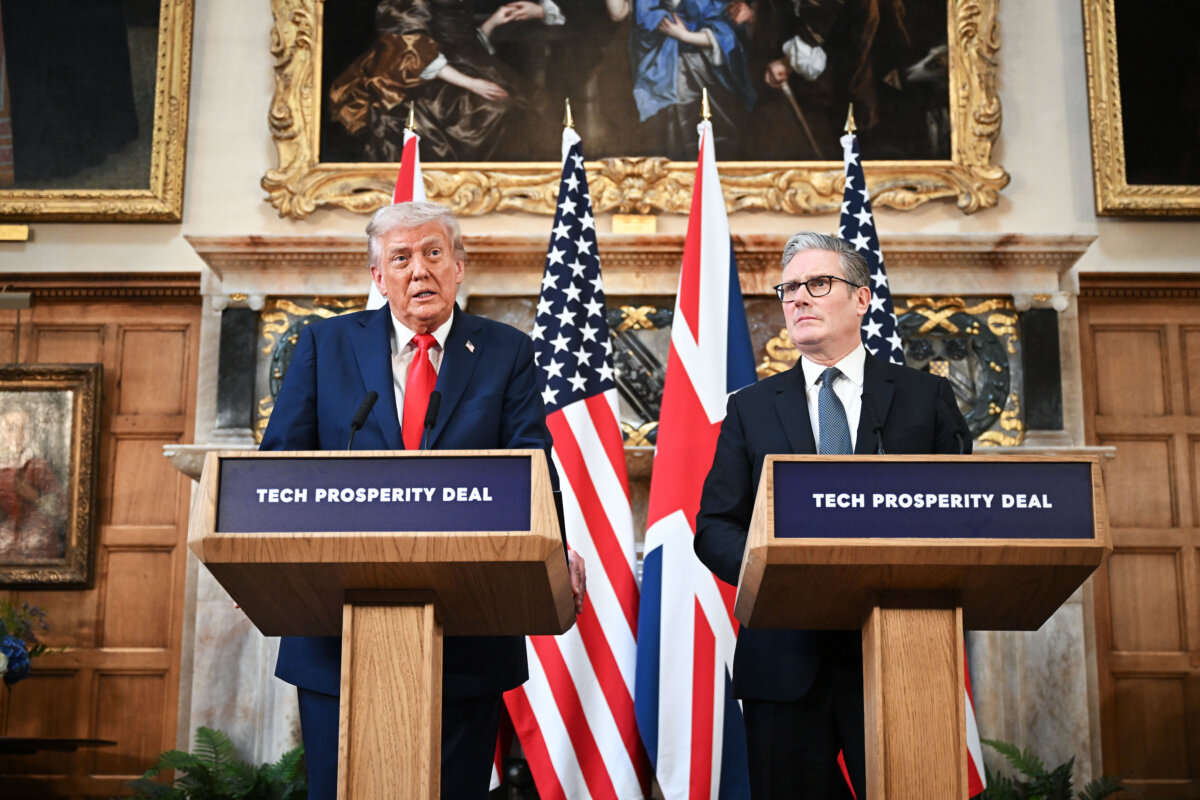
Trump’s warning comes despite recent efforts to deepen U.S.–UK technology ties. In September 2025, the two countries announced a $42 billion “Tech Prosperity Deal.”
Under the agreement, major American firms, including Microsoft, Nvidia, Google, OpenAI, and CoreWeave, committed investments in UK AI infrastructure.
The deal was framed as a strategic partnership spanning artificial intelligence, quantum computing, and advanced energy technologies.
The British government said the investment package could create more than 5,000 jobs and help establish a new AI growth zone in northeast England.
The United States and the UK agreed to the Economic Prosperity Deal framework on May 8, 2025, the first major trade agreement announced after Trump unveiled his broad global tariff agenda on April 2 of that year.
Trump described the reciprocal trade framework as a “great deal for both countries,” though it left in place the United States’ baseline 10 percent tariff on UK exports.
Digital taxes remained one unresolved point. A May 2025 fact sheet from the Office of the U.S. Trade Representative (USTR) said Washington remained “disappointed that the UK was unwilling to agree” to fully address its DST.
“It is discriminatory, unjustified, and should be removed promptly,” the USTR said.
The dispute is not limited to the UK. In June 2025, the Canadian government announced it would rescind its 3 percent DST as part of broader trade negotiations with the United States.
The DST was scheduled to go into effect on June 30, 2025, and was retroactive to 2022, leaving U.S. tech companies with a $2 billion bill to pay by the end of June.
Ahead of the deadline, Trump said on June 27, 2025, that he was ending all trade negotiations with Canada over Canada’s digital services tax, which would impact U.S.-based tech companies such as Amazon, Google, and Netflix.
Announcing the tax removal, Canadian Finance Minister François-Philippe Champagne said in a June 29, 2025, statement that the move would “allow the negotiations of a new economic and security relationship with the United States.”
 Friends Read Free
Copy
Facebook
Tweet
Friends Read Free
Copy
Facebook
Tweet