
The Republican People’s Party (CHP), Turkey’s main opposition party, has been thrown into disarray following a series of court rulings and the arrest of prominent party members.
“The head of our party’s Istanbul branch was removed by court order and replaced by a [government-appointed] trustee,” Ilhan Uzgel, the CHP’s deputy chairperson for foreign affairs, told The Epoch Times.
“This was something unseen in Turkish history and part of the multi-frontal attack on our party that began last October.”
Early this month, an Istanbul court ordered the head of the CHP’s Istanbul branch, Ozgur Celik, to vacate his post.
According to the judicial ruling, Celik’s election to the post in 2023 was marred by irregularities, including vote-buying—an allegation the party denies.
The court further ruled that Gursel Tekin, a former CHP official, would take over the post on a temporary basis.
Tekin is close to Kemal Kilicdaroglu, who led the CHP for 13 years until 2023, when—after losing a presidential election—he was replaced by Ozgur Ozel, current head of the party.
Some have accused the CHP’s “old guard” of seeking to regain control of the party with the help of the government, which for more than 20 years has been led by President Recep Tayyip Erdogan’s AK Party.
“This claim is frequently voiced by CHP’s current leadership,” Aydin Sezer, an independent Turkish political analyst, told The Epoch Times.
“There are allegations that certain delegates’ votes were bought in the [CHP] elections that Kilicdaroglu lost in 2023.”
Sezer said the allegations have been taken to court. “The AK Party didn’t waste the opportunity and initiated a judicial process [against the poll results],” he said.
Uzgel, for his part, rejects the notion that the CHP is suffering from an internal rift.
“There is no division within the party, which is united like never before,” he said. “You can’t say there’s an ‘old’ or ‘new’ guard.
“The government is trying to portray it as infighting, but that’s not true.
“Our party is unified because it’s under attack.”
Showdown in Istanbul
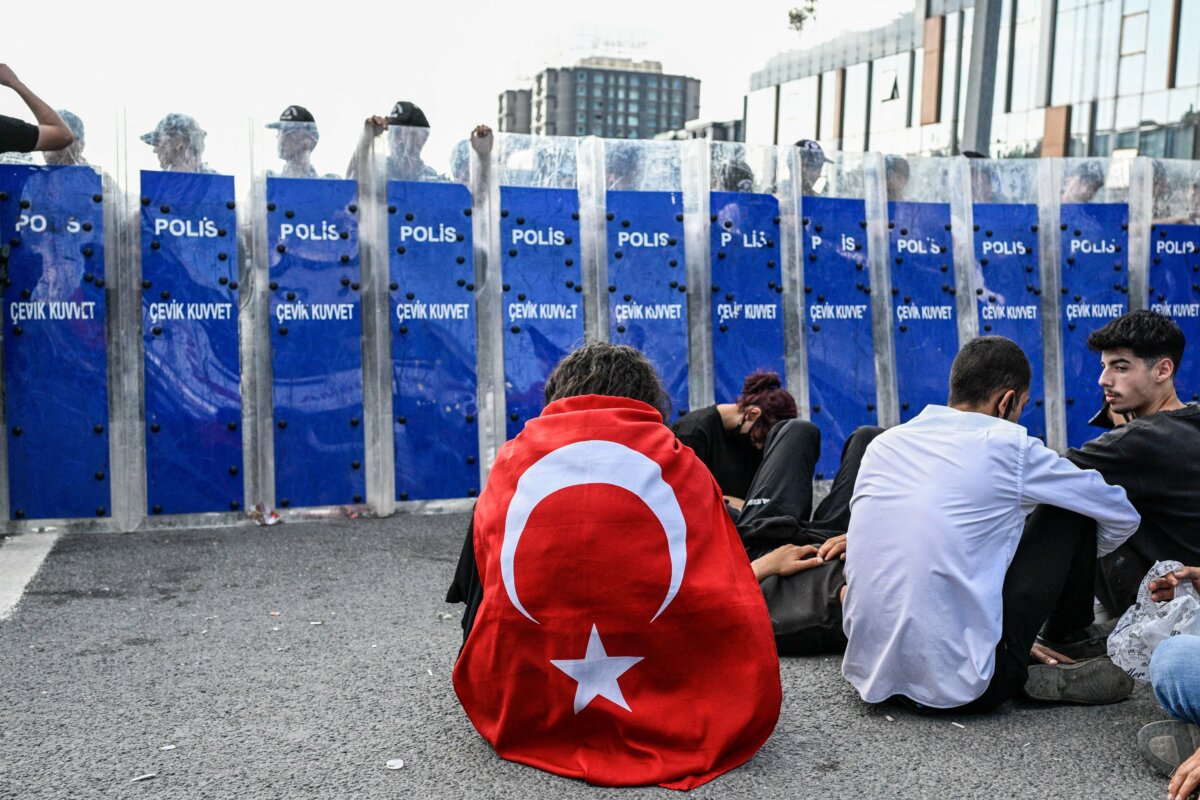
On Sept. 8, Tekin, the court-appointed trustee, arrived at the CHP’s Istanbul headquarters—with police—to take over the branch, in line with the judicial injunction.
In a dramatic effort to bar his entry, CHP lawmakers barricaded the building and scuffled with pepper-spray-wielding police, who detained several party supporters.
In a video message posted live from the scene on X, Gokhan Gunaydin, a CHP lawmaker, accused the authorities of seeking to “dismantle democracy.”
Addressing Tekin, he said: “You may have entered [party headquarters] with police, but we will not hand over justice and democracy to you.”
Remarking on the incident shortly afterward, Erdogan accused the CHP of violating the rule of law and inciting public unrest.
“Criticizing court decisions is one thing; disregarding them is another,” Erdogan said, adding that any refusal to comply with judicial decisions would “not be tolerated.”
On Sept. 15, an Ankara court will rule on a separate case challenging the legitimacy of the party’s 2023 general congress in which Kilicdaroglu was replaced by Ozel as leader of the party.
“Now they’re trying to remove our party leader from his position and install another trustee—probably a party member or previous leader,” Uzgel said.
Asked if this meant Kilicdaroglu could be reinstated as party leader, he said, “That’s a possibility.”

Arrest Campaign
Over the past year, the CHP has also seen scores of its members, including several elected officials, arrested on charges that they say are politically motivated.
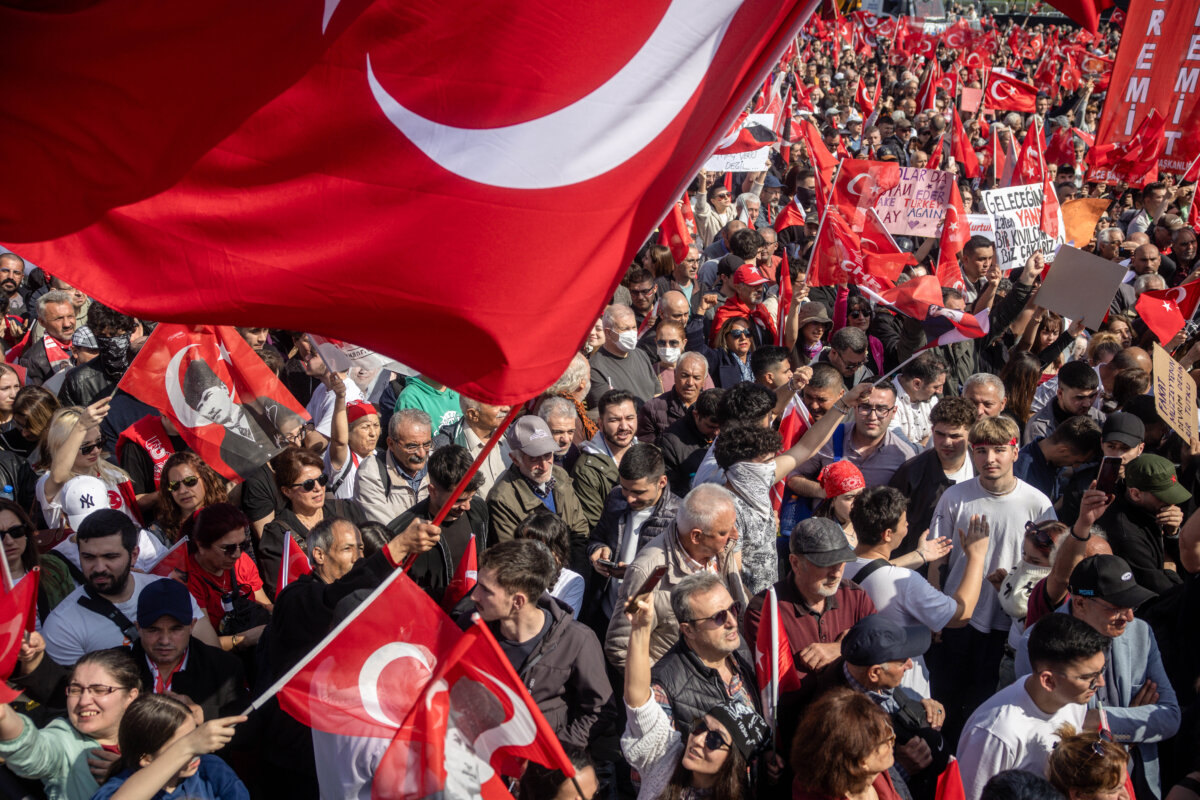
The most prominent of these is Ekrem Imamoglu, Istanbul’s CHP-affiliated metropolitan mayor, whose arrest in March sparked Turkey’s largest wave of street demonstrations in more than a decade.
Long viewed as a potential presidential challenger to Erdogan, Imamoglu remains in detention pending trial on corruption and terrorism-related charges. He has denied the allegations.
“If Imamoglu becomes a [presidential] candidate, his chances of defeating Erdogan are high,” Sezer said. “That’s why the AK Party doesn’t want him to run.”
In municipal polls held in 2024, CHP candidates won in Turkey’s three largest cities—Istanbul, Izmir, and the capital, Ankara—and in several other municipalities.
Since then, more than a dozen CHP-affiliated mayors, including Imamoglu, have been arrested on an array of charges.
Earlier this year, the European Parliament decried what it called the “arbitrary dismissal and imprisonment of democratically elected mayors” by the Turkish authorities.
The government rejects the criticism, saying Turkey’s judiciary is independent and that the ruling party lacks any influence over court decisions.
Like most other leading CHP members, Uzgel accuses the government of “instrumentalizing the courts for political purposes.”
According to Sezer, the CHP has thus far been unable to mount “sufficient resistance on the issue of the [arrested] mayors.”
He said public rallies and street demonstrations—of the kind seen after Imamoglu’s arrest—are “not enough.”
Spate of Defections
Adding to the party’s woes, recent weeks have seen several opposition mayors abruptly leaving the CHP and joining the ruling AK Party.
“They’re afraid of ending up in jail,” Uzgel said. “So they change their party allegiance and resign from the CHP.
“It’s not something we’re happy about, but it happens.
“Not everyone has the same degree of courage as Mr. Imamoglu or other mayors who have been jailed on a questionable legal basis.”
Sezer also attributed the rash of defections to fears of possible arrest.
“A large number of CHP mayors have been detained, arrested, and are awaiting trial,” he said. “Others have defected to the AK Party to avoid a similar fate.”
Asked if he thought that the myriad of challenges now facing the CHP constituted an “existential crisis,” Sezer responded in the affirmative.
“The CHP is searching for its identity,” he said.
“Is it social democrat? Does it embrace universal leftist values? Or does it compromise its principles in order to win votes from the center-right?”
Sezer noted that there is “a growing wave of nationalism within the party.”
“If the CHP splits, people wonder whether a genuine leftist party might emerge,” he said.
According to Uzgel, the AK Party is losing popularity—especially among younger voters—and is trying to “cling to power” by tightening its grip on the political landscape.
“We are under multi-frontal attack,” he said. “We’re relying on our society, people, members, and voters to resist.”
Reuters contributed to this report.
 Friends Read Free
Copy
Facebook
Tweet
Friends Read Free
Copy
Facebook
Tweet