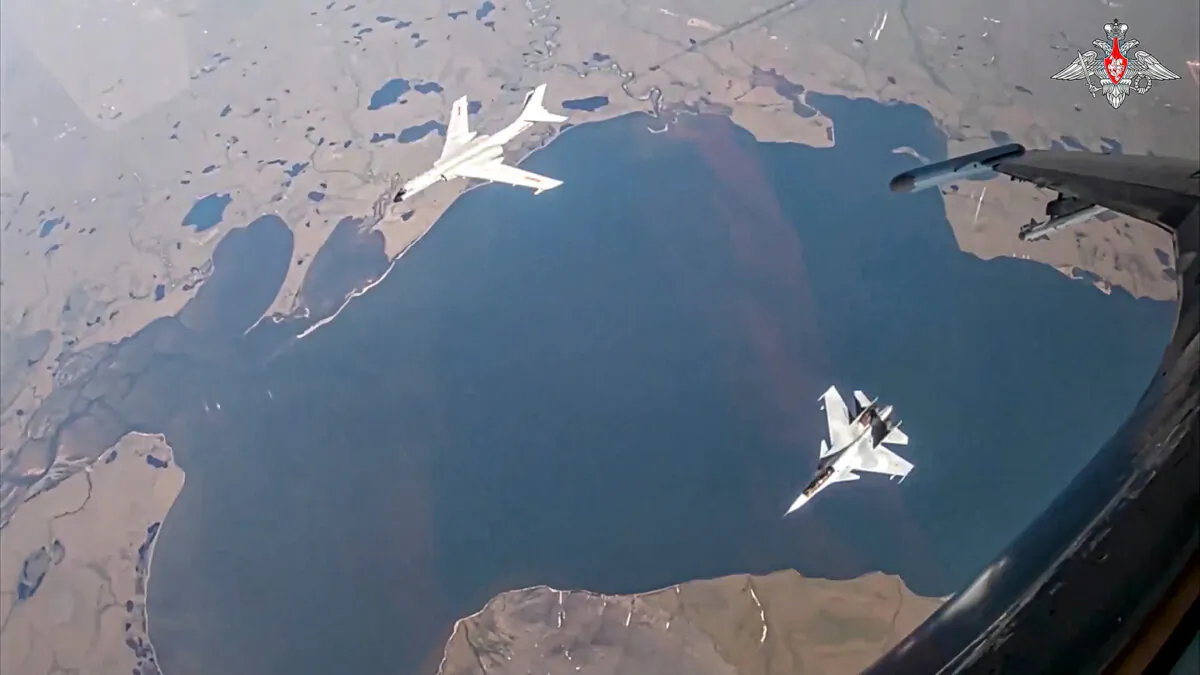

Two Russian military aircraft—an Su-30 fighter and an Il-78 refueling tanker—entered NATO member Lithuania’s airspace on Oct. 23 for roughly 18 seconds, according to Lithuania’s military.
The military said the two aircraft were potentially on a refueling training mission when they flew more than 2,000 feet into Lithuanian airspace from the Kaliningrad region at roughly 15:00 GMT.
“Today, an incident was recorded when Russian military aircraft briefly violated Lithuanian airspace—they were in it for less than 20 seconds. I want to assure you: The situation is completely under control,” Lithuanian Prime Minister Inga Ruginiene wrote on social media, in a translation from Lithuanian.
“Our services acted precisely—two Spanish Air Force fighters on a NATO air police mission took off into the air, flew to the site of violation, and are currently continuing patrolling.”
Ruginiene said the incident “shows once again that Russia behaves as a terrorist state in spite of international law and the safety of neighboring countries.”
“However, such actions will not affect us—Lithuania remains firm, united and ready to defend itself,” she wrote.
Lithuania’s military said the NATO Baltic Air Police scrambled the Spanish Eurofighter Typhoon jets to patrol the area in response.
On Sept. 19, according to Estonian officials, three Russian military jets violated Estonia’s airspace for 12 minutes, and NATO responded by sending fighters to escort them out. Moscow denied its jets entered Estonia’s airspace and suggested Tallinn lacked evidence to support its claim and was merely trying to heighten East–West tensions.
More than 20 Russian drones had breached Polish airspace nine days prior. The ensuing NATO response—in which its jets shot some of the drones down—was the first time an alliance member fired on Russian targets since Russia invaded Ukraine in 2022.
Earlier this week, Alexus Grynkewich, a U.S. Air Force general serving as NATO’s Supreme Allied Commander Europe, said Russia appeared to have been deterred by the firm NATO response to its recent incursions over Polish and Estonian airspace, but that he expected Russia to keep testing boundaries.
“We do see indications that the Russians are trying to be more careful, that they recognize that they came close to or crossed a line in a couple of cases, particularly when you consider the drone event in Poland,” he told Reuters.
On Wednesday, Russian President Vladimir Putin directed a wide-ranging exercise involving the country’s strategic nuclear forces, including the test launch of intercontinental ballistic and cruise missiles. He had recently announced that Moscow is actively developing new nuclear weapons.
Tom Ozimek and Reuters contributed to this report.
 Friends Read Free
Copy
Facebook
Tweet
Friends Read Free
Copy
Facebook
Tweet