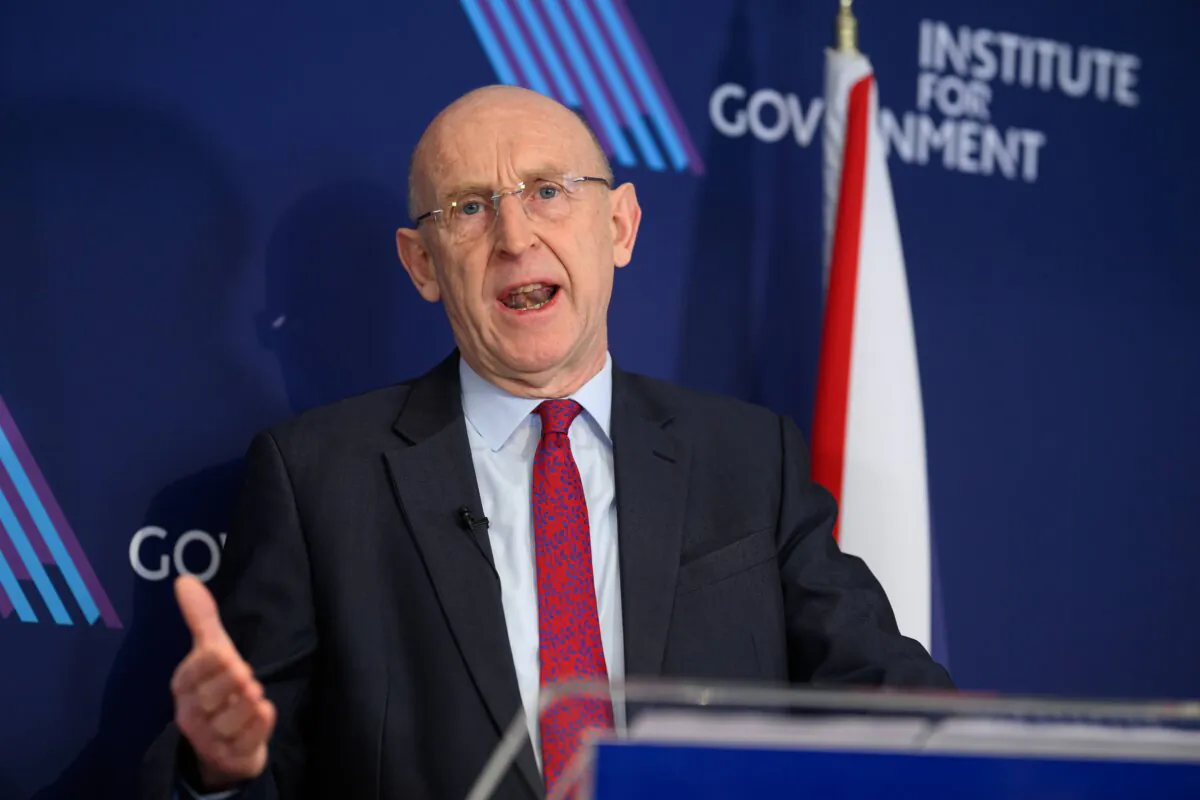
British Secretary of State for Defence John Healey will on Monday call on allies to back a 50-day push to arm Ukraine in hopes of pressuring Russian President Vladimir Putin to the negotiating table.
Healey will use his role as chairman of the Ukraine Defense Contact Group (UDCG) to support U.S. President Donald Trump’s proposal to send arms—including Patriot air defense systems—to Ukraine, with European allies covering the cost. Healey will also pledge that the UK will “play our full part in its success to bolster Ukraine’s immediate fight,” according to a prepared statement released ahead of the meeting.
Healey will tell the UDCG, which brings together officials and defense ministers from more than 50 of Ukraine’s allies, that the United States “has started the clock on a 50-day deadline for Putin to agree to peace or face crippling economic sanctions,” according to the statement.
“As members of the Ukraine Defence Contact Group, we need to step up in turn with a ‘50-day drive’ to arm Ukraine on the battlefield and force Putin to the negotiating table,” Healey is expected to say.
Monday will be the fourth time Healey has chaired the UDCG, and the third time alongside his German counterpart, Boris Pistorius.
Healey told the UK House of Commons on July 17 that the forum will be attended by U.S. Secretary of Defense Pete Hegseth, NATO Secretary-General Mark Rutte, and Gen. Alexus G. Grynkewich of the U.S. Air Force, who is NATO’s current supreme allied commander of Europe.
During the meeting, Healey is also expected to update allies on other issues, including drone supplies, with London having delivered nearly 50,000 drones to Kyiv since March.
The British defense minister told parliamentarians that Russia is escalating its drone attacks on Ukraine, having launched its largest aerial strike on July 9.
According to a British government factsheet last updated on June 30, the UK has committed to delivering 100,000 drones to Kyiv between 2025 and 2026, worth 350 million pounds ($471 million).
Negotiations
On Sunday, Putin signaled he was ready to negotiate with Ukraine, after Ukrainian President Volodymyr Zelenskyy proposed on July 19 a new round of peace talks with his Russian counterpart.
Two rounds of negotiations were held in Turkey earlier in 2025, but they did not yield progress on a peace deal. Moscow has listed as some of its demands Ukraine’s surrender of four southeastern provinces, which have been under the partial control of Russian forces, and for Kyiv to abandon plans to join NATO.
U.S. Vice President JD Vance had earlier said that Russia was making unrealistic demands in cease-fire negotiations, telling European allies on May 9 that Moscow was “asking for too much.”
On July 14, Trump announced that he would impose “secondary tariffs” if Moscow does not agree on a peace deal with Kyiv in 50 days. This would see a 100 percent levy put on goods from third countries that trade with Russia, which would further isolate Moscow from the global economy.
The U.S. president said at the time, “I’m disappointed in President Putin because I thought we would have had a deal two months ago, but it doesn’t seem to get there.”
Adding further pressure on Moscow, the European Union on July 18 approved sanctions targeting Russia’s energy industry and shadow fleet.
Ukraine to Boost Arms Production
Last week, Zelenskyy reshuffled his cabinet, appointing Yulia Svyrydenko as the new prime minister and moving former prime minister Denys Shmyhal to lead the Ministry of Defence.
Priorities for the new government will include boosting domestic weapons production, easing regulations to support economic growth, and delivering social support programs, according to the president’s website.
Zelenskyy told the Ukrainian parliament on July 17 that he aims to boost domestic weapons production to 50 percent in the next six months. According to the president, 40 percent of the weapons his country uses are made in Ukraine.
He added that government and military officials are working on new defense cooperation agreements with key partners to usher in an era in which Ukraine becomes “one of the world’s leading security donors and weapons manufacturers.”
PA Media contributed to this report.
 Friends Read Free
Copy
Facebook
Tweet
Friends Read Free
Copy
Facebook
Tweet