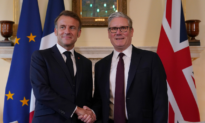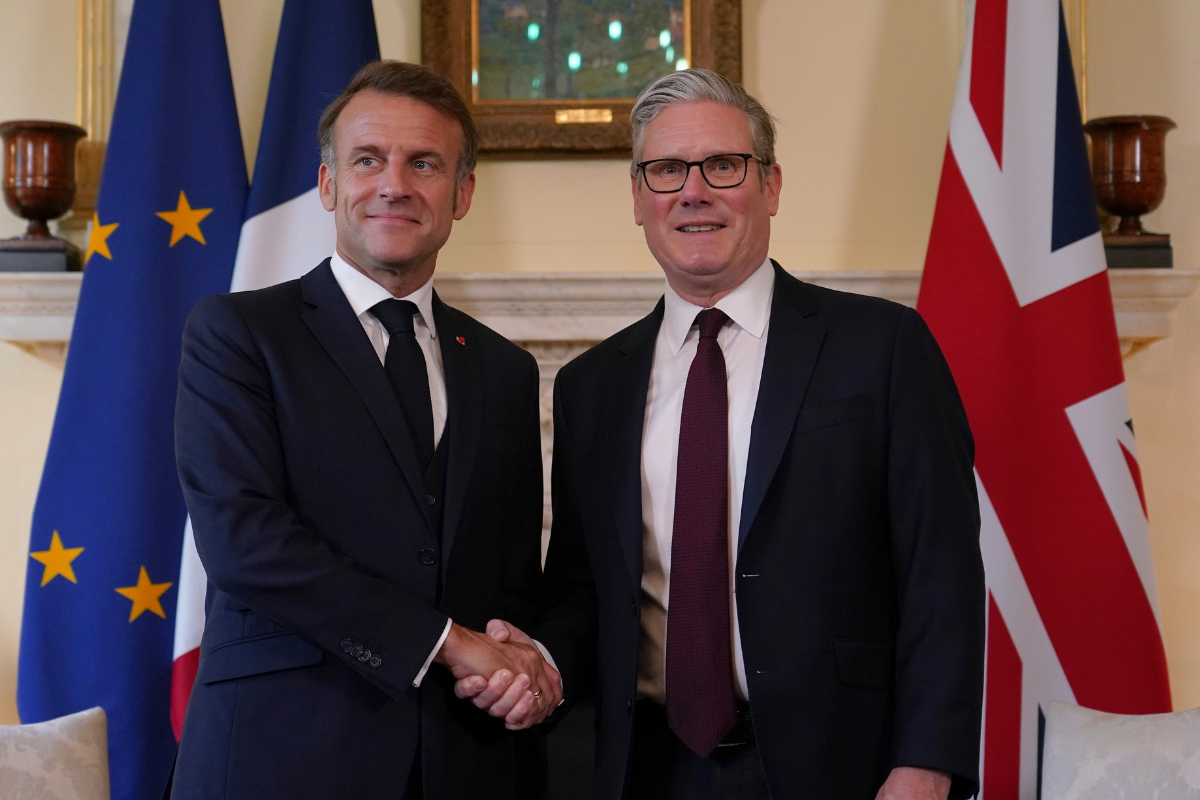

British Prime Minister Keir Starmer and French President Emmanuel Macron pledged on July 10 to coordinate their independent nuclear deterrents if needed to defend Europe, the UK government said.
It is the first time that the UK and France—NATO’s only nuclear powers in Europe—have agreed to coordinate their use of nuclear weapons.
The British government said the new declaration, signed by both leaders during Macron’s state visit to the UK, states that both nations’ nuclear deterrents remain independent but can be coordinated, and that “there is no extreme threat to Europe that would not prompt a response by both nations.”
The United States has forward-deployed nuclear weapons in NATO member countries across Europe, but the United Kingdom and France maintain their own nuclear forces. While these forces have independent roles, they contribute to the overall security of the alliance.
The announcement comes amid a wider push for European nations to boost defense spending and preparedness, driven by the Russia–Ukraine war on NATO’s doorstep and U.S. President Donald Trump’s pressure on allies to commit more to defending the continent, an issue he has pressed since his first term in office.
On June 25, NATO allies backed a commitment to increase defense spending to 5 percent of gross domestic product by 2035, with 3.5 percent designated for core defense, such as weapons and troops.
Storm Shadow Missile Replacements
The UK government said the two countries will also order more “highly lethal Storm Shadow cruise missiles,” while stepping up work to replace the missile as part of the agreement signed on July 10.
The new industrial partnership will enable the two countries to develop the next generation of deep-strike, anti-ship missiles, which are needed to replace the Storm Shadow cruise missiles, the government said.
Both countries will also work on advanced technologies, including the development of radio frequency weapons such as microwave weapons and jammers that can be used to take down unmanned aerial threats such as missiles and drones.
Starmer said that the agreements came in the context of war in Europe and the growing risks of cyberattacks and nuclear threats.
“As close partners and NATO allies, the UK and France have a deep history of defence collaboration and today’s agreements take our partnership to the next level,” Starmer said. “We stand ready to use our shared might to advance our joint capabilities—equipping us for the decades to come while supporting thousands of UK jobs and keeping our people safe.”
British Defense Secretary John Healey said, “This partnership strengthens our leadership in Europe, ensures continued support for Ukraine, and sends a clear signal to our adversaries that we stand stronger, together.”
French Nuclear Umbrella
The UK government said in June that Britain would purchase a dozen U.S.-made F-35A stealth fighter jets, which are capable of firing tactical nuclear weapons.
Procuring the aircraft would mark the first time since the Cold War that Britain’s air force would be able to carry nuclear weapons.
In May, Macron said he was open to offering France’s nuclear umbrella to other countries, with a framework to follow in the coming months.
This would mark a first for the continent, as most of Europe is still reliant on a nuclear sharing agreement with the United States.
 Friends Read Free
Copy
Facebook
Tweet
Friends Read Free
Copy
Facebook
Tweet