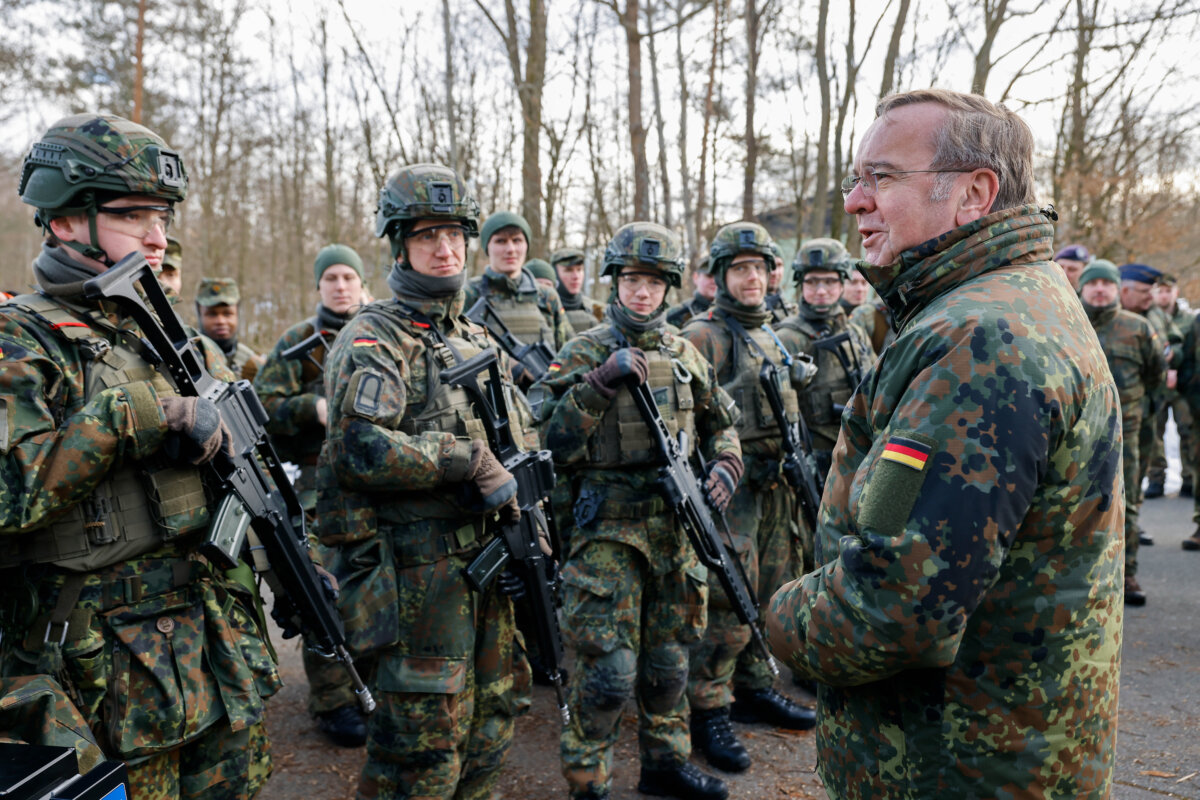

Defense chiefs from the UK and Germany are calling for the public to back an increase in military spending to deter a possible war with Russia, saying it is not warmongering to rearm for the purpose of securing peace.
The UK and Germany’s highest-ranking military officials wrote in The Guardian and Die Welt newspapers on Feb. 15 that since the start of the Russia–Ukraine war, Russia’s “military posture has shifted decisively westward,” reorganizing in a way that could now pose a threat to NATO allies in Europe.
“This is a reality we must prepare for; we cannot be complacent,” wrote Air Chief Marshal Richard Knighton, the UK’s chief of the defense staff, and Gen. Carsten Breuer, Germany’s chief of defense. “Moscow’s military buildup, combined with its willingness to wage war on our continent, as painfully evidenced in Ukraine, represents an increased risk that demands our collective attention.”
The officials added that rearmament is “the responsible action of nations determined to protect their people and preserve peace.”
“Strength deters aggression. Weakness invites it,” they wrote.
The publication of the letter follows last weekend’s Munich Security Conference, at which U.S. Secretary of State Marco Rubio reaffirmed the United States’ commitment to NATO but called on Europe to strengthen its own defenses and accept more responsibility for its security.
“We want allies who can defend themselves so that no adversary will ever be tempted to test our collective strength,” Rubio said in a Feb. 14 speech to European leaders.
“We want allies who are proud of their culture and of their heritage, who understand that we are heirs to the same great and noble civilization, and who, together with us, are willing and able to defend it.”
‘Hard Choices’ on Public Spending
In their joint letter, Breuer and Knighton reflected on the decades of peace that the continent has experienced and how public money was invested.
“Governments of all political colours chose to take what was known as the ‘peace dividend’ — investing in public services and reducing spending on defence,” they wrote. “That was an understandable choice at the time. Now it’s clear that the threats we face demand a step change in our defence and security.”
NATO allies agreed in 2025 to increase defense spending targets from 2 percent of gross domestic product to 5 percent by 2035. This was acknowledged by the two defense officials in their letter, who said it “reflects our new security reality and requires hard choices and prioritisation on public spending for all members.”
U.S. President Donald Trump has long argued that members of NATO should pay more toward their own defense.
According to NATO, the imbalance between what the United States spends on defense and what other allies spend “has been a constant” and “has grown more pronounced since the tragic events of 11 September 2001, after which the United States significantly increased its defence spending.”
“The combined wealth of the non-US Allies, measured in [gross domestic product], is almost equal to that of the United States,” the alliance states on its website. “However, non-US Allies together spend less than half of what the United States spends on defence.”
German lawmakers on Dec. 5 backed the government’s plans to create a legal framework for a “new, attractive military service,” aimed at boosting the number of people in the Bundeswehr, the German armed forces.
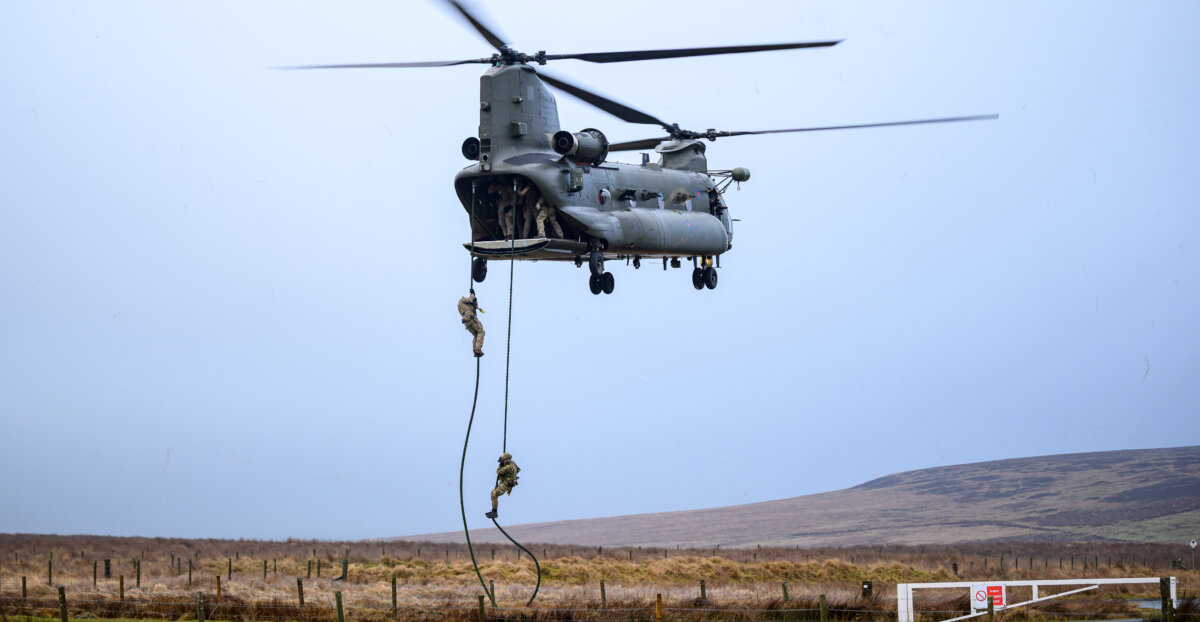
The UK has pledged to boost its presence in the Arctic. The number of British soldiers deployed to northern Norway to help secure the Arctic will double from 1,000 to 2,000 over the next three years, the UK’s Ministry of Defence said on Feb. 11.
Russia
Russia, which began its invasion of eastern Ukraine in February 2022, has consistently denied that it has any intention of initiating conflict, particularly with Europe or NATO.
On Feb. 2, former Russian President Dmitry Medvedev, who serves as the deputy chairman of Russia’s Security Council, said his country is “not interested in a global conflict.”
Russian President Vladimir Putin on Dec. 19 dismissed claims that Moscow was planning to attack European countries, telling the BBC that the notion was nonsense.
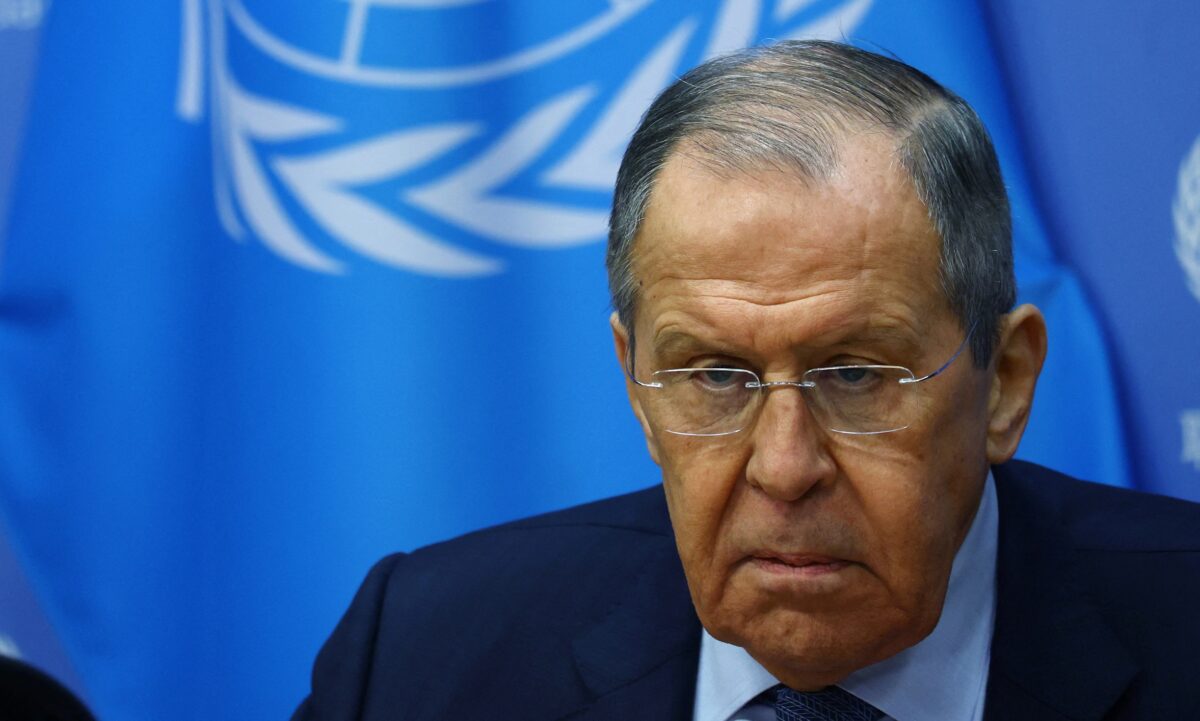
Russian Foreign Minister Sergey Lavrov said during a Feb. 8 interview with the NTV television channel that Moscow is not interested in launching a military assault on Europe but will retaliate if European forces attack the Russian Federation.
“We have no intention of attacking Europe; we have absolutely no need for that,” Lavrov said, according to comments reported by Russian state-owned news agency TASS.
“And if Europe were to carry out its threats to prepare for war against us and launch an attack on the Russian Federation, the president said that this would not be a special military operation on our part, but a full-scale military response using all available military means, in accordance with the relevant doctrinal documents.”
 Friends Read Free
Copy
Facebook
Tweet
Friends Read Free
Copy
Facebook
Tweet