
The UK and Germany will launch a partnership to counter sabotage and cyberattacks on critical infrastructure, naming Russia as one of the adversaries whose covert activities threaten Europe.
The office of British Prime Minister Andy Burnham said in an Oct. 8 statement that London and Berlin will jointly identify hybrid activity by sharing information and coordinating action to disrupt the threats.
“Britain and Germany are joining forces to find, expose and disrupt this activity,” Burnham said. “Security and growth go hand in hand, and both must be felt in every town and city in our two countries.”
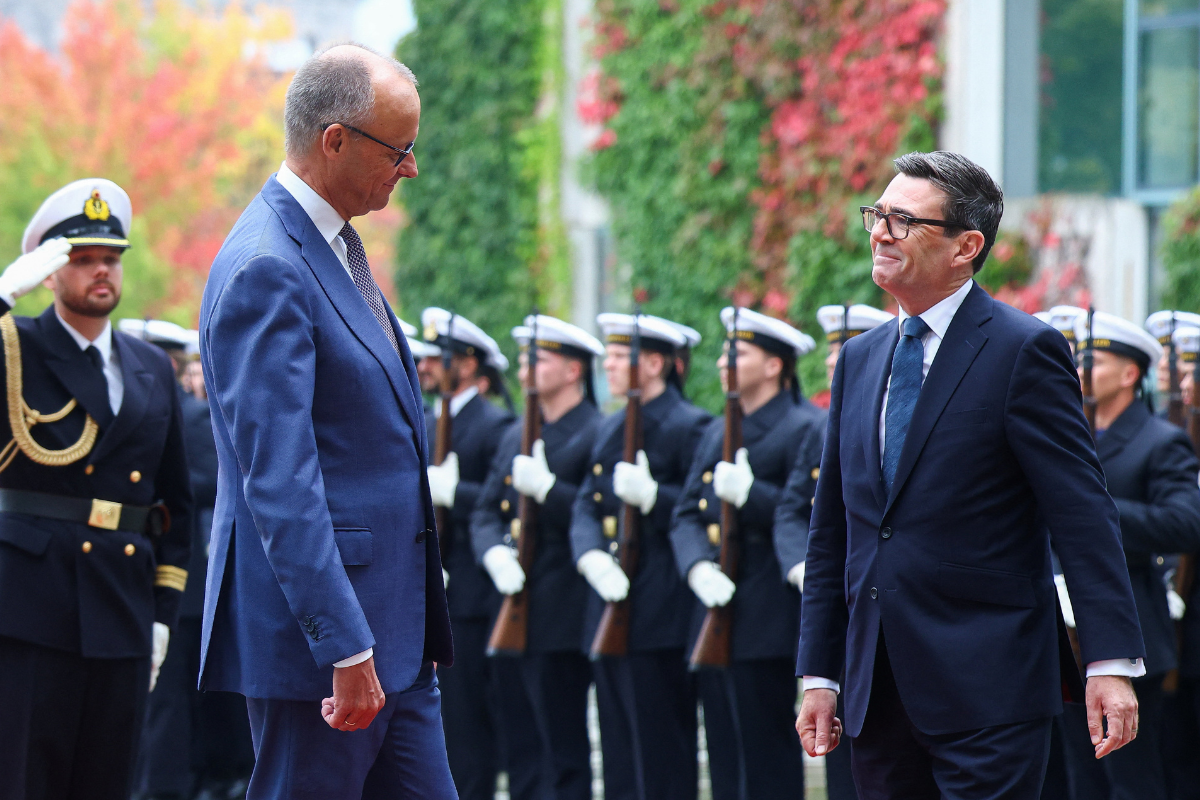
The announcement was made on Thursday ahead of a meeting between Burnham and German Chancellor Friedrich Merz in Berlin.
After the meeting, the prime minister’s office said in another statement that through the partnership, the UK and Germany “will work together to build democratic and societal resilience, better protect critical national infrastructure, and improve our ability to monitor, mitigate and counter Hybrid threats.”
Hybrid attacks fall short of an act of war and can include sabotage, propaganda, drone incursions, and other non-overt tactics.
Sabotage and hybrid warfare have gained renewed attention following the attempted drone attack at Leipzig/Halle Airport in August, which Germany said was orchestrated by Russia.
Moscow has repeatedly denied that it is involved in any kind of hybrid warfare and has rejected claims of involvement in the Leipzig incident.
During the Berlin visit, both leaders ratified the Kensington Treaty, which commits the UK and Germany to deepen cooperation in fields such as science, technology, security, and defense.
Risk of Conflict
The collaboration follows recent warnings from Germany’s foreign intelligence agency that Germany was at risk of conflict with Russia.
Martin Jaeger, head of Germany’s foreign intelligence agency, told the annual public hearing of intelligence chiefs in the Bundestag on Oct. 5 that the confrontation Russia is facing with Germany “has taken on a new, more dangerous dimension.”
Jaeger said that Russia is “waging a shadow war” and that the threat of attacks against Germany is “real and imminent.”
“Germany is in danger of becoming embroiled in a violent conflict with Russia—the attempted attack in Leipzig is just one example,” the intelligence chief said.
Russian President Vladimir Putin said on Oct. 1 that he had “no intention of attacking anyone” but if his country were “subjected to aggression,” it would “have no choice but to respond.” These comments were broadly in line with previous remarks from Moscow.
Last week, Merz said that Germany is preparing for more hybrid attacks, “including severe ones.”
His comments came amid increasing warnings from European authorities that Russia is likely to escalate covert operations against the West, including from the Danish intelligence.
The Danish Defence Intelligence Service said on Sept. 24 that Russia is likely to increase its hybrid warfare on NATO allies, with the agency not ruling out the possibility that Moscow could launch a limited military attack on a Western country.
Reuters contributed to this report.
 Friends Read Free
Copy
Facebook
Tweet
Friends Read Free
Copy
Facebook
Tweet