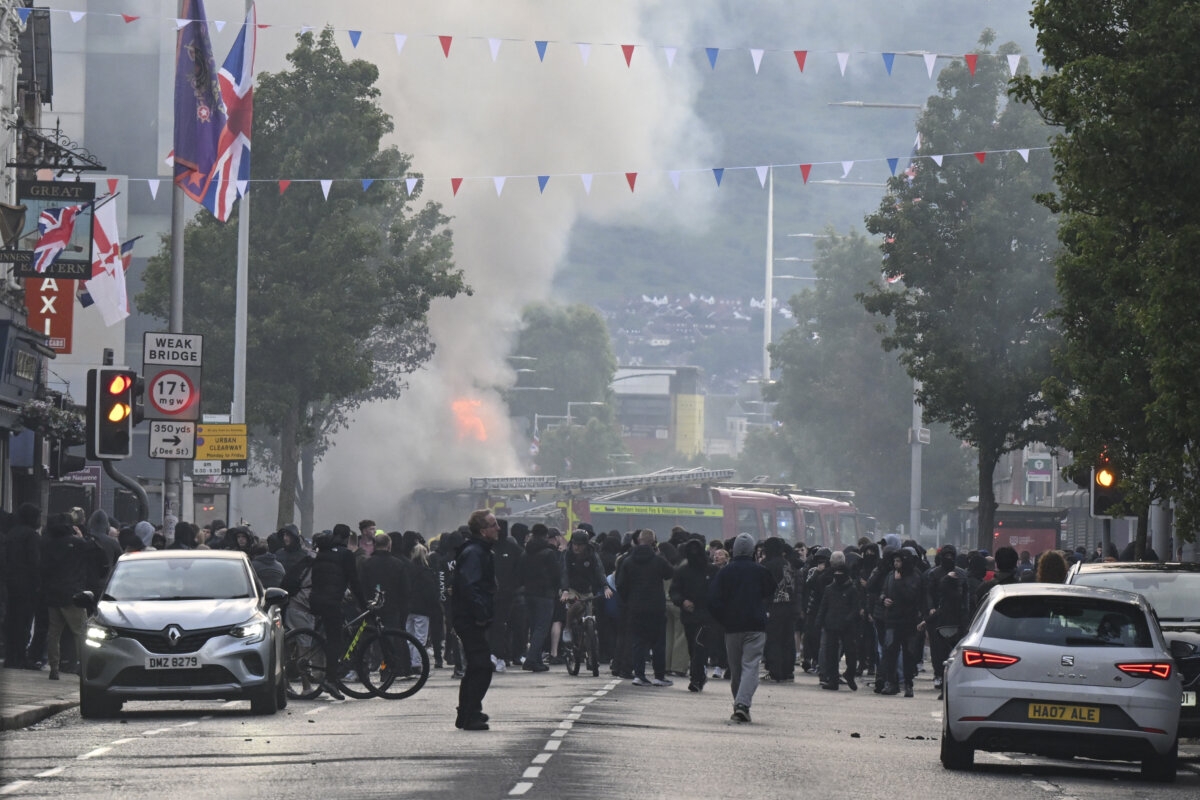
The UK government is preparing new powers to control content online during “times of crisis,” after unrest in Belfast, Northern Ireland, was sparked by viral footage of an alleged knife attack by a Sudanese asylum-seeker, which left a local man with serious head and neck wounds.
Technology Secretary Liz Kendall said that next week, ministers will lay an update to the Online Safety Act before Parliament, requiring platforms to “take quicker action to remove illegal content circulating during times of crisis.”
“Those who use social media to incite violence and disorder are breaking the law,” Kendall said in a June 10 post on X.
She said that she had “explicitly asked” online regulator Ofcom to urgently discuss with X and other platforms how they will comply with the Online Safety Act.
Created by the former Conservative government as the world’s first comprehensive online safety law, the Online Safety Act received Royal Assent in October 2023.
The move follows rioting in Belfast after footage of a June 8 knife attack was widely shared online.
The video footage appears to show a man repeatedly stabbing a blood-drenched victim as members of the public shout for help. Police later declared the assault a “critical incident.”
A 30-year-old male asylum-seeker from Sudan, Hadi Alodid, has appeared in court charged with attempted murder. The victim has been named as Stephen Ogilvie.
The violence that followed saw two nights of unrest from masked protesters, with some attacking police and setting vehicles alight. Several cars and a bus were burned out, while police had to help one family escape from a burning house.
Ofcom claimed in a June 10 open letter to online service providers that the unrest in Belfast appeared to have been “incited online,” including racially motivated violence.
The regulator stated that it wanted to “remind” platforms that, under the Online Safety Act, they are required to act quickly to remove “illegal content” once they become aware of it and to reduce the risk of such content appearing on their services.
It did not specifically mention any examples but stated that this could be “content amounting to offences of stirring up hatred or provoking violence.”
Labour is pursuing wider internet regulation.
Prime Minister Keir Starmer said on June 8 that technology companies operating in the UK must stop children from sending and receiving nude images on their phones or face legislation forcing them to do so.
“Today I’m calling on tech companies operating in this country to introduce device controls that prevent children from sending and receiving sexually explicit images,” Starmer said at London Tech Week.
Tech companies such as Apple and Google have been given “three months” to build or activate such systems. Adults would still be able to access or share such content through age verification.
Signal, the encrypted messaging app, criticized the proposal in a June 8 statement, calling it a demand that “all content on all devices sold or used in the country be scanned” using “a dystopian combination of age verification and content scanning.”
“This proposal will not safeguard children,” Signal stated. “It endangers us all.
“We know from history that once in place, there will be an inevitable authoritarian expansion of the kind of content and people these technologies will be expected to surveil. We also know such tools will be leveraged to automatically report people to government authorities.”
Signal President Meredith Whittaker threatened to pull the encrypted messaging app entirely from the UK in an interview with Bloomberg on June 10.
Author, free speech campaigner, and comedian Andrew Doyle claimed in a June 10 post on X that the government “never want to address the problem; they only want to prevent people from talking about the problem.”
“The previous government did the same after the murder of Sir David Amess,” he said.
After the murder of Conservative MP David Amess in 2021, Tory politicians called for “David’s Law,” a proposed law that would end online anonymity.
Amess was murdered by Ali Harbi Ali, a British man of Somali heritage, in an Islamist terror attack while he was holding a constituency surgery in Leigh-on-Sea, Essex.
Ali, who admitted allegiance to the ISIS terrorist group, had previously been referred to Prevent, the government’s multi-agency program that aims to stop individuals from becoming terrorists.
Ali made an appointment through the member of Parliament’s office, falsely claiming that he was moving to the area and was interested in churches. Ali pulled out a 12-inch carving knife and stabbed Amess more than 20 times.
At the time, the Columbia Journalism Review noted that the calls to restrict online anonymity were “surprising to some” because Amess’s death wasn’t linked to online anonymity or even the internet.
Guy Birchall and Alexander Zhang contributed to this report.
 Friends Read Free
Copy
Facebook
Tweet
Friends Read Free
Copy
Facebook
Tweet