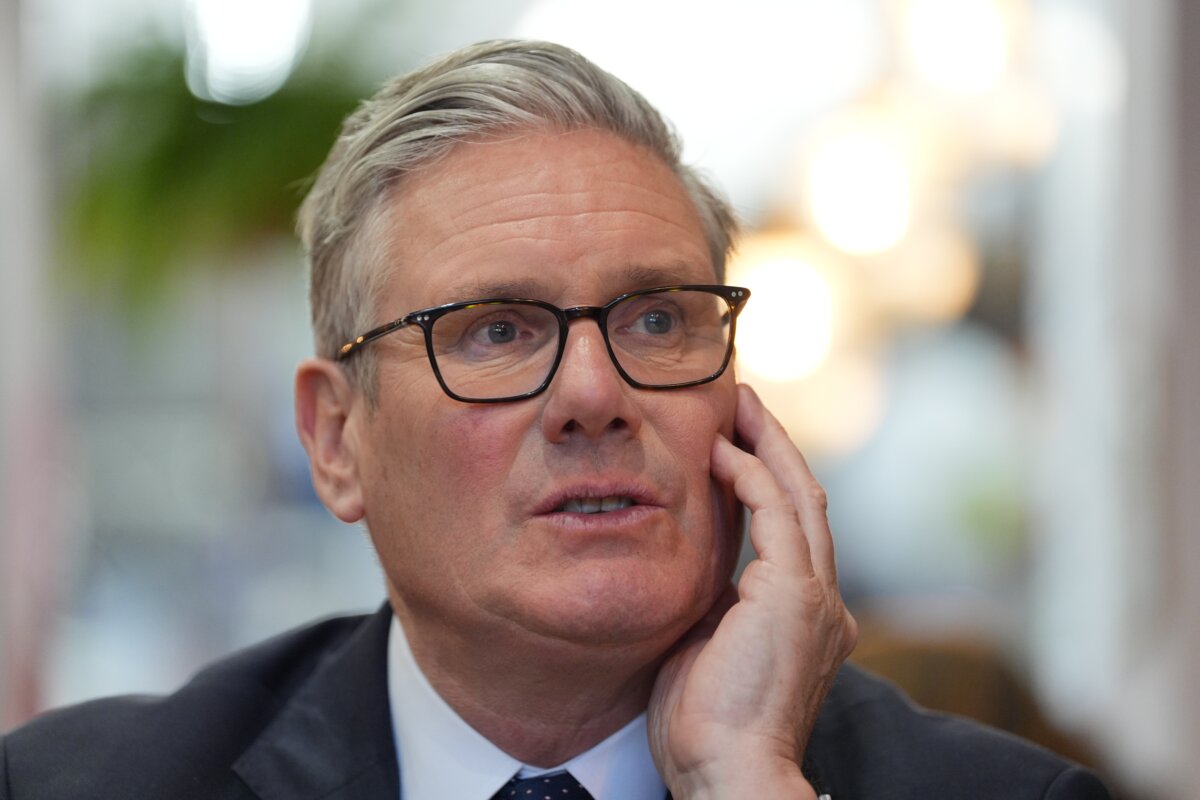

Big Tech companies operating in the UK must stop children from distributing and viewing nude images on their phones, or the firms will face legislation forcing them to do so, British Prime Minister Keir Starmer said on June 8.
“Today I’m calling on tech companies operating in this country to introduce device controls that prevent children from sending and receiving sexually explicit images,” Starmer said while giving a speech at London Tech Week.
“This is not an impossible challenge.”
Under the new plans, tech giants would have to build or activate technical solutions at the device level to detect and block nude images for and of children.
Adults, meanwhile, would still be able to take, share, or view nude content via an age verification process.
“One issue is the ability for children, with phones, to send and receive nude images,” Starmer said. “Now for too long people have been told that is simply the price of modern tech. That nothing can be done. That government is powerless. That parents just have to accept it. I reject that completely.
“Tech should adapt to the needs of society, not the other way around.
“These are some of the most innovative companies in the world. And I believe they can solve it.
“But if they choose not to, then we will act, and we will change the law because when it comes to the safety of our children, standing by is not an option.”
After Starmer’s speech, the UK Home Office said in a June 8 post on X that if tech companies do not act within weeks, the government will make them comply.
“Tech companies like Apple and Google have three months,” the Home Office said. “Activate safeguards on smartphones and tablets to detect and block nude images for children, or we will bring forward legislation to force you to do so.”
A Google spokesperson told The Epoch Times in an emailed statement that the company “is deeply committed to protecting children online.”
“We are working constructively with UK partners to find effective, privacy-preserving solutions that deter the spread of harmful content while ensuring a safe digital environment for young people,” the company said.
Apple did not respond by publication time to a request for comment.
In a post on X on June 8, British Home Secretary Shabana Mahmood said tech companies have a “moral duty” to make it “impossible for children to take, share or view nude images.”
In another post on the same platform, she said she would make “no apologies for doing the right thing to protect children from paedophiles.”
“This is about stopping the coercion and sextortion of children, not surveilling or policing people’s phones,” she said, noting that there would be “no reporting, no data collection, no monitoring, and no images leaving the device” and that “all adults will be able to switch off the protections if they are over 18.”
“This technology is already on devices. The tech firms just need to switch it on to block children from seeing nude imagery.”
However, some privacy campaigners have objected to the move, with UK-based Big Brother Watch Director Silkie Carlo saying in a June 8 post on X that Mahmood was being “dishonest with the public.”
“Yes, tech companies could ‘switch on’ a child lock for every UK adult—but parents can already just switch it on for their kids!” Carlo said.
“Your plan means the population must show ID to stop your child lock being put on our phones.”
The UK has separately been considering whether to ban children from accessing social media, with a public consultation on the issue closing in May.
A report by senior UK doctors released last month warns that the exposure of children to phones and social media is fueling a health and safety crisis, comparing the issue to past public health battles over seatbelt laws and smoking.
The Academy of Medical Royal Colleges described concerns among frontline clinicians who said children are increasingly arriving in hospitals with mental health, behavioral, and physical harms linked to online activity.
The announcement by the UK follows countries such as Australia, Malaysia, and Indonesia introducing or announcing plans for age-based restrictions on children’s access to social media.
Other countries, including France, Spain, and Denmark, are considering similar approaches.
Correction: A previous version of this article misspelled the name of Big Brother Watch Director Silkie Carlo. The Epoch Times regrets the error.
 Friends Read Free
Copy
Facebook
Tweet
Friends Read Free
Copy
Facebook
Tweet