
Ukraine’s battlefield expertise in counter-drone tactics and technologies is in demand, with the United States, Israel, and Persian Gulf States’ militaries scrambling to ward off Iranian Shahed and, increasingly, Russian-made Geran-2 “kamikaze” attacks.
But during the March 23–March 27 CERAWeek by S&P Global conference in Houston, a Ukrainian delegation led by First Deputy Prime Minister Denys Shmyhal and leaders of the nation’s energy companies also provided hard-earned insight into how to rebuild an electric grid under fire with all-of-the-above resilience and dogged persistence that could reshape 21st-century energy systems.
“Lessons learned in Ukraine are not just lessons for Ukraine, they are lessons for a global economy facing the same challenges of security, resilience, diversification, and development” of energy infrastructure less vulnerable to disruption by natural disasters, terrorism, and war, Joshua Volz, U.S. Department of Energy special envoy for global energy integration, said during a March 25 roundtable discussion.
“We have in Ukraine a tremendous opportunity, at a terrible cost,” he said.
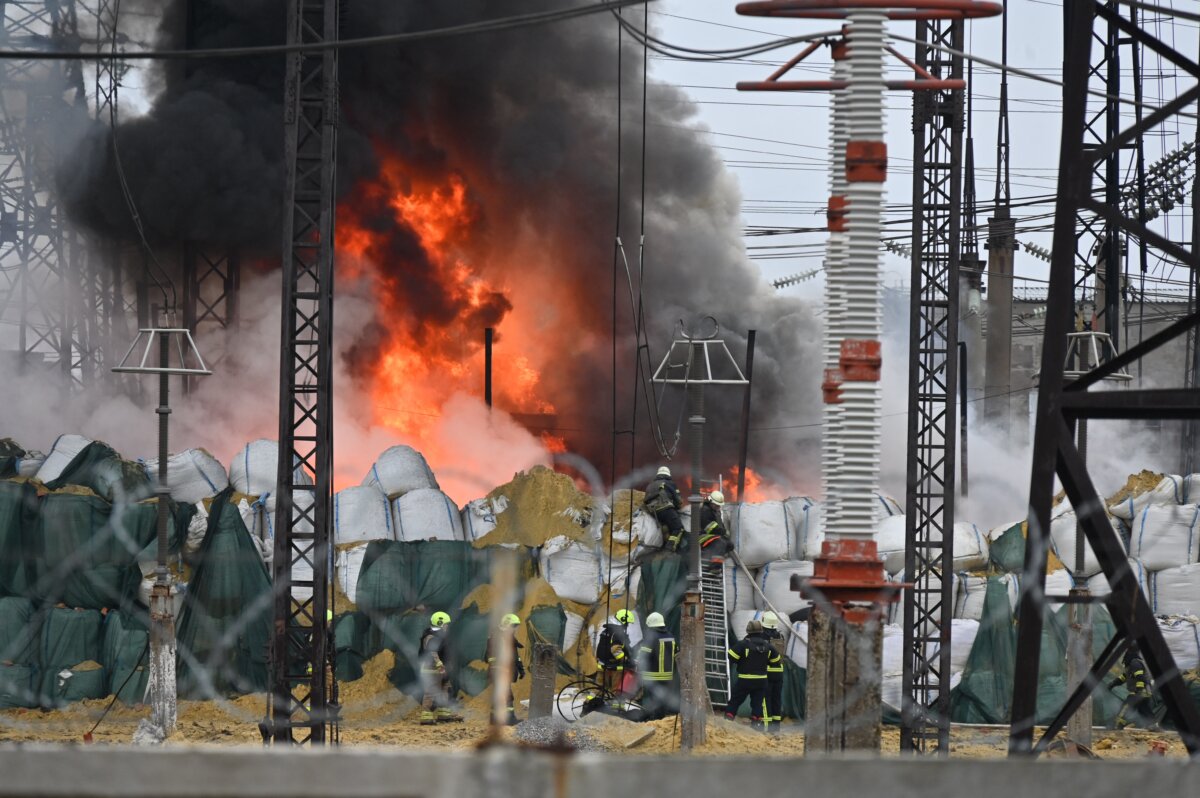
With the war grinding into its fifth year, peace talks are in a “situational pause,” and a summer of brutal offensives looms after the coldest winter in nearly 20 years was weaponized by Russia with drone and missile strikes systemically targeting remaining power plants and electrical transmission substations. Ukrainians invented a word for what they endured in January and February: “Kholodomor,” meaning a plague of cold death.
But this was nothing new. Since Russia invaded Ukraine in February 2022, launching Europe’s most lethal conflict since World War II, energy infrastructure has been a prime target, despite such attacks being defined as war crimes under the Geneva Convention. In 2024, the International Criminal Court issued “crimes against humanity” arrest warrants for four senior Russian military officers who allegedly issued orders to target Ukraine’s electric grid.
Prior to 2022, nuclear power generated half, coal-fired plants generated 23 percent, and gas-fired plants generated 9 percent of Ukraine’s electricity in a centralized Soviet-legacy matrix hooked into Russia’s and Belarus’s grids and managed by state-owned Ukrenergo, according to the International Energy Agency.
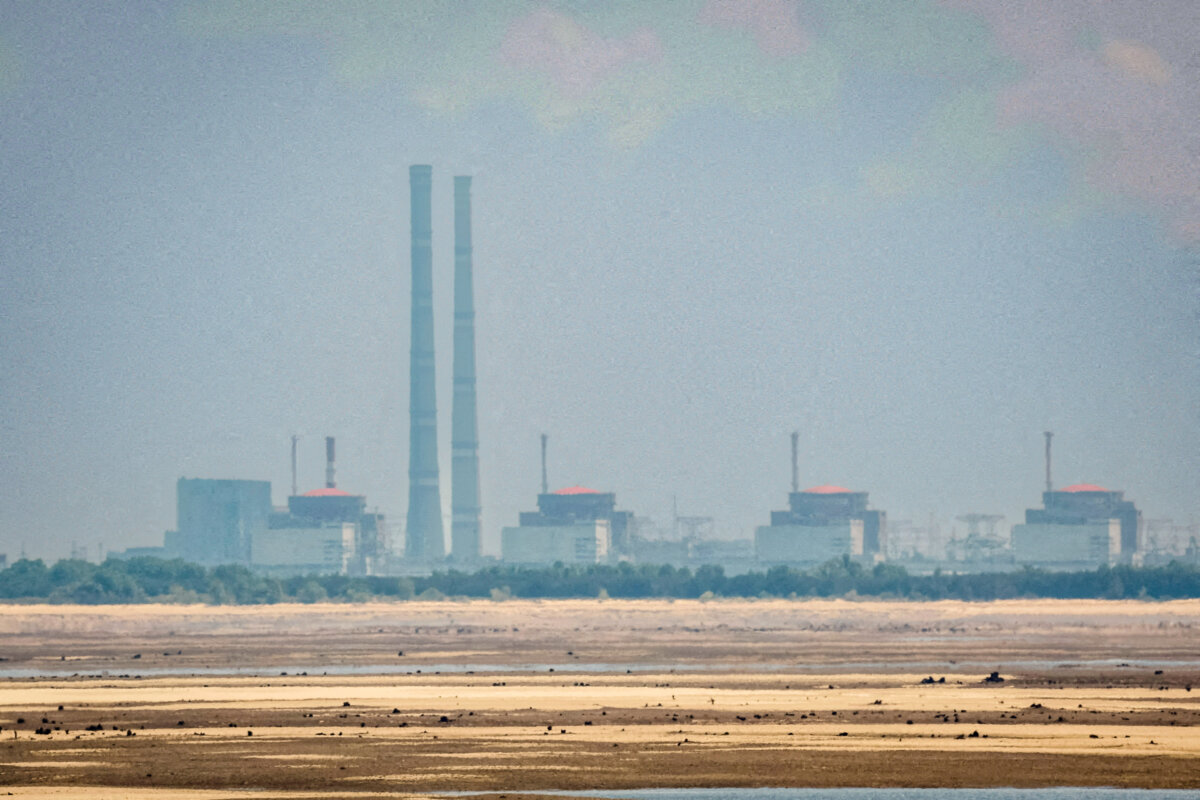
Since then, the agency reported in October 2025, at least 18 large Ukrainian power plants have been damaged beyond repair or flattened, virtually all above-ground natural gas storage devastated, and up to 70 percent of pre-war generation sites destroyed or occupied by Russian forces, including the Zaporizhzhia Nuclear Power Station, which by itself produced nearly 25 percent of the nation’s electricity.
Less than one-quarter of Ukraine’s pre-war generation capacity now remains episodically functional, yet since 2024, its reliance on electricity imported via a hastily erected connection to the European Network of Transmission System Operators has declined, and in June 2025, the besieged nation actually became an energy exporter for three months, sending excess electrons to neighboring nations.
“The irony of this war in Ukraine is it’s helped us to build an absolutely new energy system,” said Maxim Timchenko, CEO of DTEK Group, the nation’s largest private energy company. “We’ve built more wind, solar, battery storage … closer to consumption [in] big cities. We have from our wartime experience a demonstration of what is the system of the future.”
‘Crucible of Creativity’
Timchenko recalled for the roundtable panel that on Feb. 24, 2022, the day of “the Moscow invasion,” Ukrenergo and Moldova had just disconnected from the Russian and Belarusian grids as part of an “isolated mode” test for a plan to synchronize with the European transmission system by 2023.
“It was supposed to be for three days. I think now it’s forever,” he said, noting that Ukraine and Moldova requested an emergency synchronization projected to take months to complete. “We managed, in three weeks, to connect to the European grid, meaning we [became] physically present on [the] European energy market.”
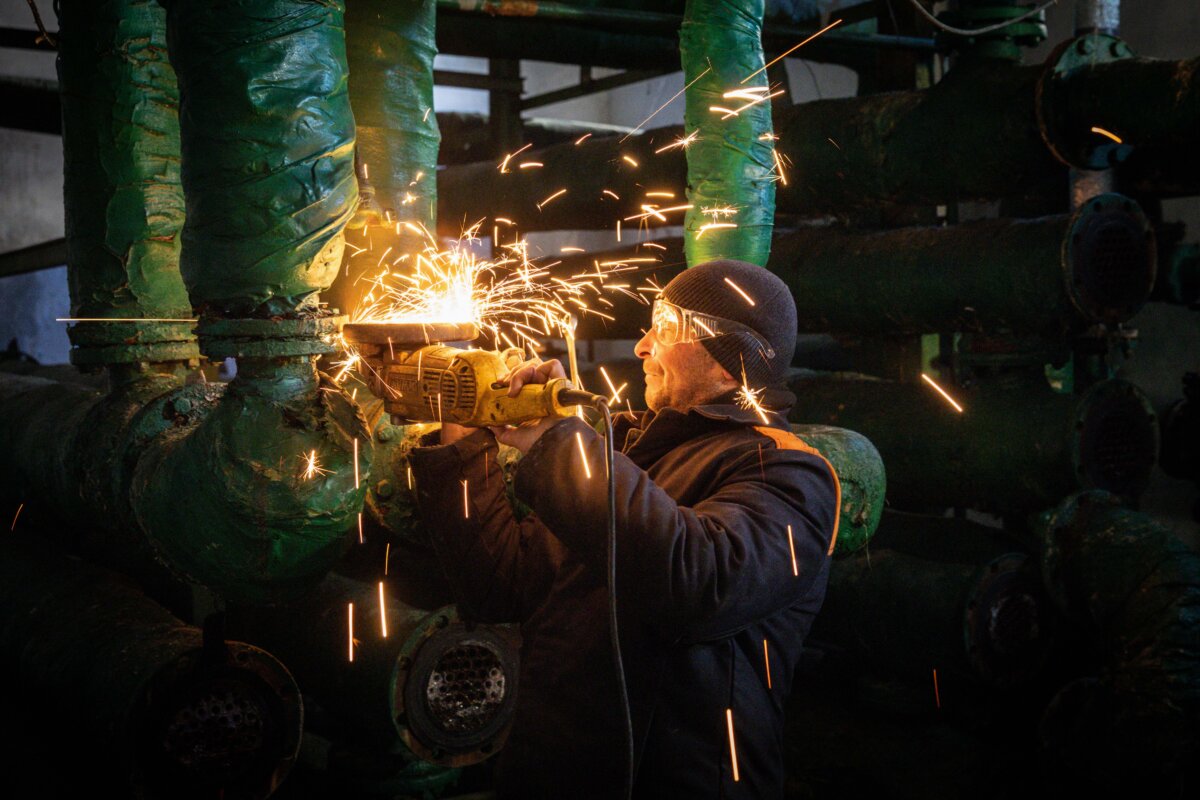
With coal, natural gas, hydropower, and the nation’s largest nuclear plant destroyed or occupied, Ukrainians—many on their own—began rigging backyard windmills and rooftop solar linked to basement generators and boilers.
“Our response [was] to build more and more distributed generation and, from a resilient point of view, we now have one of the highest potential of solar, wind, and developed infrastructure,” Timchenko said, and large projects, such as the Tyligulska wind farm expansion on the Black Sea, are expected to dramatically boost renewable energy capacity by late 2026.
Solar and wind energy projects don’t require much on-site management.
“Of course, our host households, small, medium businesses, they do their own investments in … rooftop solar and battery storage, behind-the-meter technologies,” he said.
“Every year, we are surprised by realizing we got another 1 gigawatt of additional capacity built by our people and our businesses to survive all these challenges.”
Ukraine has matched its European-leading underground battery storage with increased imports of natural gas through buried pipelines from Greece via the Trans-Balkan corridor, Croatia’s Krk LNG terminal, Poland, and the “Amber Road” from Lithuania and Latvia, Volz said, adding that pipeline operators and natural gas companies aren’t doing so solely to support Ukraine’s fight for survival, but because they are “competitive” profitable ventures.
“Ukraine has built—in fact, DTEK has built—Europe’s largest battery energy storage project,” said Geoffrey Pyatt, McLarty Associates senior managing director for energy and critical minerals, who served as U.S. ambassador to Ukraine from 2013 to 2016.
In terms of natural gas, rather than processing it with large Soviet-era turbines, it is now funneled from underground storage to dispersed small modular gas turbines in what Timchenko described as Europe’s “most developed gas transportation system.”
“Ukraine is really the crucible of creativity when it comes to the architecture of real-time transformation of energy systems, and one of those transformation points has been shifting from single points of failure to multiple sources of resilience,” Volz said.
The United States and the European Union are betting—and banking—on Ukraine surviving Russia’s invasion with investments that will be “the fulcrum point for not just the energy system in Ukraine,” he said, “but energy systems throughout Europe.”
Postwar Prospects
“This is the moment of opportunity we need to plan for in the hope, and expectation, you will see some cessation to the conflict in the weeks and months ahead, at which point Ukraine can go full speed ahead [in rebuilding],” said Shmyhal, who is also Ukraine’s minister of energy.
According to the United Nations and World Bank, rebuilding Ukraine will require a massive, decade-long international effort estimated to cost nearly $600 billion.
Timchenko said that “$91 billion is needed just to recover [the previously existing] energy system, according to World Bank estimations,” but what Ukrainians are building will “play one of the more important roles in energy security of the European Union and Europe” because “if you go to any sector, you can find opportunities to develop it in Ukraine and bring this energy [to Europe and beyond].”
This is especially true, he said, for nuclear energy.
“We know … the nuclear industry and this is, in my strong opinion, the future of Europe,” Timchenko said.
Shmyhal agreed.
“In the future, the main pillar of energy production should be nuclear,” he said. “And it is in Ukraine.”
“As for now, more than 75 percent of [Ukraine’s] energy”—despite the occupation of Zaporizhzhia—comes from 15 other reactors that remain under Ukrainian control, Shmyhal said.
He said that 18 months before Russia’s invasion, Ukraine transitioned from “dependence on Russian nuclear fuel to the American technology of the Westinghouse company.”
“[It’s] an absolutely exemplary model and approach” that has fostered a “vertical, integrated approach for nuclear production of energy … from extraction of uranium, to enrichment of uranium, creation of nuclear fuel, and utilization of nuclear waste,” Shmyhal said.
Ukraine’s uranium deposits and experience in mining and refining for nuclear energy are one reason why the United States and Kyiv established a $150 million joint investment fund to develop Ukraine’s critical mineral reserves.
“We will implement smart grids for management of such a [decentralized, diverse energy] approach, and it will let us be absolutely resilient to any possible Russian attacks,” Shmyhal said.
“That and an all-of-the-above strategy reinforces the importance of renewable energy that is locally available, not dependent on imports, and can quickly be repaired and interconnected with battery systems that provide a sense of resiliency.”
Pyatt recalled attending 2023’s CERAWeek with Timchencko.
“Ukraine’s success on the energy battlefield has been a product of what I would argue is the most dramatic transformation of an energy system anywhere in the world today,” Pyatt said. “It’s a big deal. It’s a remarkable story.”
Volz said he sees Ukraine’s story as one of opportunity for the future.
“One of the most heartening things about the conversation I’ve heard here at [2026] CERAWeek about Ukraine is the shift in perception of what Ukraine is,” he said. “It’s not a liability, it’s an opportunity. Ukraine has the ability to both provide resilience in its fight for tomorrow, as well as provide fertile ground for opportunity to invest for the future.”
Timchenko said partnerships and capital will be key to that future.
“We are not asking for solidarity or support,” he said. “We are proposing partnership and investment opportunities. We need partners. We need capital. We need trust that Ukraine is building the future of an absolutely new landscape of energy security.”
 Friends Read Free
Copy
Facebook
Tweet
Friends Read Free
Copy
Facebook
Tweet