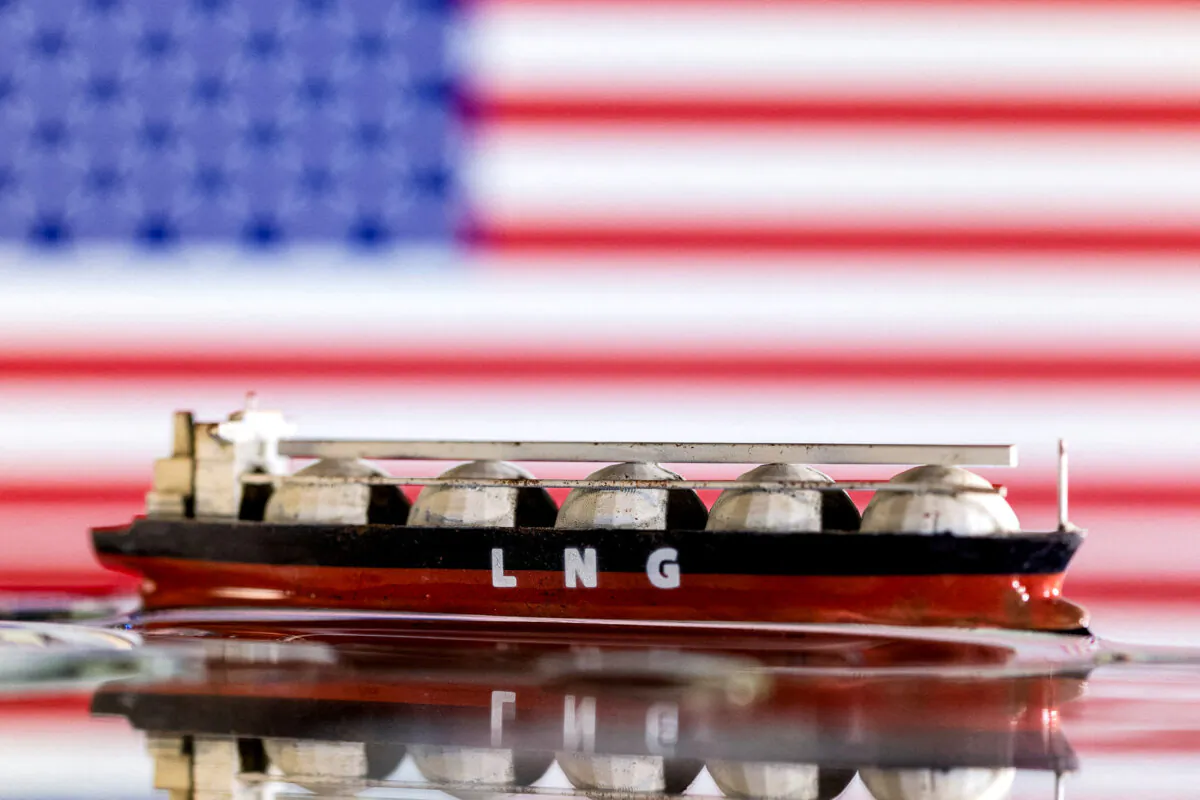

Ukraine received its first delivery of liquified natural gas of the year from the United States, Ukrainian state energy company Naftogaz announced on Feb. 4.
“Naftogaz, in partnership with Poland’s ORLEN, secured delivery of the first batch of American liquefied natural gas (LNG) to Ukraine in 2026,” the company said in a statement.
“The volume delivered is almost 100 million cubic meters—enough to provide gas to about 700,000 families for one month during the winter period.”
The tanker carrying the gas took 20 days to reach Poland from the United States, Naftogaz said.
The company also stated that total “US LNG supplies to Ukraine could reach 1 billion cubic meters in 2026.”
The news comes just days after Greek energy company Atlantic-See LNG Trade, a joint venture involving two Greek companies, signed its first deal to supply U.S. LNG to Ukraine, and the first delivery is set to arrive in the war-torn country in March, Atlantic-See announced on Feb. 2.
Atlantic-See is a joint project between AKTOR, a Greek construction giant, and DEPA Commercial, a Greek energy supplier.
The LNG will be supplied by British energy company BP through its U.S. operations and will be bought by Naftogaz, according to a statement released by DEPA.
The maximum quantity may reach up to 1 terawatt hour, depending on the available capacity of the involved gas grid operators, Atlantic-See stated.
The cargo of U.S. LNG will reach Greece’s Revithoussa LNG terminal and will be delivered to Ukraine via a pipeline linking Greece to Ukraine through Bulgaria, Romania, and Moldova, which form part of the Vertical Corridor.
The Vertical Corridor is a regional energy infrastructure initiative in Southeastern and Central Europe that creates a south-to-north natural gas transmission route that uses and upgrades existing pipelines and interconnectors to deliver non-Russian gas supplies from Greece to Bulgaria, Romania, Moldova, Ukraine, Hungary, and Slovakia.
It is not a single new pipeline but a coordinated system provided jointly by the countries involved and repurposes parts of the old Trans-Balkan Pipeline, which used to carry Russian gas to the region but whose flow has now been reversed.
The move has long been backed by Washington, and the United States Energy Association has called it a “key component” of Europe’s energy diversification in 2025.
News of the incoming delivery was greeted with enthusiasm by U.S. Ambassador to Greece Kimberly Guilfoyle, who called it an “excellent development” in a post on X, and by the U.S. Embassy in Kyiv, which called it “a win-win for Ukraine and America,” saying it “heralds a new route to replace Russian gas in Europe, and demonstrates how American business supports Ukraine’s energy security.”
Greece is looking to bolster its role as a transit route for gas into the continent, as the European Union moved in January to ban Russian gas imports by late 2027.
Atlantic-See last year agreed to import 700 million cubic meters of U.S. LNG per year starting in 2030, in Greece’s first long-term deal with a U.S. firm. Washington is looking to fill the gap left by Moscow in the European gas market.
The influx of U.S. gas is welcome news for Ukraine, which faces its worst wartime energy crisis as its energy sector has been crumbling under Russian attacks, cold weather, and the accumulated damage of nearly four years of war.
“Nobody in the world has ever faced such a challenge,” Ukrainian Energy Minister Denys Shmyhal said on Jan. 16.
“There is not a single power plant left in Ukraine that has not been hit by the enemy during the war. Thousands of megawatts of generation have been knocked out.”
Reuters contributed to this report.
 Friends Read Free
Copy
Facebook
Tweet
Friends Read Free
Copy
Facebook
Tweet