It’s a question increasingly raised not just in the comment pages of British newspapers and in parliament, but also by the likes of U.S. President Donald Trump and Vice President JD Vance.
Is free speech in Britain really getting worse?
Yes, says Lord Young, the founder of the Free Speech Union (FSU), a watchdog established just five years ago.
“It certainly seems as though things are getting worse, and we’ve seen an explosion in the Free Speech Union’s membership,” Young told The Epoch Times.
Last July, the union, which offers legal help to people disciplined or arrested over lawful expression, had 14,000 members built up over five years, he said.
Since then, the figure has risen to 38,000, and Young expects 50,000 by year’s end.
Once dismissed as a fringe concern, the issue of free speech now fuels talk-radio debates and fills hours of primetime television coverage in the country.
Police forces are accused of devoting more energy to monitoring online posts than solving street crime.
A high-profile example came on Sept. 2, when one of Britain’s most successful sitcom writers and co-creator of Father Ted, Graham Linehan, was arrested at Heathrow on suspicion of inciting violence over posts he made on X mocking males identifying as transgender.
Linehan said five armed officers met him as he stepped off a flight from Arizona and told him he was under arrest “for three tweets.”
Health Secretary Wes Streeting later told the BBC that ministers need to look at laws concerning online speech.
“Every time there is a video on X of someone being arrested by the police for a tweet or a Facebook post goes viral, that drives membership growth,” said Young, who became a member of the House of Lords last year.
Young said many people come to the FSU because their trade unions refuse to defend them as they challenged “some aspect of radical progressive orthodoxy.”
“In some cases, it’s actually worse than that. We have a few cases we’ve got involved in which trade unions themselves have dobbed in their members to their employers and urged their employers to sack them because they’ve said, for instance, ‘trans women aren’t women,’” he said.
“If you’ve spent thousands of pounds on trade union membership, it must be pretty galling. Instead of defending you, the trade union actively tries to get you fired.”
Two Laws
The issue was raised in the House of Lords this July, where peers discussed a Times of London investigation in April that had sent Freedom of Information requests to 37 police forces.
It found that officers had made 12,183 arrests in 2023, the equivalent of about 33 per day, a 58 percent increase since 2019.
Most of these arrests for online speech fell under just two statutes, the Malicious Communications Act and Section 127 of the Communications Act.
Baroness Fox of Buckley warned that “something certainly seems to have gone awry in the police and criminal justice system.”
“Every force in the country has a team of officers sifting through people’s posts, trying to determine whether they cross some undefined line,” she said.
She noted that The Economist was even blunter in its description: “It is much easier to catch Instagram posters than thieves; the evidence is only a mouse-click away.”
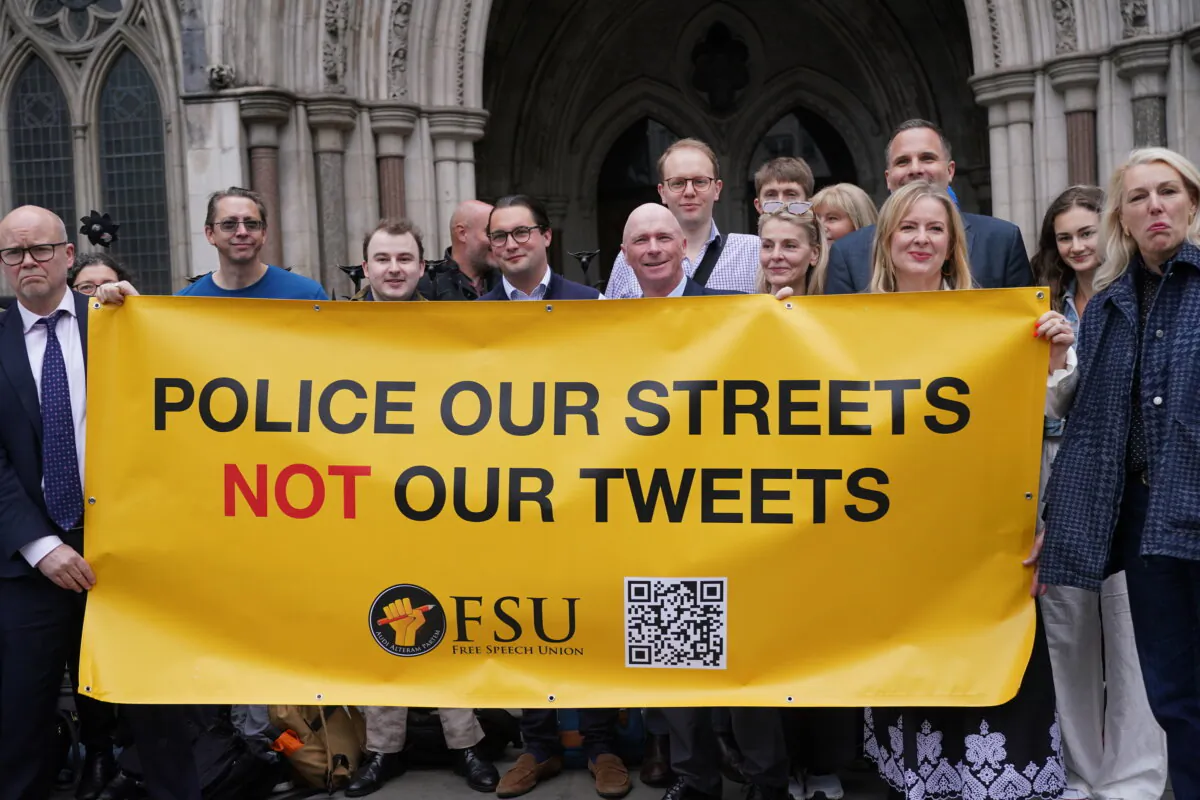
 Free Speech Union founder Toby Young speaks at the launch of the union in Scotland on April 22, 2022. (Courtesy of Free Speech Union)
But Young argues the true number of arrests could be higher, as there are many more speech offenses on the statute book.
“So the real number of people being arrested every day for online speech offences is probably far greater than 30, which, incidentally, is more than the number of people arrested for speech offences during the McCarthy era in the United States,” he said.
To compare, a University of Washington research project found that between 1941 and 1957, at the height of the Red Scare, around 140 Americans were arrested under the Smith Act, most of them Communist Party members or leaders.
Misplaced Priorities
Young noted that Home Office guidance tells the police that if a “quote, unquote victim” reports what they believe to be a hate crime, then police have to investigate it.
While arrests in Britain are rising, convictions for hate speech offences are dropping.
The authors of the Times of London investigation reported that their analysis of Ministry of Justice data showed that the number of convictions and sentences for the relevant offences had decreased dramatically over the past decade.
“Which tells us that the police are being overzealous in their policing of social media,” Young said.
For him, the problem stems from skewed training priorities.
“One of the reasons the police are overreaching in this way is that they received very little training, if any, about the various legal protections that are in place for free speech,” he said.
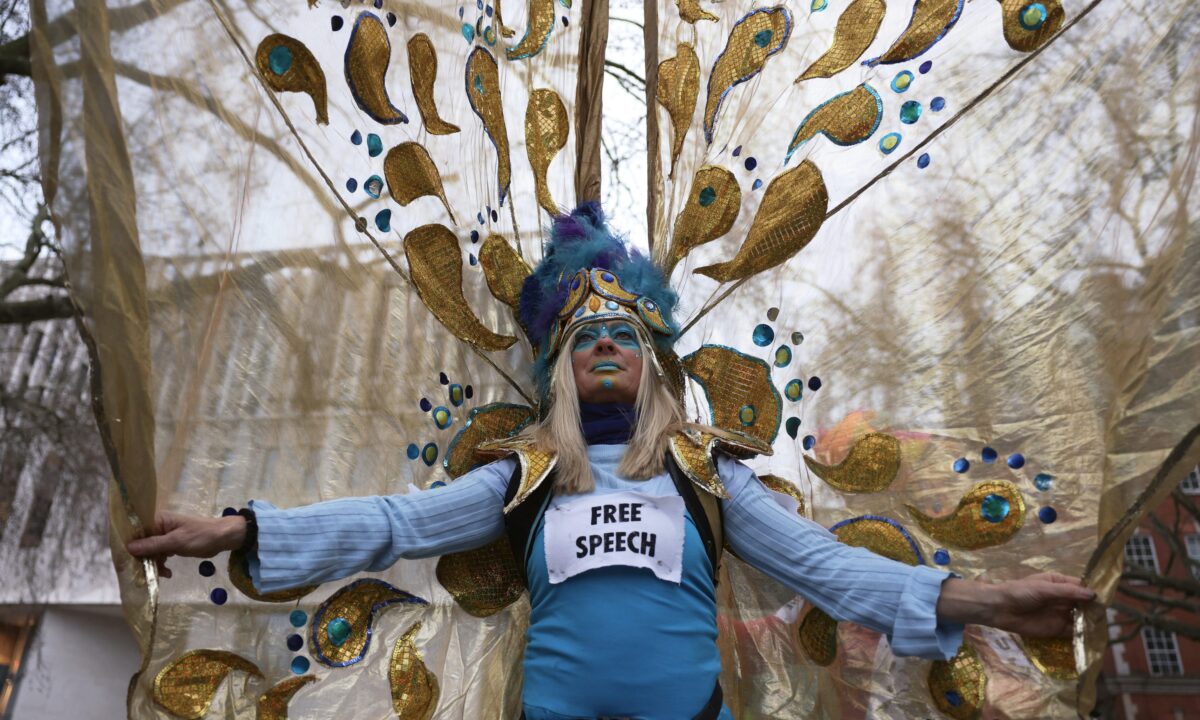 A woman with a sign saying “free speech” as she prepares to take part in a protest against Julian Assange’s continued imprisonment, in London, on Feb. 11, 2023. (Dan Kitwood/Getty Images)
Instead, he said they receive lots of training on unconscious bias, anti racism, and transgender inclusion.
“They’re deluged with woke training courses as part of their induction to become police officers, but receive little or no training about free speech,” he said.
The FSU filed Freedom of Information (FOI) requests to police forces asking how much instruction officers received on Article 10 of the European Convention on Human Rights.
“The answer was little or none,” said Young.
Connolly Case
One of the most controversial prosecutions is that of Lucy Connolly.
She made a post on X July 29, 2024, just hours after the fatal stabbing of three girls at a holiday club in Southport by 17-year-old Axel Rudakuban.
Rudakubana, who was born in Cardiff to Rwandan parents, is currently serving a minimum of 52 years.
During the unrest sparked by the stabbings, Connolly wrote: “Mass deportation now. Set fire to all the [expletive] hotels full of the [expletive] for all I care … if that makes me racist, so be it.”
It was viewed more than 310,000 times in under four hours before being deleted. Connolly was arrested on Aug. 6.
Connolly’s case drew the backing of the FSU, which described the ruling as “deeply disappointing” and called the 31-month sentence “plainly disproportionate.”
She was jailed after pleading guilty to inciting racial hatred. However, Young said that had she pleaded not guilty, “she would have had a reasonable chance of being acquitted.”
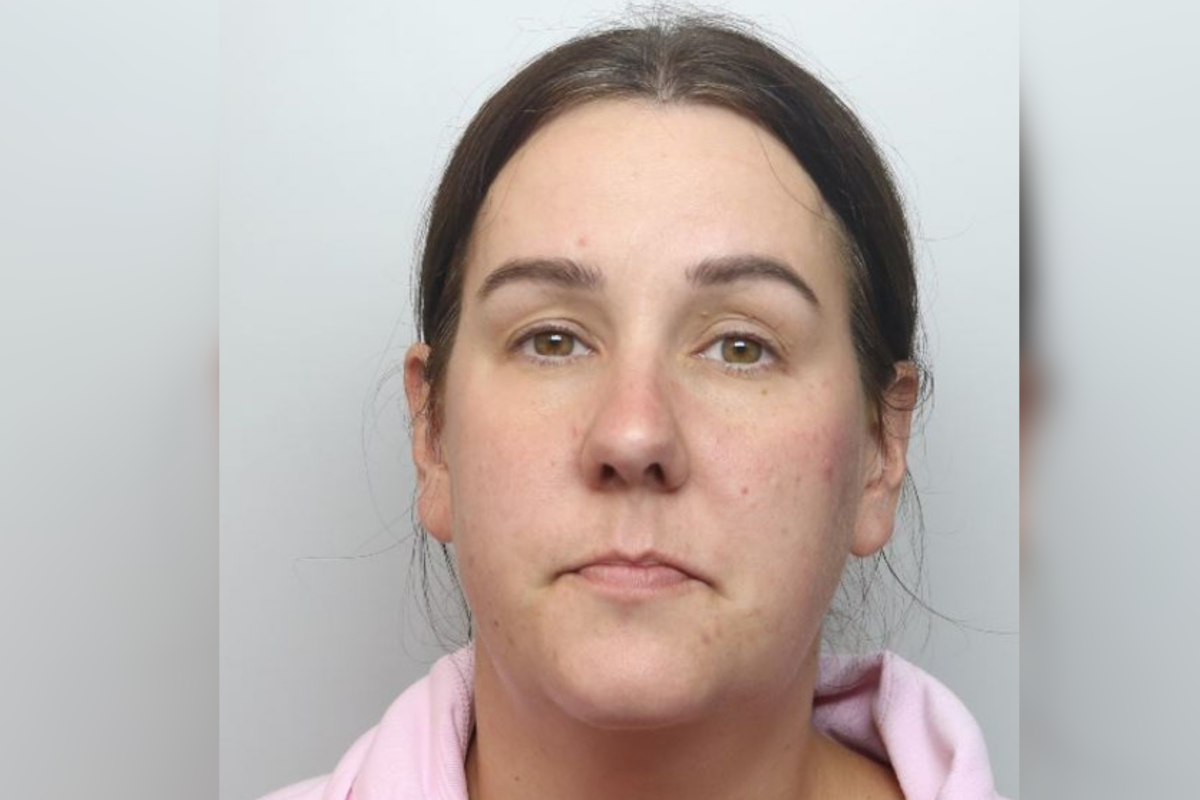 Lucy Connolly in an undated police photo. (Northamptonshire Police/PA)
The FSU challenged Connolly’s prison sentence. However, the appeal was denied.
She was freed in August after serving 40 percent of her term in prison.
Young noted that defendants often plead guilty because of the risks of harsher sentencing after trial.
“But in Lucy Connolly’s case, it’s also because she was refused bail, and worried that because her case would take so long to come to trial, she’d end up spending longer on remand than she would in prison if she pleaded guilty,” he said.
In Britain, the discussion on free speech seems to feature mainly left-wing cancel culture over trigger warnings or micro-aggressions, or the latest shibboleths of campus politics.
But according to Index on Censorship, the free speech problem now cuts across the political spectrum.
It noted that on the left, Guardian columnist Owen Jones was booted out of Labour’s conference after his pass was revoked over “safeguarding issues.”
Non-Crime Hate Incidents
Another free speech concerns are the “non-crime hate incidents” (NCHIs), which were logged by police forces since 2014 on the recommendation of the Macpherson inquiry.
The inquiry was set up after the 1993 racist murder of Stephen Lawrence and recommended recording incidents perceived as racist.
They document behavior perceived to be motivated by prejudice, even when no offence is committed.
Lord Lebedev told peers in July that more than 133,000 incidents have been filed since 2014.
He said that some entries involve children below the age of criminal responsibility whose words “may be held against them for the rest of their lives.”
“The innocence of youth has been replaced with the presumption of guilt,” he said.
One of the most prominent challenges came from Harry Miller, a former policeman and co-founder of Fair Cop.
In 2019, after Humberside Police logged a limerick he reposted as a non-crime hate incident. Miller sued.
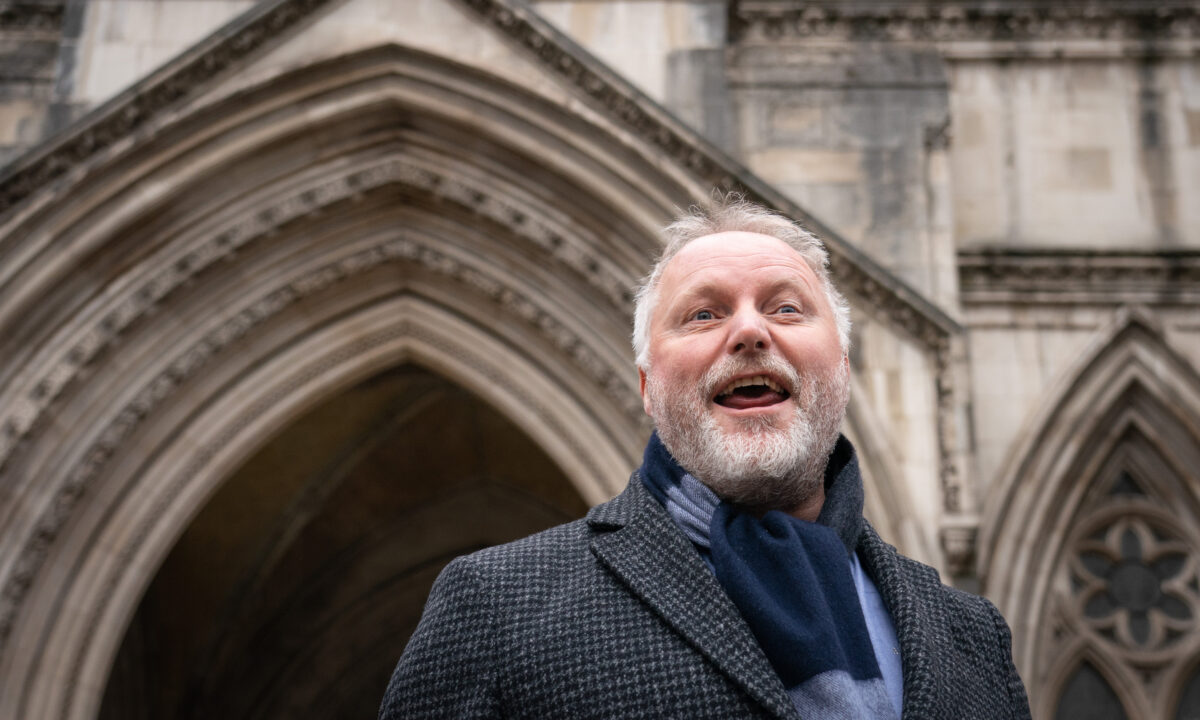 Former police officer Harry Miller speaks to the media outside the Royal Courts of Justice in London on Dec. 20, 2021. (Dominic Lipinski/PA)
He won at the High Court against the force, though the national guidance was upheld.
In December 2021, the Court of Appeal overturned that guidance, ruling the practice an unlawful interference with free expression under Article 10 of the ECHR and warning that knowledge that such matters are recorded “is likely to have a serious chilling effect on public debate.”
However, despite this and political promises to drop them, British police still encourage the public to report non-crime incidents on official sites.
But the tide could be turning.
In a press briefing with the BBC ahead of His Majesty’s Inspector of Constabulary’s Sir Andy Cooke State of Policing report, he spoke specifically about non-crime hate incidents, saying that he believed they are “no longer required.”
“I’m a firm believer […] that intelligence can be gathered in a different way, which would cause less concern to the public and would make recording of such issues much easier for policing,” said Cooke.
Scotland
If England needs to loosen the screws on free speech, Scotland has dug in further by criminalizing broad categories of expression.
Its Hate Crime and Public Order Act, in force since April 2024, criminalizes “stirring up hatred” across a wide range of characteristics, from religion and disability to transgender identity and variations in sex characteristics, regardless of whether harm or violence is likely to result.
Fraser Hudghton, the FSU’s Scottish director, told The Epoch Times the law could unleash a wave of trials in the coming months on top of already severe lockdown-era backlogs.
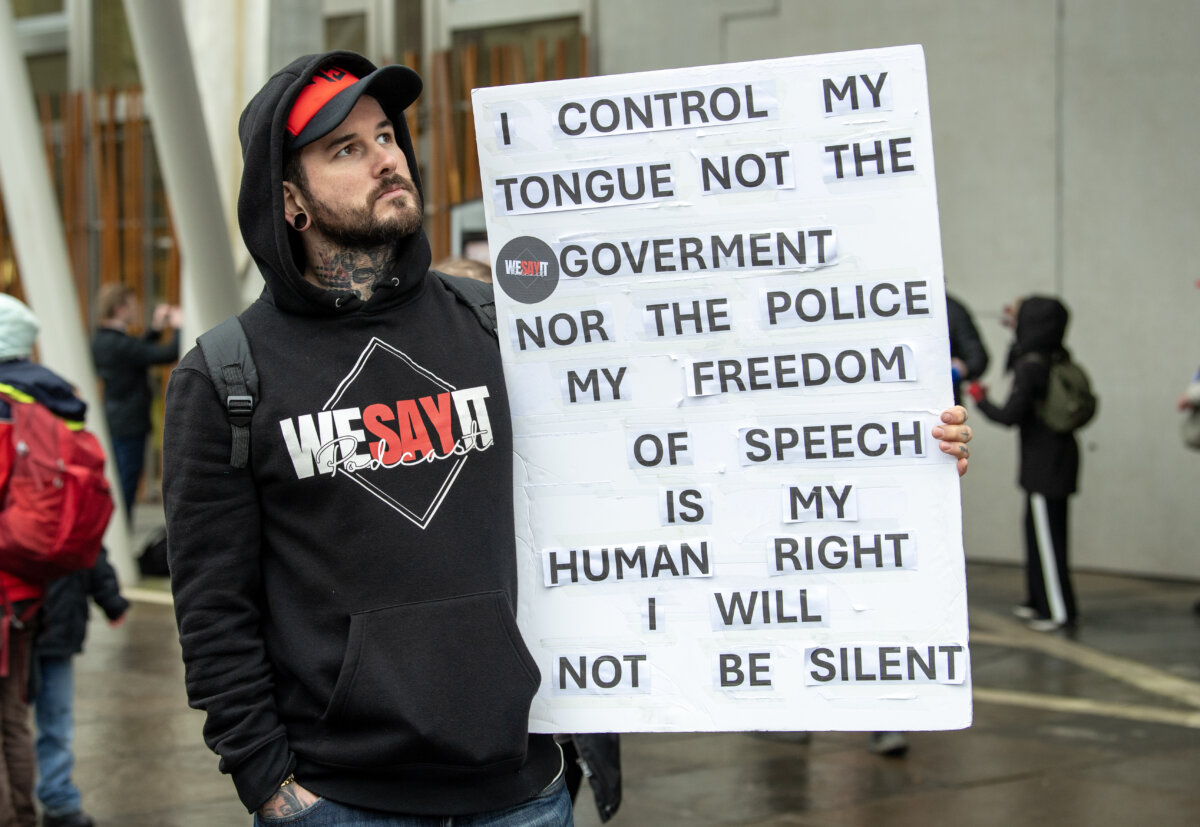 Campaigners gather outside the Scottish Parliament at Holyrood in Edinburgh, to mark the introduction of the Hate Crime and Public Order (Scotland) Act, on April 1, 2024. (Lesley Martin/PA)
“In the last 10 to 20 years, there’s been a very heavy focus on the victim’s perception of an individual circumstance,” he said.
He noted that the Abortion Services (Safe Access Zones) Act, which came into force in September 2024, prohibits protesters from being within 200 meters (about 656 feet) of abortion clinics in Scotland.
“It’s conceivable that someone could be accused of a crime because of the perception of an individual external to their property and that perception being given a particular emphasis by Police Scotland in those circumstances,” he said.
He said that “bread and butter case work” that they do is in universities, colleges, and workplaces where people have been disciplined or are under investigation for something that they have said.
Hudghton described how activists often use anonymized complaint forms in workplaces and universities to silence debate.
“What they are doing is going in and complaining and submitting a formal complaint to the person’s workplace or university or school or whatever, and of course, that then kickstarts an investigation,” he said.
“But just as in criminal law, you would be hoping that common sense and impartiality would apply at the start of an accusation being submitted, that isn’t the case,” he said.
Discriminating
Another FSU Scotland case involved the National Theatre of Scotland, which introduced mandatory racism training for all productions.
FSU argued it discriminated by exempting black performers while delivering curators and workshops only to white people.
“Now that is highly questionable. That appears to be discriminating,” Hudghton said.
“They were adamant no one was compelled, and that’s what they were hiding behind […] but once we looked at the material, it was very clear it was specifically about white privilege and things like that,” he said.
But he said that if such practices spread into policing and the application of criminal law, “you get into quite dangerous territory.”
Figures from an FOI he shared with The Epoch Times show Police Scotland has poured tens of thousands of hours into hate-crime and diversity training.
Between January 2023 and June 2025, more than 18,000 officers and staff completed Equality, Diversity and Inclusion modules, 18,678 took an “Upholding Our Values” course, and a face-to-face programme called Unity Through Learning, whose main aim was to “address the subject of racism,” reached more than 1,200 staff.
The force also created “Hate Crime Champion” roles, ran dozens of workshops, and more than 15,000 officers completed a Hate Crime and Public Order module in 2024 alone.
It is not known to the public what is in the materials or who is teaching them.
Police Scotland says it has trained a cadre of around 80 hate crime advisers and 450 hate crime champions.
According to a separate FOI, hate crime champions assist “with the recognition and recording of hate crimes and incidents, providing colleagues with general updates on all aspects of hate.”
The FSU has supported more than 2,700 people since 2020.
Some eye-catching cases include when a bank manager was dismissed after quoting an imaginary person using the N-word in a question during a race education training session.
Another included a woman who was banned from Newcastle United football club for believing that biological sex is important and real.
It is also warned that a vague “Islamophobia” definition, adopted by over 50 councils, which is being considered nationally by the government, could see councillors or council workers face disciplinary action if they speak out in areas rocked by grooming gang scandals.
‘I Can Get Myself Into Trouble’
A serving civil servant and FSU member, who did not want to be named in case he was identified at work, told The Epoch Times the culture inside Whitehall itself drives people to join the union.
“The civil service is pretty woke and so it’s not uncommon for them to be celebrating all sorts of events which have no real logical sense, that seem designed to wind up white British men or to appease some niche interest group that the public couldn’t care less about,” he said.
“And being a somewhat outspoken person, I’m not careful, I can get myself into trouble, and so I thought it best I should sign up.”
During the Black Lives Matter protests, he recalled diversity briefings where “a few people on the call” pushed back.
“And after this, one of them was approached, saying, ‘You cannot say stuff like this. You know, it’s unacceptable for you to be going against this,’” he said.
That colleague was required to undergo diversity training.
He said that he read about this all the time in the papers. “But you didn’t think it was actually true until you witnessed it yourself,” he said.
First Amendment
The Trump administration has pressed Brussels and London on speech regulation.
Prime Minister Sir Keir Starmer and Trump delivered a joint press conference in the UK in September; however, the U.S. president chose not to comment on the free speech flashpoint, instead moving to the next question.
Before his UK visit, Trump criticized the UK’s laws around online speech, saying “strange things are happening” there and that it was “not a good thing.”
 President Donald Trump (L) and British Prime Minister Keir Starmer shake hands during a press conference at Chequers near Aylesbury, England, on Sept. 18, 2025. (Leon Neal/AP)
U.S. Vice President Vance told the Munich Security Conference in February of his concerns over the case of Adam Smith Connor, an army veteran convicted for silent prayer in an abortion clinic buffer zone in Bournemouth, England.
Referring to “the backslide away from conscience rights,” which has “placed the basic liberties of religious Britons in particular in the crosshairs,” the vice president said that “in Britain and across Europe, free speech, I fear, is in retreat.”
Young, who was awarded a peerage in 2024 and now sits in the House of Lords as Baron Young of Acton, did not know whether this had been accompanied by American diplomatic pressure behind the scenes.
“I certainly hope it has,” he said.
However, he says Britain may need something like America’s First Amendment.
“Politically, that would have been a non-starter five years ago. I think it’s becoming increasingly politically feasible,” he said.
“If the Conservatives or Reform, or some combination of the two, form the next government, I don’t think it’s out of the question that we will see something like a First Amendment introduced in this country.
“I think in some ways, the United States has a better understanding of the ancient tradition of English liberty. If that means we have to look to the United States to help us understand why our ancient liberties need to be protected, then so be it.”
A Police Scotland spokeswoman told The Epoch Times by email: “Our training package around the Hate Crime and Public Order (Scotland) Act was developed in consultation with diversity staff associations to ensure all characteristics protected by legislation are clearly represented and articulated, and that officers are best prepared when responding to incidents.”
She noted that an “extensive programme of workshops also took place last year to allow officers to gain more understanding and ask questions.”
“Police Scotland is a rights-based organisation and officers balance the protections people have under human rights legislation against other laws every day,” she said.
A spokesman for the College of Policing, the professional body for the police in England and Wales, pointed The Epoch Times to past statements highlighting that its guidance for officers underscores a duty to protect freedom of speech under Article 10 of the European Convention on Human Rights.
The group also mentioned that Met Commissioner Sir Mark Rowley, Gavin Stephens, chair of the National Police Chiefs’ Council, and College of Policing CEO Sir Andy Marsh, last month wrote to the Home Secretary and asked the Home Office to review the investigation and recording of online comments.
It noted that it is also conducting, together with the National Police Chiefs’ Council (NPCC), a review of non-crime hate incidents, with findings expected by the end of the year.
The Home Office did not respond to The Epoch Times’ request for comment by publication time.
Evgenia Filimianova and Rachel Roberts contributed to this report.
 Friends Read Free
Copy
Facebook
Tweet
Friends Read Free
Copy
Facebook
Tweet