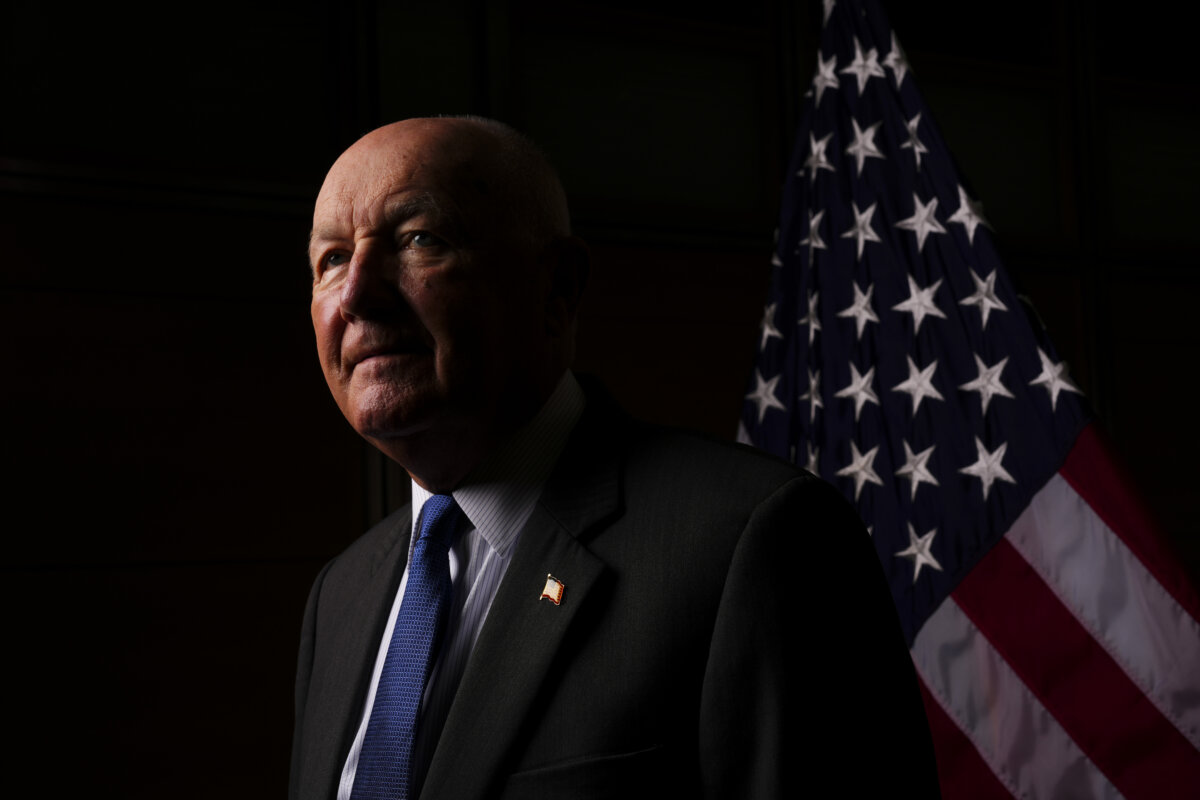

U.S. Ambassador to Canada Pete Hoekstra had a simple response when asked how he sees the Canada-U.S. relationship 10 years from now.
“I’m just hoping that you guys like us more than China,” he said while attending the National Manufacturing Conference in Ottawa on Nov. 19.
The response came after Canadian Manufacturers & Exporters president and CEO Dennis Darby asked Hoekstra during a fireside chat about his perspective on how the Canada-U.S. relationship may evolve in the future.
Darby reacted to Hoekstra’s comment saying that Canada liking the United States more than China would be a “pretty low bar.”
“I don’t know if it’s a low bar or high bar, okay? But it’s like, how we ever got in that position, I have no idea,” said Hoekstra, adding he doesn’t understand why Canadians were angry about U.S. President Donald Trump repeatedly suggesting Canada become the “51st state.”
The ambassador did not elaborate on that point, but he has previously said such comments reflect fondness and a U.S. desire to be closer to Canada.
“We don’t extend that [51st state] offer to many folks, but the president obviously is very, very fond of Canada,” Hoekstra said in May, shortly after Prime Minister Mark Carney’s first visit at the White House.
That meeting took place soon after the April federal election, which Carney won amid growing anti-U.S. sentiment.
Since then, Canada and the United States have not been able to reach a deal to lift the various tariffs Trump put in place after he took office.
One deal on metals and energy, which Hoekstra said could have been announced this week, fell through after Ontario aired an anti-U.S. tariff TV ad in the United States. Trump cancelled trade talks because of the ad, saying Canada was trying to interfere with the U.S. Supreme Court’s review of the legality of some U.S. tariffs.
Carney has pushed to diversify trade outside the United States since the introduction of the tariffs. That push has included resetting relationships with China and India.
Chinese interference in domestic politics became the focus of a public inquiry in recent years, which identified Beijing as the foremost perpetrator of foreign interference in Canada.
Relationships With China
Perceptions of China in Canada, and relations between Ottawa and Beijing, crashed following the Chinese detention of Canadians Michael Kovrig and Michael Spavor for more than 1,000 days before being released in 2021. This came in apparent retaliation to Canada in late 2018 executing a U.S. extradition warrant on Huawei executive Meng Wanzhou, who was accused of fraud.
Foreign Affairs Minister Anita Anand visited China in October and declared that Ottawa and Beijing are now in a “strategic partnership.” Carney met with Chinese Leader Xi Jinping in South Korea a few weeks later and announced a “turning point” in the relationship.
The Trump administration has also sought to maintain a good relationship with the Chinese regime, while taking aggressive trade actions to counter it. The White House has also made deterring China a military priority.
Hoekstra didn’t voice any concerns about Carney’s plan to expand trade beyond his country, but said the two countries should work together to protect their economies against unfair trade practices like dumping from China.
“We don’t get upset when the prime minister talks about doubling the number of exports to countries other than the United States. It’s like ‘hallelujah,’ a strong Canada, a strong and prosperous Canada is good for us, okay?” he said.
“You don’t want to live in a weak neighbourhood. You want to live in a neighbourhood where you’ve got strong neighbours so that you can feed off of each other, build each other up, benefit from the strengths of the cross border relationship.”
The ambassador said the deal on metals that was being worked on before Ontario ran its TV commercial included the harmonization of trade barriers.
“The primary target is probably China, because they’re dumping steel,” he said.
“Obviously we have different legal mechanisms and tools available to us, but we were attempting—and the prime minister was very clear on this—we’re going to try to get as close to what American barriers are to unfair competition as what we can,” Hoekstra added.
Canada imposed tariffs on Chinese steel, aluminum, and electric vehicles in late 2024, following Washington’s lead. China retaliated in March 2025 by targeting Canadian agricultural and seafood products.
Trump imposed tariffs on Canadian steel and aluminum during his first term, which was met with counter-measures by Ottawa. The conflict was resolved with the two countries agreeing to better counter dumping and transshipment from other countries.
 Friends Read Free
Copy
Facebook
Tweet
Friends Read Free
Copy
Facebook
Tweet