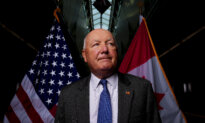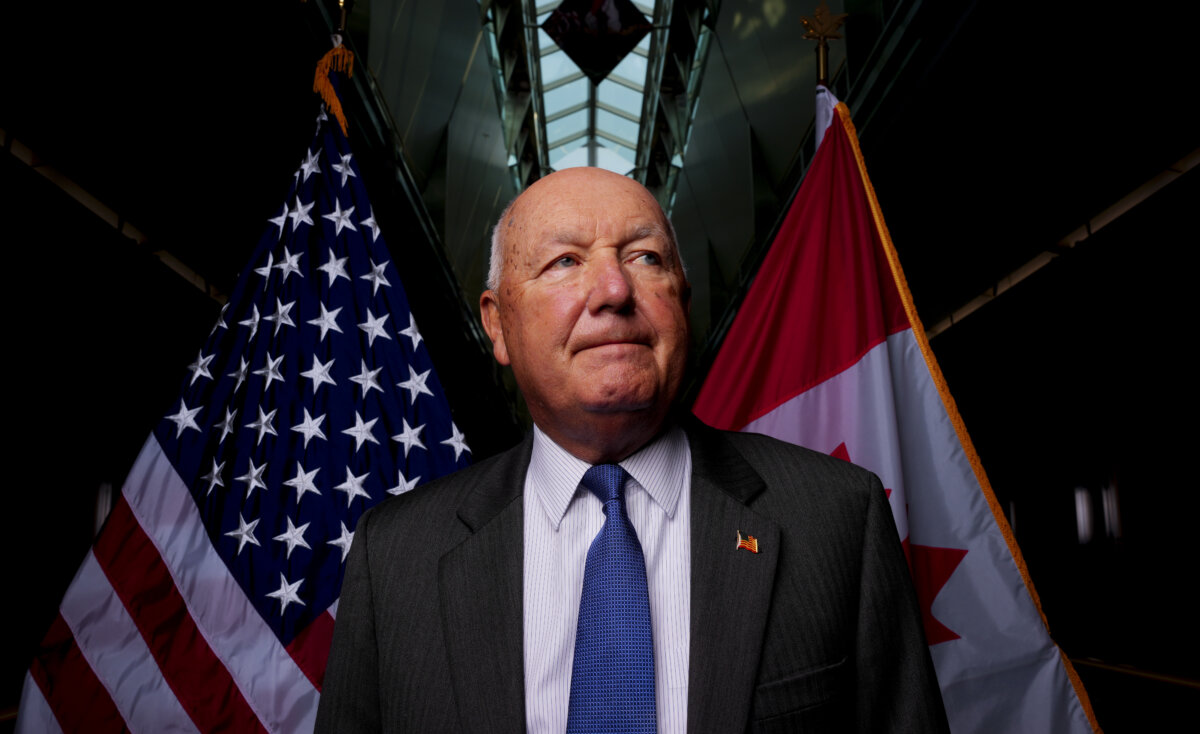

U.S. Ambassador to Canada Pete Hoekstra said restarting trade talks with Canada will not be easy after they were cancelled by Washington following the airing of Ontario’s anti-tariff ad down south.
Hoekstra said the move by Ontario Premier Doug Ford appeared to be without precedent and that anyone should “seriously consider” before adopting such a strategy to reach political objectives in the United States.
Hoekstra said, while attending the National Manufacturing Conference in Ottawa Nov. 19, that “no one can even remember a circumstance where a foreign government came into the United States” to broadcast an ad “targeting the president of the United States and his policies 10 days before an election and a couple of weeks before a Supreme Court case would be heard.”
Hoekstra was referring to gubernatorial elections and other down ballot races taking place earlier this month, as well as the highest U.S. court currently evaluating whether U.S. President Donald Trump has overstepped his authority in imposing a category of tariffs on foreign countries, including Canada.
“You do not come into America and start running political ads, government-funded political ads, and expect … there will be no consequences or reaction from the United States of America and the Trump administration,” he said. “As far as we can tell, it has never happened in America before.”
Hoekstra said it doesn’t matter that the ad came from a province and not Ottawa. “I’m sorry, we don’t go through that, you know, slicing and dicing.”
Prime Minister Mark Carney said it was an “obvious” choice for Ottawa not to run anti-tariff ads in the United States.
The Ontario government started a $75 million anti-U.S. tariffs ad campaign in the United States in late October, using part of a 1987 radio address from then-President Ronald Reagan.
The address extolls the virtues of free trade but began with Reagan explaining his decision to impose tariffs on Japan, accusing it of unfair trade practices. This portion of the speech was not used in the ad.
Trump cancelled ongoing trade talks with Canada because of the ad, saying it was an attempt to interfere with the Supreme Court’s decision on tariffs. He also pointed to a statement from the Ronald Reagan Presidential Foundation and Institute saying the ad misrepresents Reagan’s address.
Hoekstra had reportedly publicly lashed out against Ontario’s representative in Washington during a high-profile event in Ottawa in late October, berating David Paterson over the anti-tariff ad.
The U.S. embassy had declined to comment on the matter at the time. Hoekstra mentioned during his talk on Nov. 19 that he had been affected by the trade talks falling through.
“I was kind of passionate earlier this month that the deal got blown up,” he said, adding the Trump administration thought it might have been announced this week.
Ford had called on Hoekstra to apologize to Paterson and “bury the hatchet.” The premier has defended his use of the anti-tariff ad even though it led to the cancellation of trade talks, saying he had reached his objective of starting a broader conversation on the trade issue Canada has with the United States.
Ottawa and Washington were working on a deal on metals and energy, and Hoekstra hinted to what it contained.
The United States has imposed universal tariffs of 50 percent on steel and aluminum on national security grounds. Hoekstra said the deal being worked on would have included provisions for Canada and the United States to harmonize their barriers against foreign steel, especially to protect against Chinese dumping.
An agreement containing such provisions had been reached in 2019 during Trump’s first term to put an end to the trade conflict between Canada and the United States on steel and aluminum.
“We were attempting, and the prime minister was very clear on this, we’re going to try to get as close to what American barriers are to unfair competition as what we can,” he said.
Trade talks will restart at some point, Hoekstra said, but the “question is when.”
“I’ve got suggestions that I think can get it restarted, but it’s not going to be easy,” he said without elaborating.
Ottawa previously made concessions to restart trade talks during the summer, including by pledging to rescind its Digital Services Tax affecting U.S. tech giants, and removing most of its counter-tariffs.
Along with seeking a trade deal to remove sectoral tariffs, Ottawa is ramping up for Canada-United States Mexico Agreement (CUSMA) renegotiations next year. The blanket U.S. tariff on Canada contains a CUSMA exemption, meaning most goods can still be traded tariff-free. Carney has said that 85 percent of goods are currently exempt.
Hoekstra said that the U.S. side, on a number of issues to be discussed in renegotiations, is “waiting to see exactly where the Canadian government is going to come out on this.” He then mentioned the F-35 fighter jets, calling the plane “international” and not American because of manufacturing inputs from different countries, including Canada. The federal government is currently reviewing its planned acquisition of additional F-35s.
Industry Minister Mélanie Joly said earlier this week that Canada is not getting enough economic returns from its purchase of F-35s, while noting that Swedish manufacturer Saab is offering to create 10,000 jobs in Canada if it purchases its Gripen fighter jet.
 Friends Read Free
Copy
Facebook
Tweet
Friends Read Free
Copy
Facebook
Tweet