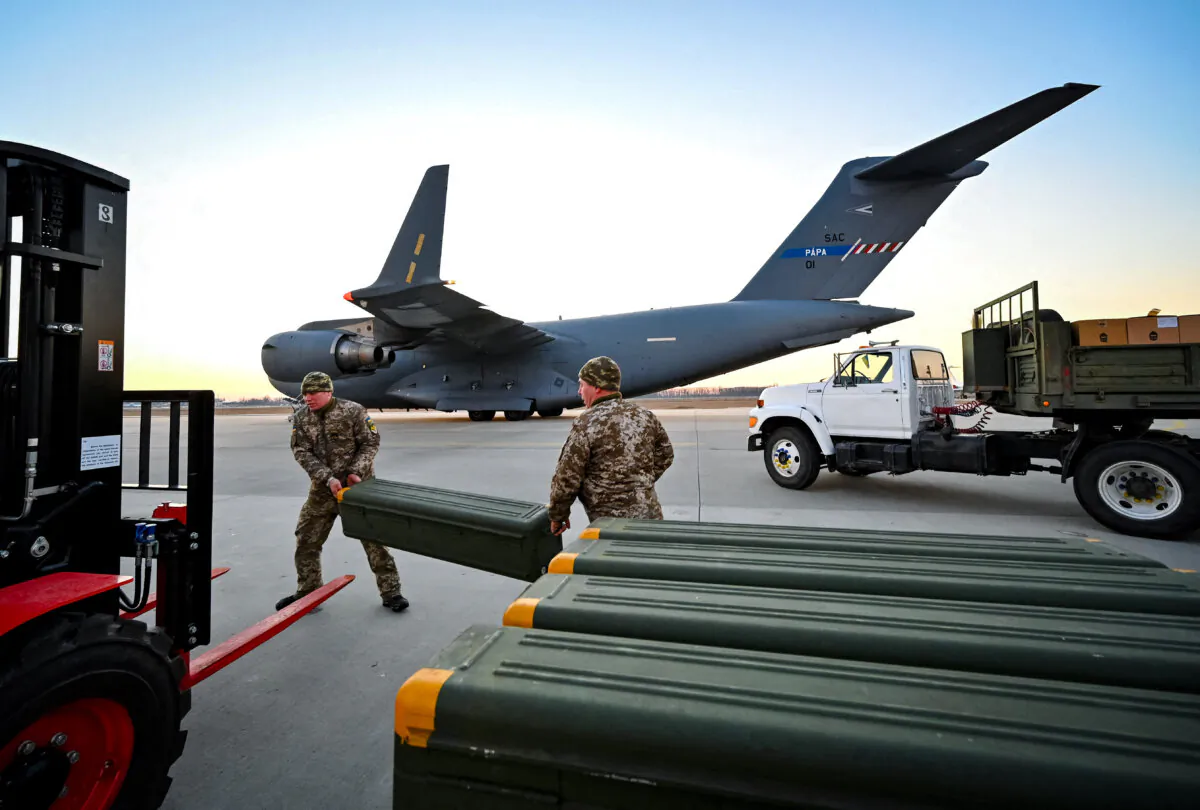

The United States approved on Thursday a possible $825 million munitions deal with Ukraine that will include extended-range missiles and related equipment for use against the Russian invasion.
Under the deal, Ukraine would receive 3,350 extended-range attack munition (ERAM) missiles and 3,350 navigation modules, along with required component parts, support equipment, and logistical support, according to the Defense Security Cooperation Agency (DSCA).
The DSCA said that Ukraine would pay for the munitions using funding from Denmark, the Netherlands, and Norway, in addition to foreign military financing from the United States.
“This proposed sale will support the foreign policy and national security objectives of the United States by improving the security of a partner country that is a force for political stability and economic progress in Europe,” it stated, noting that the munitions would help improve Ukraine’s capacity to conduct self-defense and regional security missions.
The U.S. State Department approved the arms sale, and the DSCA delivered the required certification notifying Congress of the proposed deal, according to the statement.
Andriy Yermak, head of the Ukrainian Presidential Office, also confirmed the deal on social media.
The deal comes against the backdrop of intensified Russian attacks on Ukraine and the Trump administration’s ongoing efforts to mediate peace talks to end the war that started in February 2022.
Ukrainian President Volodymyr Zelenskyy said on X that Russia launched more than 30 missiles and 600 drones at Kyiv on Aug. 28 in what he described as “one of the largest Russian strikes,” leaving at least 19 people dead and dozens injured.
Properties belonging to a Turkish enterprise, the Embassy of Azerbaijan, the European Union delegation, and the British Council were among those damaged in the strikes, according to Zelenskyy.
EU foreign policy chief Kaja Kallas said the bloc has summoned Russia’s envoy in Brussels following the recent strike against Kyiv.
“I just spoke with my colleagues in @EUDelegationUA in Kyiv, after our building was damaged by a Russian strike,” Kallas said on X. “No diplomatic mission should ever be a target.”
White House spokesperson Karoline Leavitt said that President Donald Trump “was not happy about this news, but he was also not surprised,” citing Ukraine’s recent drone attacks on Russian oil refineries.
Speaking to reporters on Aug. 28, Leavitt said that Trump is working to end the war, but that both Russia and Ukraine may not be ready to end it themselves.
“Russia launched this attack on Kyiv, and likewise, Ukraine recently dealt a blow to Russia’s oil refineries,” Leavitt said. “They have taken out, as a matter of fact, 20 percent of Russia’s oil refinery capacity over the course of their attacks throughout the month of August.”
The Ukrainian military said on Thursday that its drones hit the Afipsky oil refinery in Russia’s Krasnodar region and the Kuibyshev refinery in Russia’s Samara region in an overnight attack, according to the Kyiv Independent.
On Aug. 15, Trump hosted high-stakes peace talks with Russian President Vladimir Putin in Alaska, but the meeting ended without a cease-fire. Three days later, Trump met with Zelenskyy and European leaders at the White House to discuss the summit and possible security guarantees for Ukraine.
Following those talks, Trump began arranging a bilateral meeting between Putin and Zelenskyy, after which he said the three leaders would hold a trilateral session. So far, however, neither Russia nor Ukraine has announced a date or location for the bilateral meeting.
Emel Akan contributed to this report.
 Friends Read Free
Copy
Facebook
Tweet
Friends Read Free
Copy
Facebook
Tweet