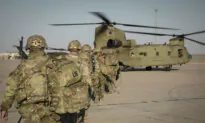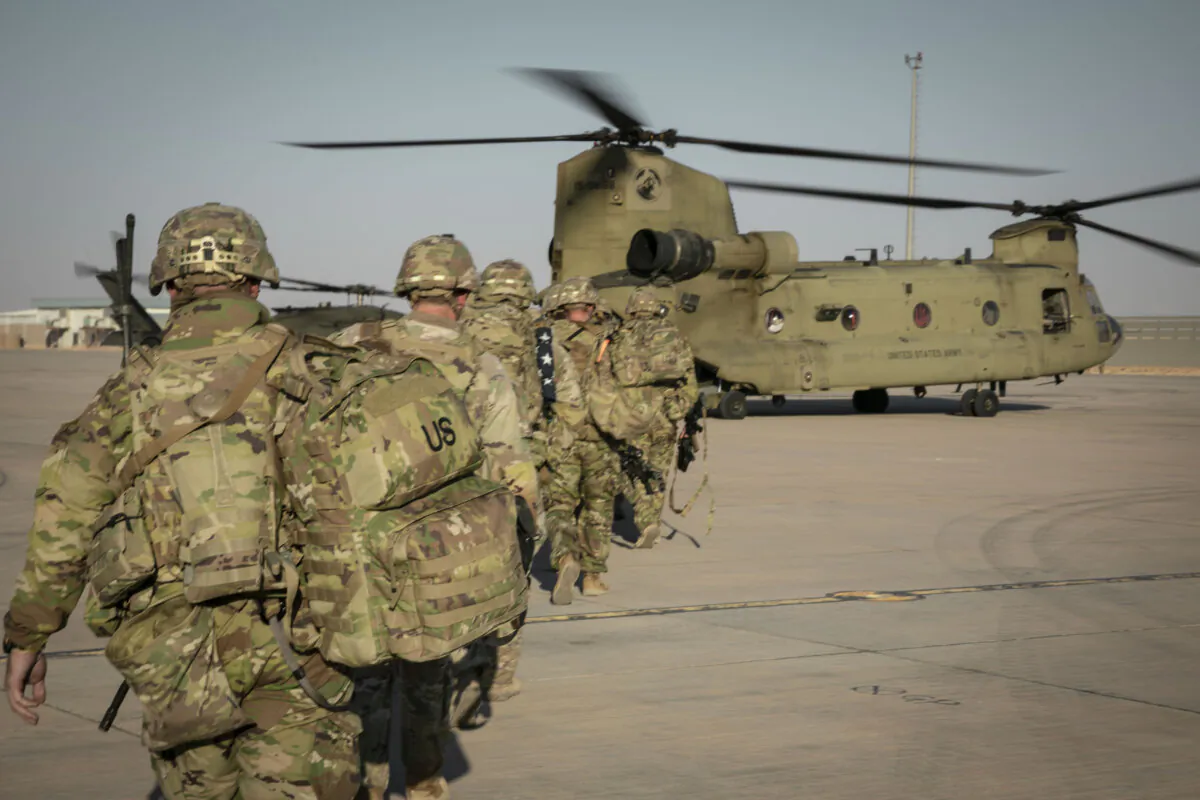
U.S. military forces in Syria completed a drawdown from a key garrison in the country on Feb. 11 as part of a planned consolidation of forces in the country.
In a Feb. 12 statement, the U.S. Central Command (CENTCOM)—responsible for U.S. military operations in Syria and across the Middle East—announced that it “completed the orderly departure of U.S. forces from al-Tanf Garrison in Syria” the day before.
CENTCOM said the al-Tanf withdrawal was part of “a deliberate and conditions-based transition” for the Combined Joint Task Force—Operation Inherent Resolve, the U.S. military mission aimed at defeating ISIS.
“U.S. forces remain poised to respond to any ISIS threats that arise in the region as we support partner-led efforts to prevent the terrorist network’s resurgence,” said Adm. Brad Cooper, the CENTCOM commander.
“Maintaining pressure on ISIS is essential to protecting the U.S. homeland and strengthening regional security.”
In April 2025, the Pentagon announced its plans to consolidate its Syrian force footprint, citing successes in the counter-ISIS effort.
Over the past year, the U.S. government has increasingly partnered with Syria’s new governing authorities in Damascus, which came to power in December 2024 after ousting then-Syrian leader Bashar al-Assad.
From 2011 until his downfall, Assad had fought to retain power against a variety of insurgent factions. The United States opposed Assad, but the U.S. military mission in Syria officially focused on defeating ISIS, rather than wading into Syria’s civil war.
Ahmad al-Sharaa is currently serving as Syria’s interim president after his forces, known as Hayat Tahrir al-Sham (HTS), drove Assad from power.
HTS began as a Syrian offshoot of al-Qaeda. The U.S. government considered HTS a foreign terrorist organization but reversed the designation in July, amid efforts to work with Sharaa’s new government.
ISIS claimed responsibility for an ambush shooting in which two U.S. soldiers and an American civilian interpreter were killed on Dec. 13, 2025.
The Syrian Interior Ministry has stated that the gunman was a member of Syrian security forces.
Following the Dec. 13, 2025, ambush shooting, President Donald Trump said Sharaa’s government is not to blame for the attack.
In recent weeks, the Trump administration has worked to help ease tensions between the interim Syrian government and the predominantly Kurdish Syrian Democratic Forces (SDF), the latter of whom U.S. forces closely partnered with in counter-ISIS efforts over the years.
Last month, U.S. forces began relocating ISIS suspects and their families to Iraq from detention camps in Syria, which had become the site of armed skirmishes between the SDF and Sharaa’s government forces.
On Jan. 30, the SDF and Sharaa’s government announced a cease-fire and a plan to safeguard Kurdish interests and integrate the SDF into the Syrian military.
The Global Coalition to Defeat ISIS, on Feb. 9, said Sharaa’s new Syrian government had become the 90th participating member of the coalition.
In a Feb. 10 X post, U.S. special envoy to Syria Tom Barrack said Damascus’s move to join this international counter-ISIS effort “marks a new chapter in collective security.”
 Friends Read Free
Copy
Facebook
Tweet
Friends Read Free
Copy
Facebook
Tweet