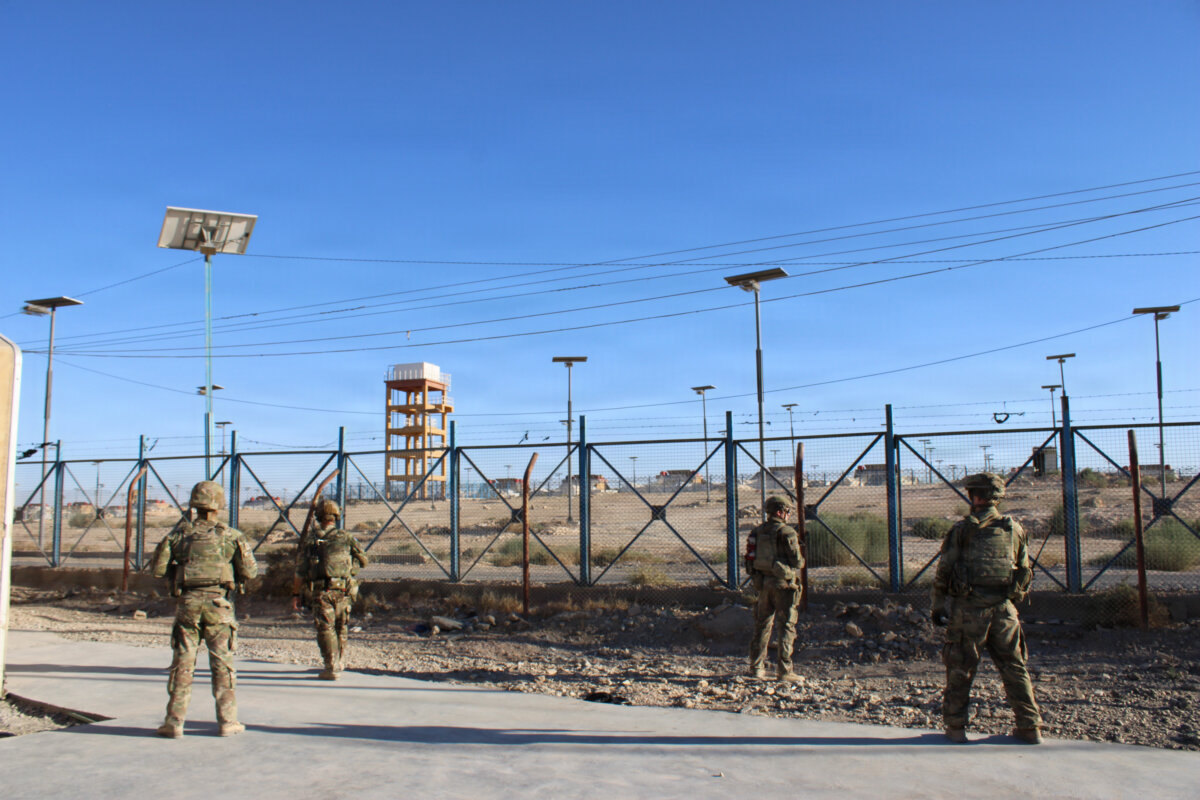
U.S. forces deployed in the Middle East relocated 150 ISIS prisoners from Syria to Iraq on Jan. 21, amid growing armed clashes in Syria.
In an emailed statement on Jan. 21, the U.S. Central Command said its forces carried out the prisoner transfer operation “to help ensure the terrorists remain in secure detention facilities.”
Syria has been the site of multiple prison camps, which were established to house suspected members of the ISIS terrorist group and their family members after the Islamic terror group lost control over its territorial holdings across parts of Syria and Iraq.
The Syrian Democratic Forces (SDF) have guarded several of the prison camps dotted throughout the country.
The de facto Syrian government in Damascus has said dozens of ISIS suspects have gone free from prison camps in recent days, as government forces have clashed with the SDF.
Central Command said the prisoner transfer mission successfully relocated “150 ISIS fighters held at a detention facility in Hasakah, Syria, to a secure location in Iraq.”
“Ultimately, up to 7,000 ISIS detainees could be transferred from Syria to Iraqi-controlled facilities,” Central Command stated.
The U.S. government had supported the SDF during Syria’s civil war and the international battle with ISIS. That relationship began to shift when Syrian leader Bashar al-Assad fled Syria in December 2024.
President Donald Trump’s administration has increasingly emphasized diplomacy with the post-Assad interim government in Damascus, currently led by Ahmad al-Sharaa.
Sharaa’s forces, composed largely of Hayat Tahrir al-Sham (HTS) fighters, led the surprise final offensive that drove Assad to flee the country at the end of 2024.
Sharaa has since positioned himself and other HTS figures at the head of Syria’s post-Assad interim government.
HTS began as a Syrian offshoot of the al-Qaeda terrorist group.
The U.S. government designated HTS as a foreign terrorist organization in 2014, but the State Department retracted that designation in July 2025.
Following more than a decade of civil war and long-standing distrust among Syria’s various ethnic and religious sects, Sharaa has called for the predominantly Kurdish SDF to integrate with the Damascus government.
Tom Barrack, who serves as the U.S. ambassador to Turkey and special presidential envoy to Syria, issued a statement on Jan. 20, advising the SDF that the best hope for Kurds in Syria is to work with Sharaa.
Barrack said the rationale for U.S. support for the SDF—including as ISIS prison guards—”has largely expired” now that Sharaa is in power in Damascus.
“While risks remain … the United States is pushing for safeguards on Kurdish rights and counter-ISIS cooperation. The alternative—prolonged separation—could invite instability or ISIS resurgence,” Barrack said.
Despite Barrack’s calls for unity, the SDF has reported continued armed clashes with “Damascus-affiliated factions” throughout Syria.
On Jan. 19 and Jan. 20, the SDF reported multiple armed skirmishes near the Shaddadi and Hol prison camps in Syria’s Hasakah Governorate, as well as the Aqtan prison camp in the Raqqa Governorate.
The Damascus interim government said that about 120 ISIS suspects had gone free from the Shaddadi prison, 81 of whom have since been re-arrested.
The government reported that the SDF had released additional ISIS suspects at the Hol prison camp before withdrawing from the camp “without any coordination with the Syrian government or the international coalition.”
U.S. Navy Adm. Brad Cooper, the commander of Central Command, said his forces are coordinating with regional partners as they work to secure prison camps and transfer ISIS detainees.
“Facilitating the orderly and secure transfer of ISIS detainees is critical to preventing a breakout that would pose a direct threat to the United States and regional security,” Cooper said in a statement.
 Friends Read Free
Copy
Facebook
Tweet
Friends Read Free
Copy
Facebook
Tweet