
The United States and Germany have agreed to deepen cooperation between their armaments sectors, as both countries seek to reinvigorate their defense industrial bases in light of shifting priorities and evolving security concerns.
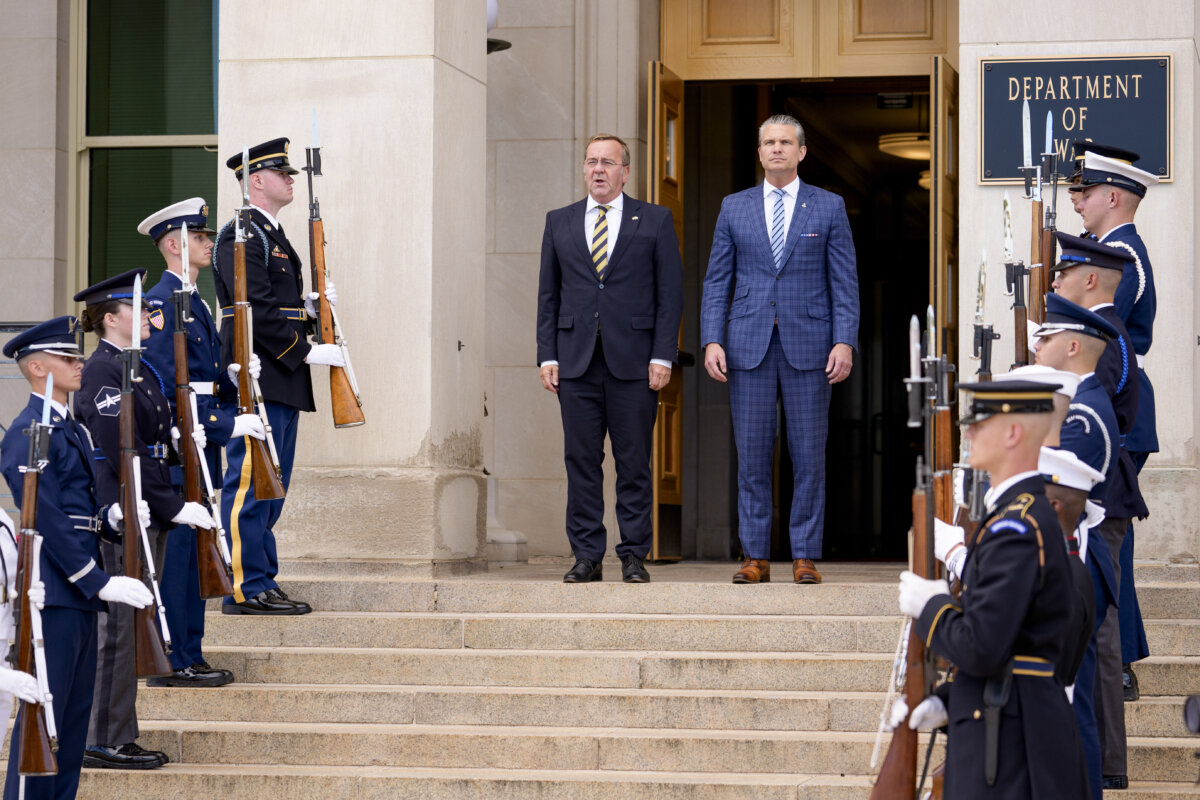
Secretary of War Pete Hegseth met with German Defense Minister Boris Pistorius at the Pentagon on Monday, where the two civilian military leaders signed an agreement that could expand opportunities for the joint development, production, and licensed manufacturing of military equipment.
Hegseth said the agreement aligns both with the U.S. War Department’s acquisition transformation strategy and Germany’s Procurement Acceleration Act.
“The objective is straightforward: Deliver capable systems to American, German and allied forces, at scale and at speed for maximum lethality,” he said, according to a Sept. 15 Department of War statement.
Pistorius said that the agreement would help Germany become a stronger partner in the NATO alliance.
“It creates a strong basis for closer armament cooperation between our two nations with one clear aim: increasing our production capacity,” the German defense minister said.
Germany and the United States are already engaged in joint armaments and defense projects, including Berlin’s purchase of U.S. Poseidon P-8A maritime patrol aircraft.
The German Federal Ministry of Defense said in a Sept. 16 statement that on Friday, Pistorius will take delivery of the first F-35A fighter jets in Texas.
Next year, the German Air Force will receive its first heavy transport helicopter, the CH-47 Chinook.
The agreement comes as the Trump administration pushes for NATO allies to take greater responsibility for their own defense, and as the United States pivots its security priorities away from Europe and toward defense of the homeland and the Western Hemisphere.
Last year, NATO allies agreed to raise defense spending targets from 2 percent to 5 percent of gross domestic product by 2035.
Burden Shift ‘Progressing’
Hegseth and Pistorius also discussed the United States and Europe increasing defense spending and NATO 3.0, according to the Department of War statement.
NATO 3.0 is Hegseth’s term for proposals that see Europe bolster its own troop readiness and reinforce its industrial base—something that the secretary of war said that Germany was “front and center” in accomplishing.
“Today, we see major progress that no one would have thought possible,” Hegseth said.
“Germany today is moving closer to fulfilling the 5 percent—leading the way on the spending commitment it made at the Hague Summit last year—but as we talked about, defense spending is just the first step.”
Pistorius said that since last year, Berlin has increased defense spending by 25 percent, equivalent to about $147 billion, highlighting investments in technology.
“We are investing in new state-of-the-art weapon systems here in the United States; we are assuming a leading role within NATO and, when it comes to providing support to Ukraine, we are strengthening NATO’s eastern flank, particularly through our armored brigade in Lithuania,” Pistorius said.
Germany has also been contributing more to leadership roles in NATO.
Earlier this year, Germany, in partnership with the Netherlands, took command of a new, second headquarters to the Baltic region covering Estonia and Latvia.
In its role, the 1 German-Netherlands Corps is responsible for directing exercises and other activities to prepare for conflict and, in the event of clashes, for NATO’s defense of the eastern flank.
 Friends Read Free
Copy
Facebook
Tweet
Friends Read Free
Copy
Facebook
Tweet