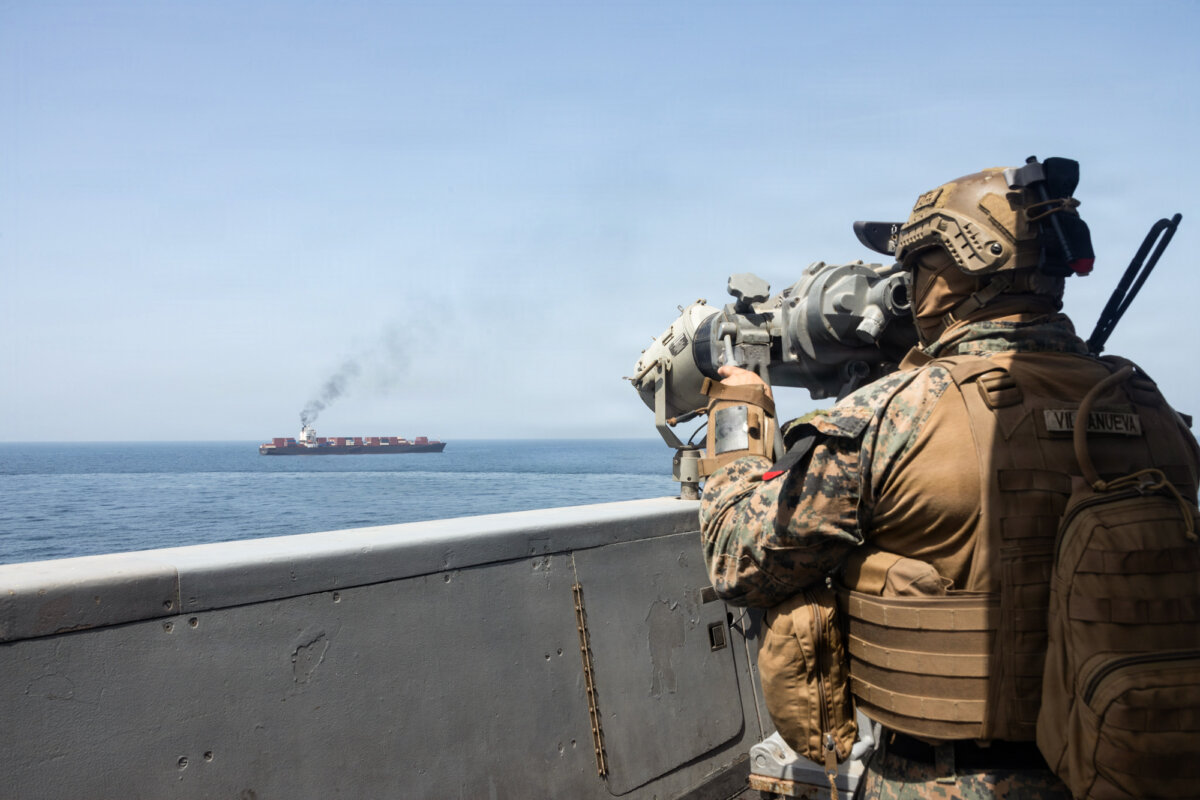

A U.S. Navy-led maritime coalition said on Friday that American forces are “fully prepared” to defend freedom of navigation in the Strait of Hormuz, insisting that no country has the authority to control the strategic waterway or impose transit fees even as the regional threat level remains “severe.”
The warning, issued by the Joint Maritime Information Center on July 10, came as President Donald Trump said the United States had agreed to resume talks with Iran while reiterating that he considers the ceasefire between the two countries to be over following a fresh round of fighting in the Persian Gulf.
“The Islamic Republic of Iran has asked us to continue ‘talks.’ We have agreed to do so, but the United States has stated to them, in no uncertain terms, that the Cease Fire is Over!” Trump wrote in a post on Truth Social.
Trump did not provide details on the nature or timing of the proposed talks. Administration officials, including U.S. Vice President JD Vance, had previously met with Iranian counterparts after a memorandum of understanding signed in June temporarily halted hostilities and reopened the Strait of Hormuz to commercial shipping.
That agreement unraveled this week after three commercial vessels came under attack in the strategic waterway, prompting U.S. retaliatory strikes against Iranian military assets and triggering a fresh exchange of attacks across the Middle East.
US Rejects Iranian Claims Over Hormuz
The Joint Maritime Information Center, a multinational body overseen by the U.S. Navy, said the maritime security threat level in the Strait of Hormuz remains “severe” despite the availability of an expanded southern transit route through Omani waters. Mariners were warned to remain alert to possible mine threats and to expect radio contact from naval forces.
The advisory stated that vessels are encouraged, but not required, to coordinate with U.S. naval authorities before transiting the route and stressed that “there is no controlling authority regulating passage or fee required for any route.”
Additional routes remain open but are not protected, according to the notice, which urged ship operators to maintain contact with the U.S. Navy’s Naval Cooperation and Guidance for Shipping office and Britain’s UK Maritime Trade Operations center.
In an accompanying statement, U.S. Naval Forces Central Command rejected Iran’s repeated assertions that ships must use routes designated by Tehran.
“No nation has the authority to close or control the Strait of Hormuz,” the statement said. “U.S. forces are fully prepared to deter threats, defend freedom of navigation, and respond decisively to any attempt to disrupt lawful transit through the Strait.”
The statement echoed remarks made by Trump and Secretary of State Marco Rubio late last month, rejecting the possibility of transit fees in the waterway, through which roughly one-fifth of globally traded oil and liquefied natural gas passed before the conflict began.
U.S. Central Command said in a July 9 post on X that Iran’s claim that vessels may transit Hormuz only along routes approved by Tehran was false, adding that American forces had facilitated the passage of more than 800 commercial vessels carrying roughly 380 million barrels of crude oil through the corridor since May.
“Iran does not control the Strait of Hormuz,” the command said, which followed a statement that U.S. forces had completed an additional round of strikes against Iran “to further degrade Iran’s ability to attack commercial shipping and innocent civilian mariners” in the strait.
Hormuz Traffic Stalls Amid Escalation
The latest escalation began after three tankers came under attack in the Strait of Hormuz earlier this week, including one that Iranian state television said had been struck after ignoring warnings from Iranian authorities.
Iran has repeatedly insisted that only routes approved by Tehran are safe, while Washington has maintained that freedom of navigation through the waterway must be preserved.
The attacks against Hormuz shipping prompted the United States to launch a fresh round of strikes against Iranian targets.
Iran retaliated by launching attacks against U.S. military installations in neighboring Gulf states. The Islamic Revolutionary Guard Corps said it had targeted facilities in Bahrain and Kuwait and had shot down an American MQ-9 drone, although Bahrain later said its forces had thwarted the Iranian attacks.
The renewed violence has cast doubt on the future of the memorandum of understanding reached between Washington and Tehran in June, which had temporarily halted fighting and reopened the Strait of Hormuz to commercial shipping.
Trump had already signaled earlier this week that he no longer considered the arrangement to be in force.
Speaking before the NATO summit in Ankara on July 8, Trump was asked whether the agreement remained valid.
“To me, I think it’s over,” he replied. “I don’t want to deal with them.”
The renewed confrontation disrupted a fragile recovery in maritime traffic through Hormuz.
Shipping analysts at Lloyd’s List, Windward, LVision, and Kpler have reported a sharp slowdown in vessel movements since the latest attacks, reversing the rebound that had followed the June ceasefire agreement.
Analysts at the Washington-based Institute for the Study of War said this week that Iran appears willing to risk renewed conflict with the United States in pursuit of greater control over the strait.
“Iran is threatening the resumption of large-scale conflict by striking civilian vessels and the Gulf states to try to achieve permanent control over the Strait of Hormuz,” the think tank said in a July 9 assessment, adding that some Iranian officials have threatened to change Iran’s nuclear doctrine “likely in part to try to deter the United States from conducting further strikes on Iran.”
Trump has said that the key reason for the joint U.S.–Israeli strikes against Iran on Feb. 28 was to prevent Iran from ever acquiring nuclear weapons.
 Friends Read Free
Copy
Facebook
Tweet
Friends Read Free
Copy
Facebook
Tweet