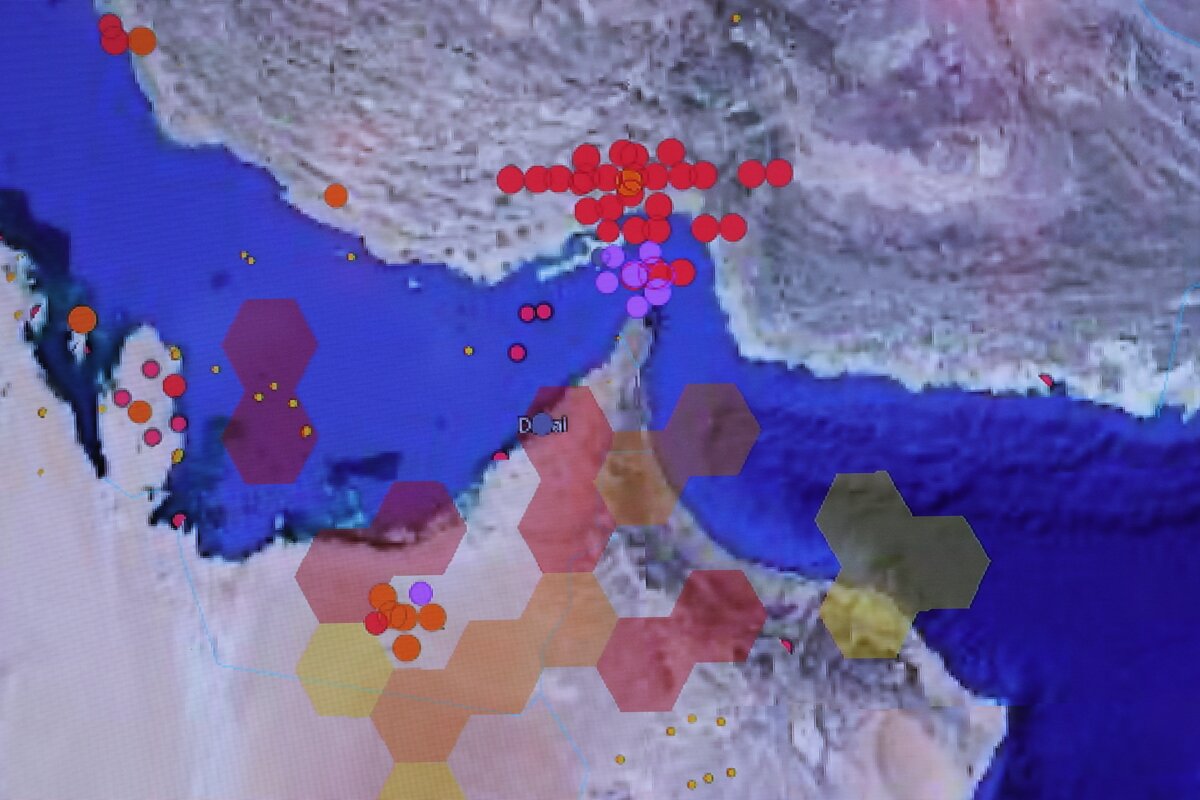

A commercial tanker caught fire after being struck by a projectile while transiting the Strait of Hormuz late Monday, in the latest attack to hit the strategic waterway and a fresh threat to the slow recovery of commercial shipping following last month’s U.S.–Iran preliminary agreement that extended a fragile truce.
The UK Maritime Trade Operations (UKMTO) center said on July 7 that the vessel was struck off Limah, Oman, while sailing southbound out of the Strait of Hormuz toward the Gulf of Oman.
The projectile hit the port side of the tanker, igniting a fire on board, although authorities said there was no reported environmental impact and an investigation was underway.
No group immediately claimed responsibility.
Iranian state television, however, said the liquefied natural gas tanker had been attacked after ignoring warnings from Iranian authorities. While it stopped short of explicitly claiming Tehran carried out the strike, the report suggested the vessel failed to follow Iran’s instructions on which route to use through the waterway.
The incident comes less than a month after Washington and Tehran signed a memorandum of understanding (MOU) aimed at reopening the Strait of Hormuz to commercial shipping while broader negotiations continue over key issues of dispute, including Iran’s nuclear program.
Shipping Recovery Faces Fresh Test
Monday’s vessel attack threatens to undermine what has already been a slow and fragile recovery in tanker traffic through the Strait of Hormuz, which, before the conflict, carried roughly one-fifth of global oil and liquefied natural gas trade.
Industry analysts said shipping volumes remain well below pre-war levels despite the formal reopening of the waterway.
“The initial rebound in tanker transits through the Strait of Hormuz has stalled, with vessel crossings remaining in single digits and no sustained recovery evident,” analysts at AMZ said in a market note.
British maritime authorities said just a day earlier that commercial traffic had stabilized but warned the security environment remained “substantial” despite the U.S.–Iran truce.
UKMTO said commercial vessels continue using both the southern Omani shipping corridor and the northern route controlled by Iran, although there is little evidence of a sustained increase in traffic through the U.S.-supported southern passage.
The British authority also warned that navigation interference persists and that the threat posed by Iranian naval mines remains relevant despite the absence of recent military escalation.
“Iranian intent and capability to conduct intentional hostile action remain, and the environment continues to warrant heightened vigilance,” UKMTO said in a July 5 security assessment.
Dispute Over Shipping Routes
The latest attack comes amid a growing dispute over who controls navigation through the narrow waterway.
Iran’s joint military command warned last week that all commercial tankers passing through the strait must use routes approved by Tehran, saying any interference by U.S. forces would be met with a “rapid and decisive reaction.”
Tehran has repeatedly declared that only its designated transit corridor is safe for shipping and has been suspected of attacking vessels that instead used a route closer to the Omani coastline.
However, the multinational Joint Maritime Information Center, overseen by the U.S. Navy, said on Monday that the southern route near Oman remains open.
“Mariners are reminded that the southern route of the Strait of Hormuz has been expanded and remains available for all traffic,” the advisory said.
The center also strongly encouraged vessels to remain in contact with U.S. naval forces operating in the region, noting that commercial ships receiving U.S. assistance have continued to transit without interference.
According to British authorities, Iranian Islamic Revolutionary Guard Corps units have continued radio hailing merchant ships and maintaining surveillance throughout the waterway, demonstrating what UKMTO described as a continued intent to assert their presence.
Oil Market Watches Diplomatic Risks
Oil prices rose on Tuesday as investors assessed the implications of the latest attack alongside uncertainty surrounding negotiations between Washington and Tehran.
At about 3:48 a.m. ET, Brent crude futures were up $1.02, or 1.4 percent, at $73.01 per barrel, while U.S. West Texas Intermediate crude gained 93 cents, or 1.4 percent, to $69.48 per barrel.
“The deal is by no means signed yet, so something can still go wrong, and any comments from either side could raise concern,” Saxo Bank analyst Ole Hansen said, adding that this “is helping to underpin prices and … removing some of the recent intense focus on an increasingly oversupplied market.”
Hansen said any renewed military escalation could push Brent toward $75 per barrel before potentially testing $80.
Diplomatic prospects also appeared increasingly uncertain on Tuesday after Iranian Foreign Minister Abbas Araghchi said substantive negotiations with Washington would not take place if the United States continued making military threats.
His comments followed remarks by President Donald Trump on Monday, warning that Iran needed to “make a deal or we’re going to finish the job.”
“I’d rather make a deal, because I don’t want to affect 91 million people,” Trump said at the White House. “We can knock down their bridges in one hour. We can knock out their energy supply.”
Talks toward a broader agreement appear to have been paused until after the burial of Iranian Supreme Leader Ayatollah Ali Khamenei, who was killed at the start of the war.
A period of national mourning for Khamenei, along with his funeral, began Saturday and is due to end on Thursday.
Reuters and The Associated Press contributed to this report.
 Friends Read Free
Copy
Facebook
Tweet
Friends Read Free
Copy
Facebook
Tweet