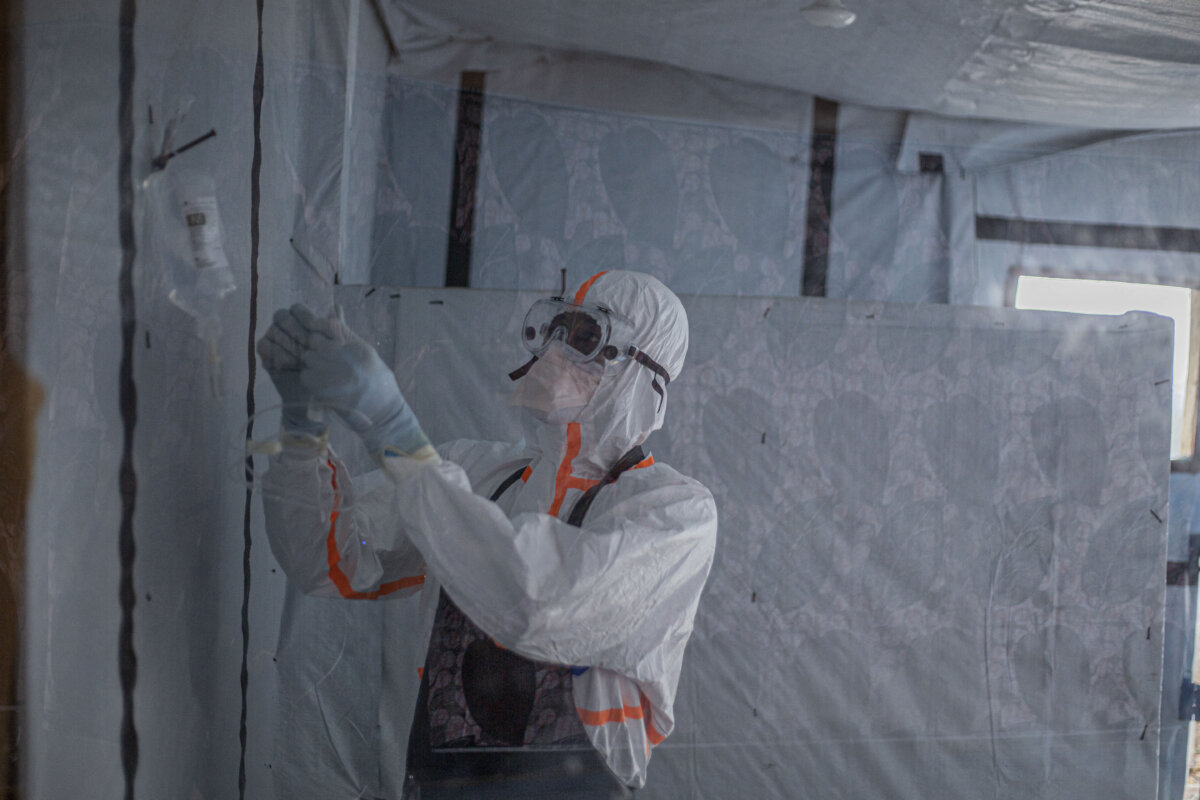

The United States is sending an additional $267 million in “direct life-saving health and humanitarian assistance” to support the response to the devastating Ebola outbreak in Congo.
Senior State Department officials announced the aid on the sidelines of the U.N. General Assembly meeting in New York, and urged other “capable nations to increase burden sharing to meet the urgency of the moment.”
“The Department, in close coordination with the U.S. Centers for Disease Control and Prevention (CDC), and in partnership with the governments of [Congo], Uganda, and other countries in the region, is continuing to mount a rapid and comprehensive response to the Ebola outbreak,” the State Department Office of the Spokesman said in a Sept. 23 statement.
The United Nations has outlined a $2.13 billion aid plan of which 48 percent is funded. U.N. Secretary-General António Guterres said in August this was “thanks in large measure to a major contribution by the United States.” He urged more countries to help fill the $1.1 billion funding gap for the ongoing humanitarian response plan.
The department said the United States remains the largest health and humanitarian provider to the outbreak, which was first detected in May and has claimed at least 3,700 lives as of the U.N. count on Sept. 22. It is the second-most deadly Ebola outbreak on record, following the 2014–16 outbreak in West Africa.
The millions in direct U.S. aid will go toward critical health commodities, specialized Ebola treatment units and health facilities in outbreak areas, additional burial teams, personal protective equipment, and expanded surveillance and contact tracing through trusted parties.
The $267 million takes the total amount of U.S. aid to combat this outbreak to $887 million.
“This additional $267 million fulfills the U.S. government’s commitment at the G7 Leaders’ Summit to provide up to an additional $500 million on Ebola response efforts,” the Office of the Spokesman said.
The efforts, in addition to supporting outbreak countries, are “protecting Americans at home and abroad, and supporting countries’ efforts to contain this outbreak at its source,” the department said.
Additional Aid
The $887 million in direct aid for the Ebola outbreak is on top of existing U.S. contributions to international aid through the U.N. Office for the Coordination of Humanitarian Affairs (OCHA).
Since the start of the second Trump administration, U.S. contributions to OCHA’s aid programs across 21 key countries have reached $3.8 billion.
A $2 million first tranche contribution was agreed to in December 2025 when the Trump administration outlined its “Humanitarian Reset” framework agreement following the U.S. withdrawal from the World Health Organization (WHO) and cuts to its funding.
A second tranche of $1.8 billion was made to OCHA on May 14. Part of this includes $350 million in aid to Congo, Uganda, and South Sudan, the department said.
In addition to aid contributions to the United Nations, the United States, under the Trump administration’s America First Global Health Strategy, has been outlining bilateral global health agreements with partner countries. In February, Washington and Congo signed a five-year health memorandum of understanding under that strategy, with the United States intending to provide up to $900 million to support HIV, tuberculosis, malaria, maternal and child health, and disease surveillance.
The current Ebola outbreak began in Ituri province in northeastern Congo. It quickly spread to Uganda. On May 17, the World Health Organization declared the spread of the virus a public health emergency of international concern.
WHO Director-General Tedros Adhanom Ghebreyesus said during a press conference on Sept. 16 that transmission is declining in the most affected areas of the outbreak epicenter, with the epidemic mostly contained to northeastern Congo.
But he warned that more work was needed. He said the situation wasn’t a single epidemic to manage, but rather “many outbreaks in many places.”
According to the CDC’s situation page, no Ebola cases associated with this outbreak have been reported in the United States, and the overall risk to the U.S. public and travelers remains low.
 Friends Read Free
Copy
Facebook
Tweet
Friends Read Free
Copy
Facebook
Tweet