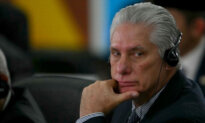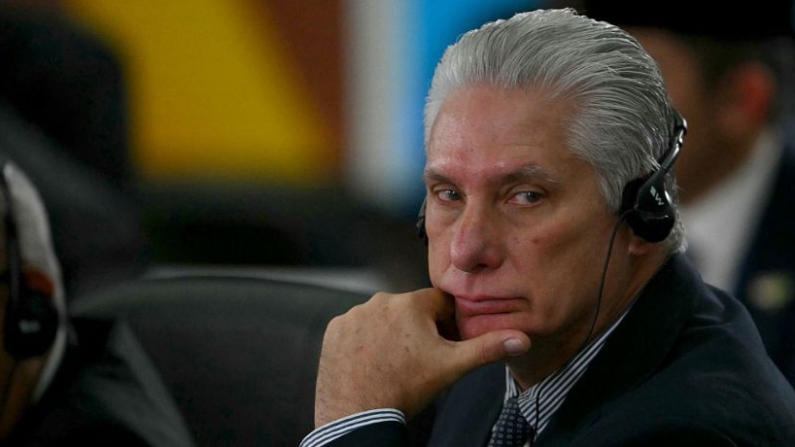
U.S. Secretary of State Marco Rubio restricted visas for Cuban leader Miguel Díaz-Canel Bermúdez and his immediate family on Friday, the fourth anniversary of the July 11, 2021, protests on the island in which Cubans called for freedom for their people from communist rule.
Referred to by Cubans as “11J,” the day was the largest mass protest Cuba had seen since the communists took power in 1959.
“In solidarity with the Cuban people and the island’s political prisoners, the United States is designating key regime leaders under Section 7031(c) for their involvement in gross violations of human rights,” the secretary of state said in a statement issued on July 11.
“We are also taking steps to impose visa restrictions on numerous Cuban judicial and prison officials responsible for, or complicit in, the unjust detention and torture of July 2021 protesters.”
The announcement by Rubio, who is himself Cuban American, is part of a toughening stance toward the regime by the Trump administration, which announced the sanctions on June 30 through the Presidential Memorandum on National Security.
“Four years ago, thousands of Cubans peacefully took to the streets to demand a future free from tyranny,” Rubio recalled in Friday’s statement. “The Cuban regime responded with violence and repression, unjustly detaining thousands, including over 700 who are still imprisoned and subjected to torture or abuse.”
On July 11, 2021, Cubans of all ages armed with pots and pans took to the streets of several cities across the island, including Havana, to protest human rights abuses, lack of freedom, and the worsening economic situation in the country perpetuated for more than six decades under communist control.
Section 7031(c) of the U.S. State Department Appropriations Act authorizes the secretary of state to deny visas or restrict entry into the United States to foreign public officials and their immediate family members if there is credible information that they are involved in significant corruption or human rights violations.
This is the first time the U.S. government has sanctioned Díaz-Canel and his immediate family under Section 7031(c).
In addition, Cuban Army Corps General and Minister of the Revolutionary Armed Forces of Cuba Álvaro López Miera and his immediate family were sanctioned under the same section, as was Cuban Interior Minister Lázaro Alberto Álvarez Casas and his immediate family.
The secretary of state also reported that the department updated the List of Restricted Properties in Cuba and the List of Prohibited Lodging in Cuba with 11 properties linked to the Cuban dictatorship, with the purpose of preventing U.S. funds “from reaching the island’s corrupt repressors.”
The list includes a new 42-story luxury hotel called “Torre K” in Havana, operated by Spanish company Iberostar. The restriction is effective as of July 14.
On July 9, Rubio expressed his support for the Cuban people on the island ahead of the fourth anniversary of 11J.
“I want you to know that from here you have our support, the support of our embassy, the support of a community in the US that looks at you every day and knows that you are suffering from shortages of medicine, electricity, and more,” the secretary said in a message that Cuban journalist Mario J. Pentón posted on X.
He added that it is well known that the situation of Cubans on the island “is the result of a regime that simply does not know how to govern, does not know how to run a country, and is only interested in staying in power.”
 Friends Read Free
Copy
Facebook
Tweet
Friends Read Free
Copy
Facebook
Tweet