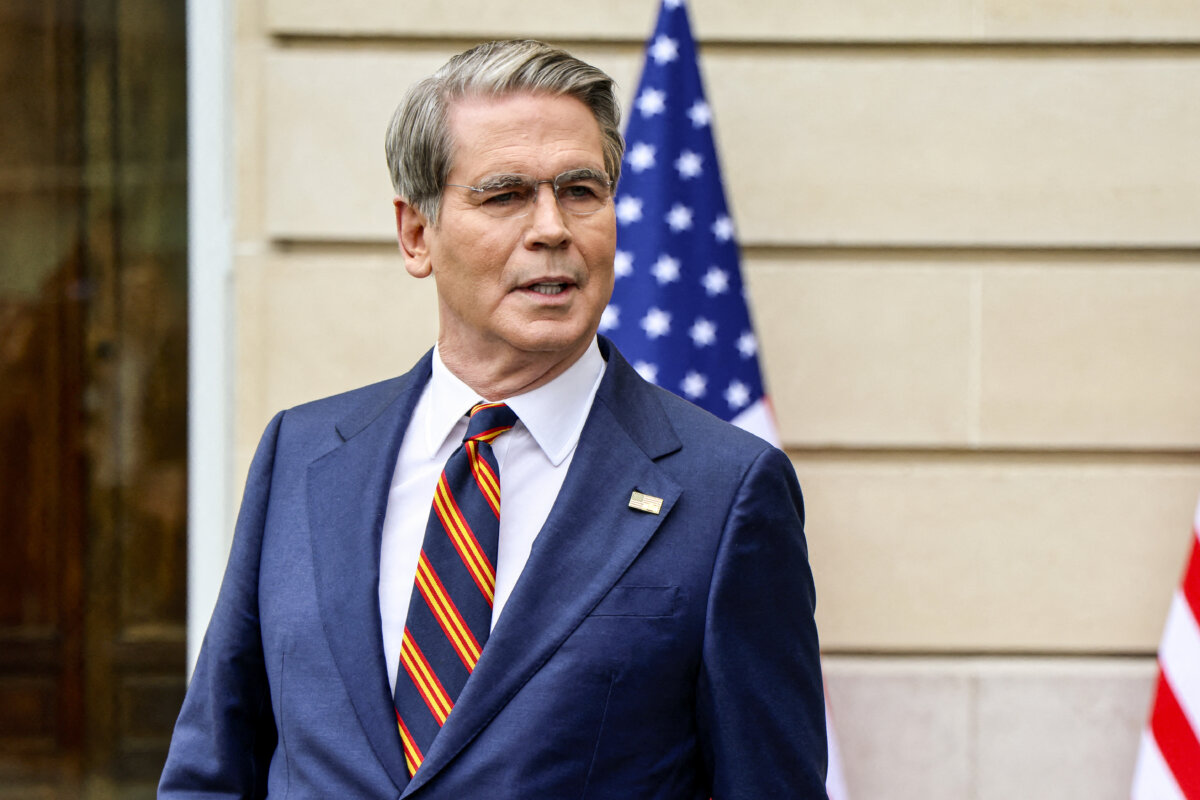

PARIS—U.S. Treasury Secretary Scott Bessent used the meeting of finance ministers from the G7 group of leading industrial nations in Paris on May 18 and May 19 to press Washington’s allies to intensify the economic campaign against Iran. European finance ministers, meanwhile, urged him to help bring the U.S.- and Israeli-led war to an end, warning that its economic fallout was spreading across the continent.
The finance ministers of Germany, France, and Italy, joined by the European Commission, pressed Bessent during a closed-door session on the economic consequences of the conflict. The war with Iran, they said, was driving a surge in oil prices across the European Union, weighing on growth and raising the risk of a food crisis.
Benchmark crude has traded above $100 per barrel since the strikes on Iran began on Feb. 28, and the International Monetary Fund has warned that the disruption could slow global growth, raise inflation, and increase the risk of recession.
A Strategic Divide
French Finance Minister Roland Lescure, who chaired the meeting, told reporters, “It’s not only the Europeans who think that: We all think [the war] must end as soon as possible,” noting that reopening the Strait of Hormuz would help mitigate the economic fallout for everyone. A coordinated release of 400 million barrels from strategic reserves last month tempered prices only temporarily.
German Finance Minister Lars Klingbeil said the war, which Germany was “not responsible for,” was being felt at German gas stations, and called for a quick negotiated solution and for the Strait of Hormuz to remain open. Ahead of the meeting, he described the G7 as the appropriate forum for discussing an end to the conflict, noting that Europeans “rely on cooperation rather than confrontation.”
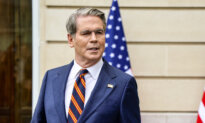
Meanwhile, Bessent repeatedly urged his counterparts to intensify the economic pressure campaign against the Iranian regime, including through additional sanctions.
On the sidelines of the ministerial, Bessent used a keynote address at the “No Money for Terror” conference in Paris to call on G7 partners to “stand with [the United States] in full measure” against Iran. The United States “too often … [seems] to be alone in [its] resolve” against terrorism, especially from Iran, he said.
He urged European partners to designate Iran’s financiers, close its bank branches, and dismantle its proxies, and said the Treasury would review its sanctions list to remove outdated designations and focus on the most sophisticated financing schemes.
Iran’s Reach Into Europe
Pascal Le Pautremat, a French professor of geopolitics at the French Catholic University of the West, told The Epoch Times that Bessent’s frustration was warranted.
He recalled that in the 1970s and 1980s, counterterrorism experts considered Iran “one of the most feared and formidable actors,” with European states “in direct contact with Iranian sleeper networks.”
That risk has resurfaced, he told The Epoch Times, with Tehran able to “conceal its action by recruiting proxies” drawn from organized crime and narcotics networks in Western European countries and paid to carry out targeted killings.
The professor described the Islamic Republic as a regime whose “capacity to do harm” since 1979 has been “appalling,” and one that has inscribed in its constitution “the physical and total destruction” of the state of Israel.
The Iranian missile system, he said, “places Europe within range,” but the more insidious threat is a radiological “dirty bomb,” a few kilograms of plutonium coupled with conventional explosives.
European reluctance to follow Washington’s lead, Le Pautremat argued, reflects above all “the fear of reprisals on the terror front” should Europeans decide to join the United States in the war against Tehran. Meanwhile, “various national political party representatives are in denial” about the overall threat posed by Iran and its proxies, he said.
Olivier Roy, a professor at the Robert Schuman Centre for Advanced Studies of the European University Institute in Florence, Italy, does not share this view. Iran’s nuclear program poses a threat to Israel but not to Europeans, he told The Epoch Times in an interview, arguing that the scenario of Iran launching a nuclear war in Europe is not credible “since nuclear deterrence works.”
As for the financing of terrorism, Roy said, it is essentially regional, channeled to the Hezbollah and Hamas terrorist groups in the Middle East. However, major terrorist attacks in Europe are carried out by the al-Qaeda and ISIS terrorist groups, not by Iran, and the brutal assaults on Jewish targets have remained largely “low-tech,” he said. As such, they are not perceived as a strategic threat by European capitals, Roy said.
A Split Over Russia
Disagreement at the G7 also extended to Russia. Bessent extended a pause on U.S. sanctions against Russian oil exports until mid-June, a step that Washington said would increase global supply and lower prices for buyers such as China and India, but which will also raise Kremlin revenue.
“Now is not the time to relax sanctions on Russia,” European Commissioner for Economy and Productivity Valdis Dombrovskis said, noting that the G7 was “not always 100 percent aligned” with the United States.
All G7 members, including the United States, signed a final statement acknowledging the economic costs of the conflict and the need to reopen the Strait of Hormuz.
U.S. Secretary of State Marco Rubio said on May 22 that there was “slight progress” in U.S.–Iran negotiations to end the conflict, although he voiced cautious optimism: “I don’t want to exaggerate it, but there’s been a little bit of movement, and that’s good.”
 Friends Read Free
Copy
Facebook
Tweet
Friends Read Free
Copy
Facebook
Tweet