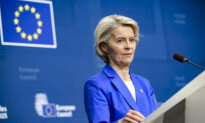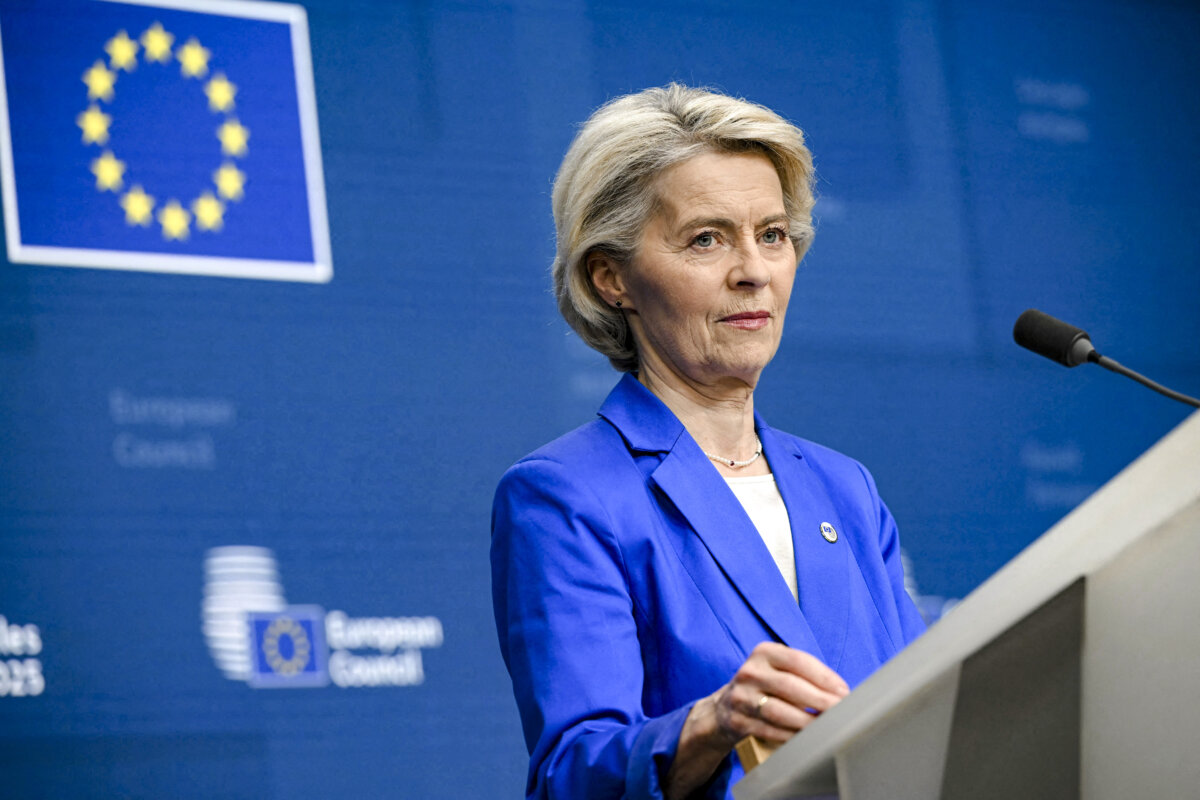
European Commission President Ursula von der Leyen proposed on Wednesday that Canada become the European Union’s first associate member, using her State of the Union address to argue that the bloc must “forge its own path” in what she described as “an openly hostile world.”
“I would like to work with you on opening the door for Canada to be the first associate member of the EU,” Von der Leyen told Canadian Prime Minister Mark Carney, who attended the speech as a guest of honor in Strasbourg, France, and is due to address the European Parliament on Thursday.
Such a membership category does not currently exist under EU treaties.
Von der Leyen portrayed Canada and Europe as natural partners confronting many of the same global challenges.
“We see the world with the same eyes: from AI to climate change, from the Arctic to geopolitics,” she said. “But above all, dear Mark, Europe and Canada believe in democracy.”
The two “share one ocean, one set of values, one way of seeing the world,” she said, calling for the relationship to evolve beyond the CETA trade agreement into an “Alliance for the Future.”
“It is a message that both the EU and Canada are sending to the United States at a time of hostility with the Trump administration,” Rob Roos, a former member of the European Parliament and political writer, told The Epoch Times.
“Canada is not part of the European continent. This only goes to show that the so-called European project is in fact a globalist one, driven above all by the pursuit of power,” he added.
‘Too Often From the Inside’
A significant part of Von der Leyen’s address focused on what she described as “a battle of narratives” being waged against Europe, with threats coming not only from foreign actors but also from political forces within the bloc.
Legitimate concerns, she said, “are being weaponized to drive a wedge between us. Sometimes from the outside, and too often from the inside. But our path is clear. Building an independent Europe that has the power to act. Nothing can divert us from this.”
“Whether it is the ultranationalists or the anti-Europeans, whether it is Russian interference or disinformation, the names may be different, but their goal is the same,” she said.
“They despise our values, and they want to shatter our European unity.”
Her comments came 10 days after the anti-immigration Alternative for Germany secured 43.8 percent of the vote in the Saxony-Anhalt state election.
Right-wing and Eurosceptic politicians have disputed the idea that opposition to Brussels amounts to opposition to Europe.
They have sought to distinguish between Europe as a civilization made up of sovereign nations and the European Union as a political and bureaucratic institution.
“Von der Leyen mentions the ‘EU’ only three times in her speech, yet uses the word ‘Europe’ 82 times. She is deliberately conflating the two, when the first is a technocratic structure and the second a civilization. Opposing Brussels does not amount to opposing Europe,” Roos said.
“Through their open-border, socialist and environmentalist policies, these European elites have built their own opposition. Now that people are suffering and rebelling against those policies, the elites accuse them of being anti-European,” he added.
Von der Leyen did not mention Viktor Orbán by name but pointed to the end of his 16 years in power following Hungary’s April election, won by Péter Magyar’s Tisza party, as evidence that political trajectories can be reversed.
“Just look at Hungary,” she said. “They chose democracy. They chose Europe.”
She said “years of backsliding have started to be reversed” and that “billions of euros” in investment had been unlocked by the EU following the election.
For Von der Leyen, the result demonstrated that “nothing is inevitable.”
The commission president also stated that European democracies are confronting “disinformation and foreign interference seeking to divide us.”
“This is cognitive warfare,” she said.
Europe’s openness to debate is “being weaponized by our opponents to distort debate and truth,” she argued, pledging to strengthen the European Centre for Democratic Resilience launched last year.
Protecting Children Online
Von der Leyen then turned to children’s use of social media.
Democracy, she said, “is about giving people the power to choose the society they want to live in,” but “much of this power has been taken out of the hands of parents.”
Young Europeans spend four to six hours a day looking at screens, she said, “pulled ever deeper into feeds designed to keep them scrolling.”
“What we are witnessing is a great capture of our children.”
The commission will propose an “EU Kids Act” on Thursday, Von der Leyen said, setting out age restrictions for access to social media.
“No social media under the age of 13. No personal account under the age of 15,” she said.
Critics have raised concerns that such measures could expand government control over online activity, particularly through age-verification requirements that they argue could lead to the implementation of digital identification.
Virginie Joron, a National Rally member of the European Parliament, told The Epoch Times in June that she was highly suspicious of the European Commission’s push to “protect the children.”
Joron cited a February 2026 report by the U.S. House Judiciary Committee pointing to the existence of a censorship apparatus in Europe.
She also pointed to what she described as “administrative harassment” targeting X.
Rather than imposing broader restrictions, Joron said authorities should provide parents with “simple and effective solutions” enabling them to control their children’s online activities.
‘Ceuta Is Spain. Ceuta Is Europe.’
On migration, Von der Leyen pointed to a summer that had put Europe’s borders under pressure from the east to the Mediterranean, including what she called “the crisis in Ceuta.”
More than 60,000 people swam or walked from Morocco into the Spanish enclave over two days in late July, according to local officials.
The city’s president later said about 100 people had died.
“Ceuta’s border is a European border. Because Ceuta is Spain. Ceuta is Europe. And Europe will be there for you,” Von der Leyen said, addressing Spaniards directly.
She presented the EU’s Pact on Migration and Asylum as “the only solution,” pointing to a 55 percent decline in illegal arrivals over the past two years.
At the same time, she acknowledged that “our tools need to evolve.”
Von der Leyen announced a new “European Emergency Response Framework” designed for “scenarios when mass movements are engineered and weaponized.”
The mechanism would permit “time-limited and strictly defined flexibility in standard procedures.”
“We will never compromise on protecting our borders,” she said. “It is we, Europeans, who decide who comes to our union and under what circumstances. And not the smugglers and the traffickers.”
She stated that Europe needs to “facilitate safe, legal migration.”
‘Let’s Make Europe’s Future Electric’
On the economy, Von der Leyen described “kickstarting Europe’s economy” as her “No. 1 priority” and pledged to complete an overhaul of the EU single market by the end of next year.
Europe “cannot remain an industrial powerhouse if its energy prices are structurally too high,” she said, tying the continent’s economic competitiveness to greater energy independence.
“For this independence, we need to electrify Europe,” she said.
Von der Leyen set a target of doubling electricity’s share of European energy consumption by 2040, drawing on renewables, nuclear power, and biomethane on what she called a “technologically neutral” basis.
After a “summer of truth” in which fires burned 660,000 hectares, she also reaffirmed the EU’s climate agenda.
“Europe can, must and will stay the course on its climate targets.”
Artificial intelligence represents another “tipping point,” Von der Leyen said, presenting the technology as both an economic opportunity and a potential security threat.
She warned that frontier models “will allow hacking on a level we never thought possible” and called on AI labs to “pace the frontier” as they develop self-improving systems. She also announced that the commission would unveil new industrial AI initiatives in November.
“We want AI with human agency,” she said.
Words Good, But Deeds Better
Von der Leyen also adopted a tougher tone on Europe’s economic relationship with China, pointing to a trade imbalance that she said had become unsustainable.
The EU’s trade deficit with China “is now 1 billion euros a day” and “has reached a tipping point,” she said.
“Some say the second China shock is looming. But it’s already here,” Von der Leyen said. “It leads to deindustrialization in the industrial heartlands of Europe. This is unsustainable.”
She also warned about “dangerous dependencies” on Beijing, noting that Europe relies on China for more than 80 percent of its supply of many critical raw materials.
To reduce that exposure, Von der Leyen announced the creation of a European Corporation on Critical Raw Materials that would stockpile strategic resources.
She said negotiations with Beijing “must now lead to results,” while signaling that Brussels was prepared to take further measures if the imbalance persisted.
“We will use all the tools at our disposal to rebalance our relationship. Words are good. But deeds are better.”
Supporting Ukraine, Palestinians
On foreign policy, Von der Leyen pledged stronger support for Ukraine through the coming winter, including humanitarian and energy assistance, additional air defenses, and a joint European-Ukrainian missile-defense system.
She also vowed to tighten enforcement of sanctions against Russia.
On the Middle East, she called Israel’s E1 settlement project “unacceptable” and lamented the EU’s inability to agree on a unified response.
She said Europe had pledged nearly 1 billion euros to rebuild Gaza and support the Palestinian Authority, stressing that “Europe is leading the way in supporting Palestinians.”
She also reaffirmed the EU’s support for Israel’s right to defend itself and reiterated its commitment to a two-state solution.
During her speech, the European Commission president also hailed a “Europe that stands up for each other,” citing its support for Ukraine “as it fights for its future,” for Greenland “when it was threatened,” and for European democracies “when drones, hybrid attacks or disinformation” target them.
 Friends Read Free
Copy
Facebook
Tweet
Friends Read Free
Copy
Facebook
Tweet