

Both the Canadian men’s and women’s curling teams have been at the centre of controversy and official warning at the 2026 Winter Olympics in Italy. Here’s how it started, and why it matters.
Marc Kennedy
Canada’s men’s team was initially accused of wrongdoing in a match against Sweden on Feb. 13 by Swedish curler Oskar Eriksson. He said Canada’s Marc Kennedy touched the stone after it had been released down the ice. Kennedy responded by engaging in an expletive-laden outburst at Eriksson.
He later apologized for his choice of words, saying he could have handled himself better in the moment, but said he didn’t do anything wrong.
“We’re human out there,” Kennedy said, adding that he felt like he was defending his teammates and himself at a tense time. He said the Canadians may have been the target of a “premeditated” attack by the Swedish team.
Footage from the match appeared to show Kennedy touching the granite stone with his finger after the stone had been released. Asked about the footage, Kennedy said, “Yes, I’m not even going there. I’ve never even known that to be a concern before. It’s never ever come up in conversation.”
Sweden’s Eriksson said he “slept good, I’m not sure about [Kennedy],” and said he decided to call out Kennedy because he had seen him make the same move in the past.
“If we see something that’s not following the rules, we tell the opponents or the official. This time we did both,” Eriksson said.
Canada won the match against Sweden 8–6.
World Curling said it issued a verbal warning to Canadian officials about the language used during the game, and also provided an update on the rules.
In a statement issued the day after the incident, the organization said it was “made clear” to the officials that further inappropriate behaviour would result in “additional sanctions,” which could include the offending player being suspended.
World Curling’s Feb. 14 statement said the organization “does not currently use video replay to re-umpire game decisions,” adding that “decisions made during a game are final.”
The organization said umpires are situated at the end of each sheet but “cannot see every delivery infraction.” It said that when umpires are made aware of delivery issues, they are “positioned to observe the delivery for three ends.” However, during that period of observation in the Feb. 13 game, “there were no violations recorded,” World Curling said.
The statement said that when delivering a stone, a player can touch the handle as many times as they wish before the stone reaches the hog line, but touching the handle after the stone has reached the hog line is not permitted and will result in the stone being removed from play.
Rachel Homan
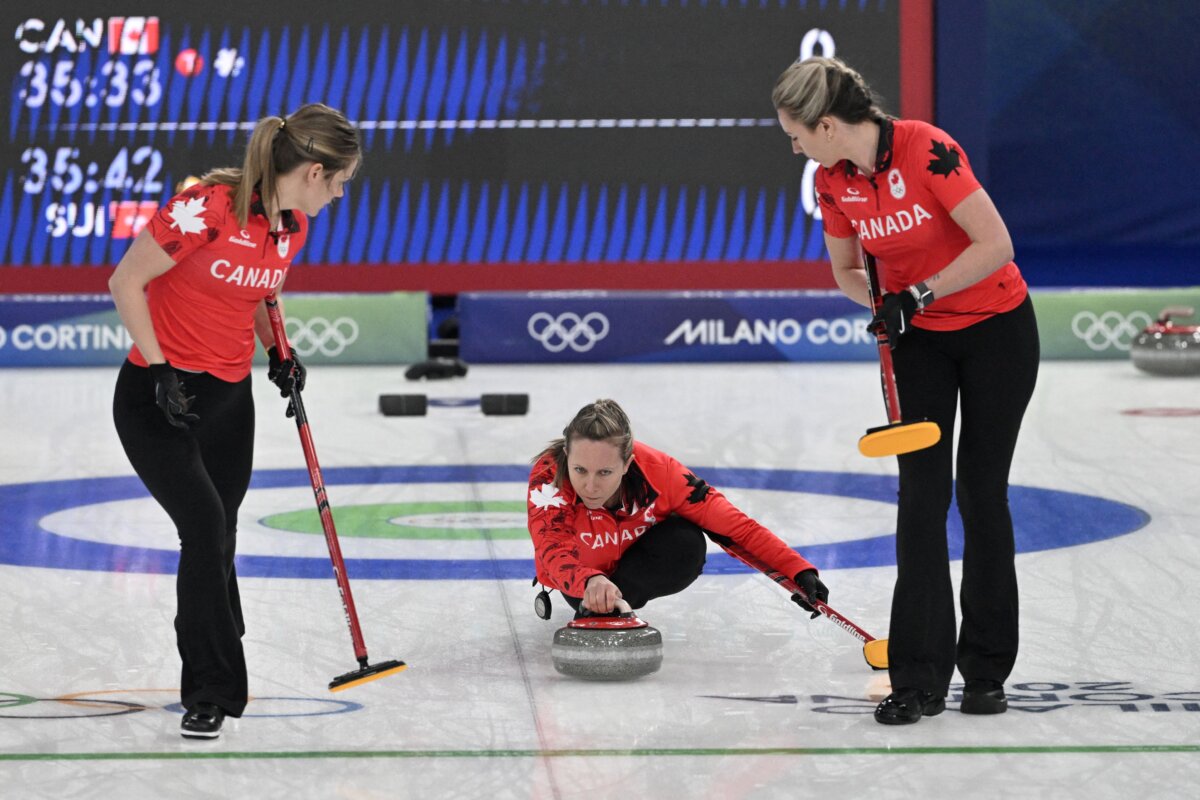
That is exactly what happened to Canada’s women’s curling team on Feb. 14 in a match against Switzerland. Canadian skip Rachel Homan was accused of double-touching the stone during the game. An umpire stopped play and removed the stone from the ice. Homan denied the allegation.
The Canadians lost the game 8–7.
Umpire Move
As a result of the men’s curling controversy, World Curling said in its Feb. 14 statement that two umpires would move between all four sheets to observe deliveries, beginning with that afternoon’s session.
However, the organization quickly reversed its decision the next day after discussions that it said it had with representatives from the competing national Olympic committees. In a statement on Feb. 15, World Curling said two umpires would remain available to monitor deliveries but the competing teams would need to request the monitoring. The protocol change would begin with the evening session on Feb. 15, it said.
British Curling Team
A British team has also been accused of the same conduct as the Canadian teams, with officials saying that curler Bobby Lammie touched a stone a second time after releasing it in a round robin match against Germany on Feb. 15. Britain won the match 9–4.
The Associated Press contributed to this article.
 Friends Read Free
Copy
Facebook
Tweet
Friends Read Free
Copy
Facebook
Tweet