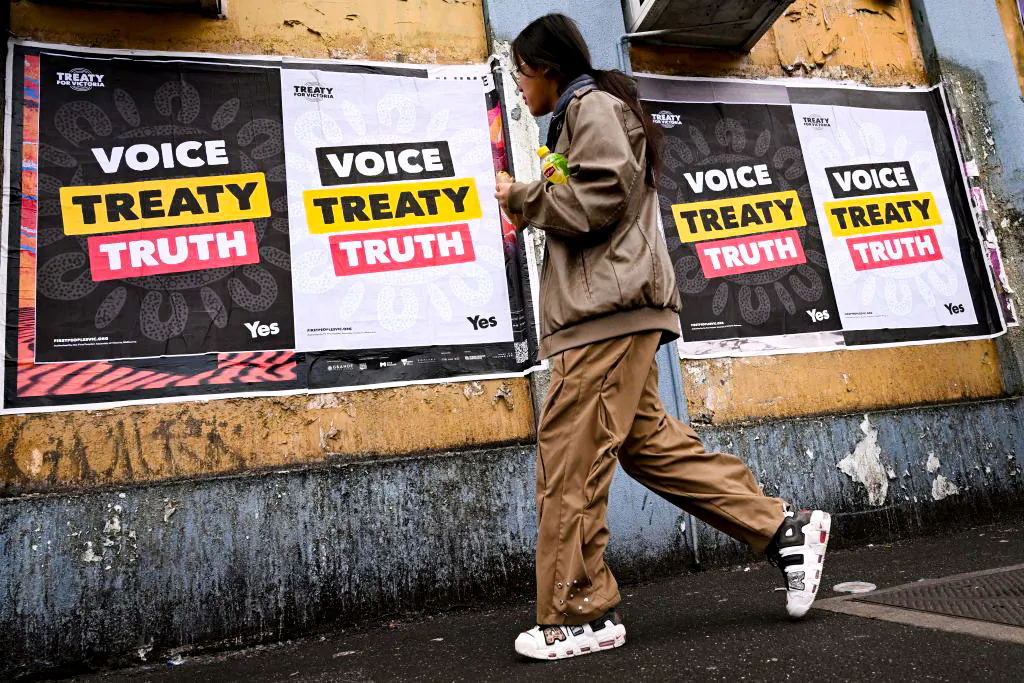
The Victorian Labor government has finally introduced its Indigenous treaty bill to state parliament on Sept. 9.
While explicit details on the treaty remained under lock and key for months, some of the major initiatives were finally revealed.
A treaty is an official agreement between Indigenous communities and the government, and is aimed at addressing perceived concerns about historic dispossession and loss to Aboriginal people.
The solutions include educating the populace about historical wrongs against Aboriginals, cultural recognition initiatives, political positions, and in some cases, reparations.
The Victorian plan is expected to cost $300 million (US$196 million) from its start until 2028, and the treaty is expected to be reviewed every five years.
Some reports have listed the total inclusive cost of establishing and running the treaty at more than $586 million to the Victorian taxpayer by 2029.
Here is what we know so far, according to recently released framework.
New Authority to Represent Indigenous Victorians
The Statewide Treaty Bill will replace the existing First Peoples’ Assembly of Victoria with a new authority called the “Gellung Warl” council to be made up of 33 representatives.
Only Indigenous Victorians will be able to vote on members, and the council will be supplied with $70 million in taxpayer funding every year.
The state will retain the final say on decisions voted on by the council.
Members will have the ability to make decisions on issues impacting Aboriginals, have the right to request Aboriginal quotas, and facilitate the development of an Indigenous institute to improve leadership ability.
The body will have a dedicated room in state parliament.
Power to Veto Appointments
The new council will have the power to veto appointments to key government departments, including fire departments, police and judiciary, if they deem the person is lacking in cultural heritage experience.
It will not have the power to appoint candidates however.
New Fund Overseeing Infrastructure
A new infrastructure fund will be created for Aboriginal-led community groups and run by the council.
In addition, there will be a new infrastructure funds overseeing hundreds of millions of dollars which will be involved in the process of determining the Victorian Honour Roll during NAIDOC Week.
State Apology and Reparations
A future apology to Aboriginal people is likely to be presented in state parliament.
The treaty is also expected to take the stance that the “state’s colonisation” has not ended because Aboriginal people still face ongoing issues in child protection, justice, health, education and politics.
AAP reported that Yoorrook has called for support for “post-colonisation pain” by way of land, money, tax cuts and financial benefits.
The agreement will allow the forming of individual treaties with Victorian Indigenous groups and the state, which some have speculated could set the scene for the payment of reparations.
Renaming Natural Landmarks
Under the place naming guidelines, Gellung Warl will be able to demand natural landmarks—like waterways, waterfalls, and parks—be known only by its Aboriginal name, omitting the Western name entirely.
It will have the power to decide if a place can be known as both its Western and Aboriginal names.
Changes to the Curriculum, Community
The Gellung Warl council along with the Victorian Curriculum and Assessment Authority (VCAA) and the Victorian Aboriginal Education Association Inc (VAEAI) will together work to create a new school curriculum from Prep to Year 10.
“Truth-telling” which views Australia’s history through an anti-colonial lens, will likely feature prominently.
The Yoorrook Justice Commission’s landmark final report (pdf) handed down in July is also expected to be incorporated as a basis for curriculum changes.
The concept of “truth-telling” will also be spread to Victoria’s regions and towns, and public servants will be trained in Indigenous culture.
Public sector workers will now face KPIs on cultural competency.
The 230-page Yoorrook report is expected to underpin much of the government’s overall response.
It frames the history of Victoria around “invasion” and Indigenous “resistance.”
Further, European settlement is referred to as “a war waged not just on bodies, but on memory, spirit and continuity.”
Just a Starting Point
The treaty document describes the initiative as a form of shared rule between the state, Aboriginal people, and Gellung Warl.
According to the treaty document, “ongoing, state-wide treaty making” will enable Gellung Warl and the state to continue to negotiate the “transfer” of decision making, rule making, advisory and other powers from the government to Gellung Warl.
What They’re Saying
In a statement, Victorian Premier Jacinta Allan, who faces a 2026 election, said developing Australia’s first treaty was a “major milestone.”
“The first negotiated Statewide Treaty Agreement brings together First Peoples, through the First Peoples’ Assembly of Victoria, and the Victorian government, to build a new relationship based on respect, trust and integrity,” she said.
“It acknowledges our past and is a chance for all Victorians to move forward together.”
Leader of the Opposition Brad Battin says he will not support the treaty.
In a statement in June, Battin said the move was driven by an “ideological agenda” and did not adequately address the issues of the state.
“My focus remains in making lives better for all Victorians,” he said.
On Sept. 9, Battin told media he did not need a treaty mechanism to consult with Indigenous Australians.
Libertarian MP David Limbrick has in the past expressed concerns over a treaty and what it could mean for Victoria.
“When I talk to many constituents about this issue, their reaction is, ‘Didn’t we vote on this in 2023?’ And I’ve got to say I feel the same way,” he told Sky News.
“There’s a lot of questions about what’s going to actually happen with this, like what does a treaty actually look like and I think that a lot of Victorians don’t like the idea of having this sort of race based distinction happening in parliament and a lot of people are opposed to it.”
Gary Johns, head of Indigenous research institute, Close the Gap, was heavily critical about the scale of authority being handed over.
“I have read the bill and although the powers of the Aboriginal ‘parliament’ are limited, in the hands of a Labor government they will cost Victorians dearly,” Johns told The Epoch Times.
“This money and influence will line the pockets of an elite group of remote descendants of the original inhabitants.”
Johns also warned changes to the education system would make Victorian children “feel ill at ease about their state.”
 Friends Read Free
Copy
Facebook
Tweet
Friends Read Free
Copy
Facebook
Tweet