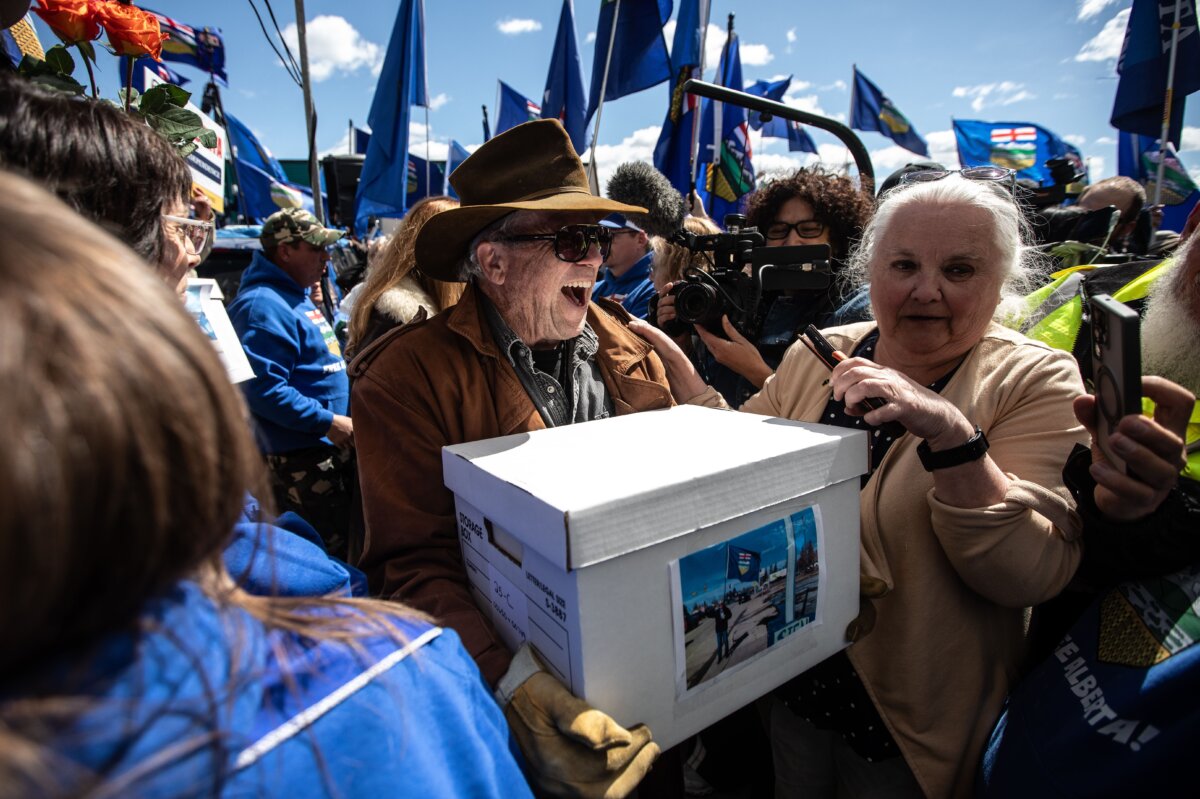

Alberta independence organizers say they have delivered nearly double the amount of signatures required to trigger a referendum, but a number of steps remain before a vote can be held.
The verification of the petition’s 301,620 signatures by Elections Alberta is temporarily blocked while the Court of King’s Bench hears arguments from multiple First Nations that say the petition for Alberta’s separation from Canada violates their treaty rights.
First Nations including Sturgeon Lake Cree Nation, Athabasca Chipewyan First Nation, and the Blackfoot Confederacy say Alberta can’t move toward a referendum without fulfilling its duty to fully consult them first, because doing so would threaten both treaty rights as well as constitutionally protected indigenous rights.
Justice Shaina Leonard granted a one-month stay on validation of the petition on April 10. The stay prevents the province’s chief electoral officer from certifying the results of the petition or referring the matter to the minister of justice until the legal matter is resolved. Leonard is expected to rule further on the case this week.
Verification and Vote
If the court allows the process to proceed, it will be up to Elections Alberta to verify that the petition contains more than the required 177,732 signatures. This is the threshold requirement for initiating a referendum and represents 10 percent of the votes cast in the last provincial election.
This process could take a number of weeks, as the agency validates petition sheets, names and addresses, and voter eligibility, as well as verifying that the signatures were collected inside the legal time period, which ran from Jan. 3 to May 2.
Alberta Premier Danielle Smith has consistently said she does not support Alberta seceding from Canada, but has also said she would allow the referendum question to be one of nine other questions scheduled for a referendum on Oct. 19 if it meets the legal requirements.
If Albertans vote to secede by a simple majority of at least 51 percent, the matter would then move to negotiations with the federal government and indigenous nations before pursuing the practicalities of full secession.
A recent Leger poll released on May 4 surveyed 1,003 Albertans adults between April 3 to April 6 and found that 23 percent backed separating from Canada, while 64 percent opposed it.
Clarity Act
A potential secession from Canada would involve negotiations under the Supreme Court of Canada’s Quebec Secession Reference as well as the federal Clarity Act.
Parliament would debate under the Clarity Act whether the referendum had resulted in a “clear majority” voting on a “clear question” and whether the results of the referendum were decisive enough to indicate that.
The Supreme Court of Canada’s 1998 landmark Reference Re: Secession of Quebec judgment established that no province has a legal, unilateral right to separate from Canada.
A clear referendum result could compel the federal government to negotiate, but such talks would involve addressing several matters such as borders, federal assets, currency, debt, and indigenous rights and treaties.
Smith, Carney to Meet
Prime Minister Mark Carney has responded to the news of the reported collection of more than 301,000 signatures on the independence petition by referencing the Clarity Act and the ongoing legal dispute from First Nations.
“Any referendum, in any part of Canada needs to be consistent with that,” he said, noting that his government will focus on “making the country work” for all Canadians and pursuing a “spirit of cooperative federalism.”
Carney is set to meet with Smith in Ottawa later this week as the question of Alberta independence and the October referendum hangs in the air.
 Friends Read Free
Copy
Facebook
Tweet
Friends Read Free
Copy
Facebook
Tweet