

A group of companies that produce around a third of the world’s mining and metals output has used the World Economic Forum (WEF) meeting in Davos to commit to a “nature positive” future, laying out a five-point plan to halt the negative impact on biodiversity by 2030.
With EVs driving demand for more and larger batteries, a 20-fold surge in demand for nickel and cobalt mining is expected by 2040, while the need for copper is projected to double by 2050, despite widespread recovery and recycling of such metals.
The companies—which include major global firms such as Alcoa, Anglo American, BHP, Glencore, and Rio Tinto—are members of a WEF subgroup ICMM, a sustainable mining platform.
“The mining industry owes its very existence to nature. At a time when the health of our natural world is in peril yet the demand for critical minerals is set to soar, we have committed to significant collective action to help create a nature-positive future,” said ICMM President and CEO Rohitesh Dhawan.
“These commitments build on the significant individual goals and actions of ICMM members over several decades, including habitat conservation, species protection, and landscape restoration.”
5 Commitments
The five main commitments the companies have pledged in a statement to uphold include protecting pristine natural areas, avoiding mining and exploration in World Heritage Sites or legally protected areas (a pledge they already made in 2018), and making sure there is at least no loss of biodiversity at all mining sites by the time they finish, compared to a 2020 baseline.
The miners will also collaborate with businesses across the value chain to halt and reverse the loss of biodiversity, and restore and enhance landscapes around operating sites—something most already do.
More ambiguous is an undertaking to “change the fundamental systems that contribute to nature loss.”
“These commitments apply to activities across all four realms of nature—land, freshwater, oceans, and atmosphere—leveraging companies’ areas of influence, from their direct operations, value chains, and wider landscapes, through to creating the conditions required to achieve systems transformation,” the announcement said.
Mining Operations to Shrink Amid Soaring Demand for Minerals: BHP
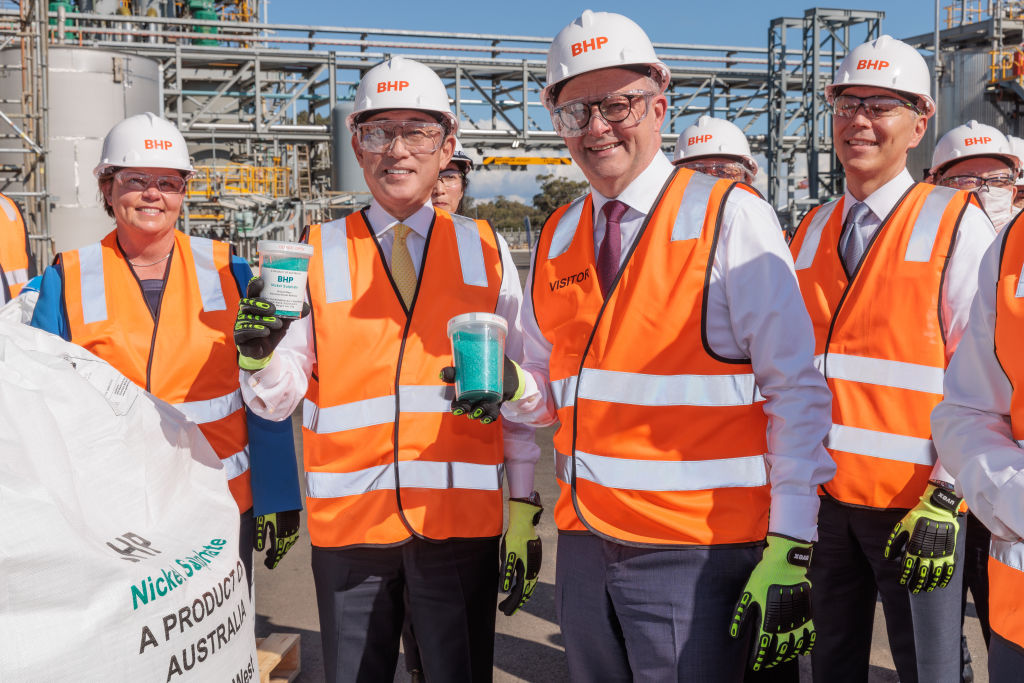
BHP CEO Mike Henry told a WEF forum that miners had to extract significantly more out of existing mines, in addition to finding and developing new sites. And he warned that any new mines were likely to come onstream slowly, be smaller, and produce lower grade materials.
A larger number of smaller mines would lead to “unintended negative impacts on water, biodiversity, local communities, and so on”, he said.
That meant the industry had to take more risks.
“Over the medium to long term, the mining industry has to get better at innovating and taking a bit more risk in deploying innovative technologies,” Mr. Henry said, citing better use of data, artificial intelligence, and new technology.
Announcing its participation in Davos, ICMM said it would look at “finding ways to reinstitute a collective sense of agency and to turn defensive measures into proactive, vision-driven policies and business strategies will be at the heart of the meeting. The magnitude of current crises and the potential of future ones demands no less.”
Issues With Environmental Regulations
In Australia, enforcement of environmental obligations relies heavily on unverified self-reporting by mining companies.
For instance, the Western Australia Auditor General’s 2022/23 report into Compliance with Mining Environmental Conditions (pdf) concluded that the two government monitoring and enforcement entities (DMIRS and DWER) were “not fully effective in ensuring mining projects comply with conditions to limit environmental harm.”
“Their monitoring and enforcement currently provide a narrow view of operator compliance and do little to deter operators from breaching conditions,” noting that “despite growth in the mining sector, the entities have reduced planned monitoring activities, shrinking planned inspection programs by 60 percent or more over the last five years.”
Late last year, WA’s Environmental Protection Authority announced a “rigorous” assessment of U.S. mining giant Alcoa’s bauxite operations, prompted by concerns about its impact on Perth’s drinking water and the state’s jarrah forests.
Meanwhile, a New South Wales Upper House Committee changed a recommendation that initially described the assessment and approvals process for the Cadia gold mine at Orange as being “not fit for purpose” to say it was “fundamentally sound.”
And in Victoria, a mining company was accused of writing submissions in support of its proposal for a new sand mine, while claiming they were authored by residents.
An analysis of 62,381 pre-operational, operational, and closed mines around the world, carried out in 2020, found they potentially impacted about 49.9 million square kilometres of land, assuming potential environmental impacts within a 50-kilometre radius.
About 82 percent of those mines were extracting minerals seen as essential for a “clean energy” transition—including copper, gold, lithium, and 28 other elements.
Eight percent of the impact zone overlapped with recognised protected areas, such as national parks; a further 16 percent covered wilderness areas; and another 7 percent included key biodiversity areas, like important bird breeding sites.
 Friends Read Free
Copy
Facebook
Tweet
Friends Read Free
Copy
Facebook
Tweet