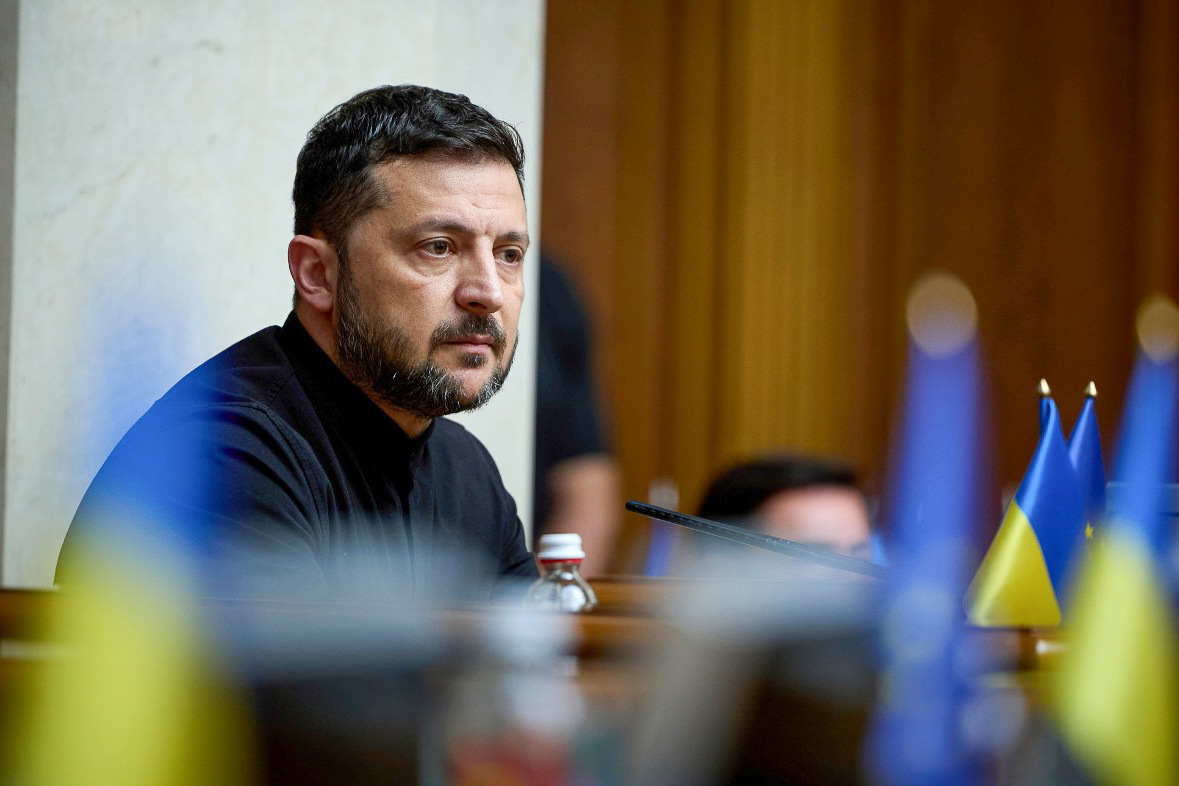

Ukrainian President Volodymyr Zelenskyy on Thursday submitted a new bill that would restore the independence of Ukraine’s anti-graft agencies after a law passed earlier this week provoked protests from Ukrainians and criticism from the European Union.
Ukraine’s two main anti-corruption bodies, the National Anti-Corruption Bureau of Ukraine (NABU) and the Specialized Anti-Corruption Prosecutor’s Office (SAPO), welcomed the new bill, which they said they helped draft, saying it guarantees their independence.
The law that was at the center of the protests was signed on Tuesday and would have allowed the country’s prosecutor general to reassign prosecutors and transfer cases from NABU and SAPO.
Following public protests and criticism from European officials, Zelenskyy issued a new bill that reversed the changes. The bill now underscores that the prosecutor general and his deputies cannot issue orders to the anti-corruption agencies or interfere in their work. It also introduces other measures aimed at “combating Russian influence.”
Before submitting the bill on July 24, Zelenskyy wrote on X, “I’ve just approved the text of a draft bill that guarantees real strengthening of Ukraine’s law enforcement system, independence of anti-corruption agencies, and reliable protection of the law enforcement system against any Russian influence or interference.”
He said that the text was balanced and “includes real tools, excludes any Russian ties, and upholds the independence of NABU and SAPO.”
The president said he would submit the bill to Ukraine’s parliament, the Verkhovna Rada, that same day.
NABU and SAPO, which were formed after Ukraine’s 2014 revolution, said they hoped parliament would pass the bill as soon as possible.
EU Criticism
Zelenskyy initially argued on Tuesday that the original law would strengthen Ukraine’s institutions, speed up investigations and convictions, and remove Russian influence from anti-corruption processes.
Criticism came almost immediately from the EU.
Ukraine has had official EU candidate status since June 2022 and has been in accession negotiations since that date. Fighting corruption and upholding the independence of anti-corruption institutions are key for bloc membership.
The bloc’s enlargement commissioner, Marta Kos, wrote on X on Tuesday that she was “seriously concerned” over the Verkhovna Rada passing the bill, saying the “dismantling of key safeguards” protecting the independence of anti-corruption bodies was a “serious step back” for the country.
“Independent bodies like NABU [and] SAPO, are essential for [Ukraine’s] EU path. Rule of Law remains in the very center of EU accession negotiations,” Kos said.

Johann Wadephul, Germany’s foreign minister, similarly said via the German Foreign Office X account on Wednesday that limiting the independence of these bodies “hampers” Ukraine on its path toward EU membership.
The bloc’s defense commissioner, Andrius Kubilius, also highlighted the importance of maintaining mutual trust between a nation’s government and its people during a time of war, writing on X on Tuesday that trust in such circumstances was “difficult to build and to keep, but easy to lose with one significant mistake by the leadership.”
Third Round of Talks
The controversy this week over the handling of anti-graft efforts in Ukraine came as representatives from Kyiv and Moscow met in Istanbul, Turkey, for the third time this year.
Both sides discussed prisoner swaps on Wednesday, with Russia’s chief delegate, Vladimir Medinsky, saying negotiators had agreed to exchange at least 1,200 more prisoners of war from each side, with Russia offering to hand over the bodies of another 3,000 Ukrainians.
However, during the 40-minute meeting, there was no progress in terms of either agreeing on a peace deal or arranging a leadership-level meeting between Zelenskyy and Russian President Vladimir Putin.
Ukraine’s chief delegate, Rustem Umerov, proposed a meeting before the end of August between Zelenskyy and Putin, saying, “By agreeing to this proposal, Russia can clearly demonstrate its constructive approach.”
The Associated Press, Reuters, and Evgenia Filimianova contributed to this report.
 Friends Read Free
Copy
Facebook
Tweet
Friends Read Free
Copy
Facebook
Tweet