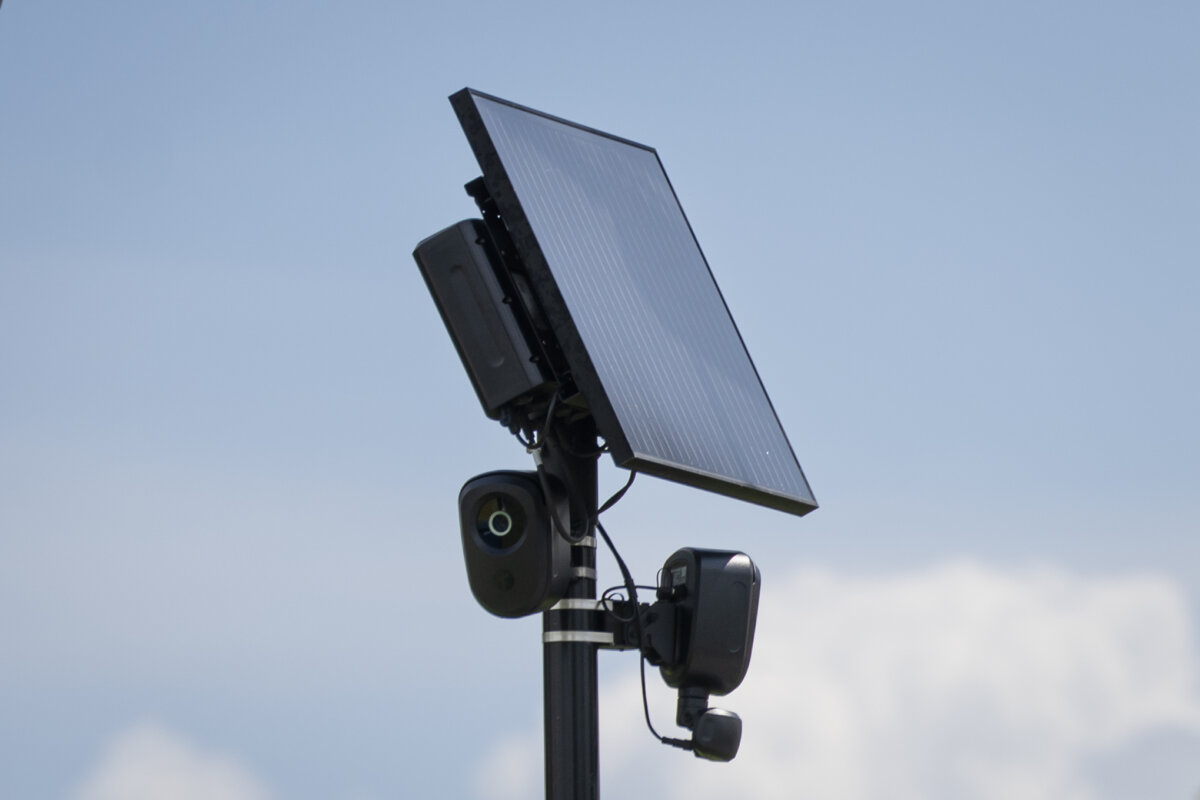

Its cameras are installed on poles at street corners, in parks and residential communities, and near countless businesses, tracking vehicles and private citizens across a growing surveillance network accessible by thousands of U.S. law enforcement agencies.
Now Flock Safety’s cameras—designed to monitor and catalog motor vehicles by license plate and physical characteristics—are facing scrutiny from lawmakers and private citizens alike, and vandalism from activist vigilantes.
In several incidents, activists cut cameras down with reciprocating saws, hit them with trucks and baseball bats, and defaced lenses with spray paint.
What has led to such a visceral reaction to the Atlanta-based company’s camera rollout?
Beyond concerns of mass surveillance and loss of privacy, there are dozens of reports of mistaken traffic stops, in which innocent motorists were pulled over, jailed, or held at gunpoint after a Flock automated license plate reader gave law enforcement a false vehicle match.
There are also cases in which officers allegedly used Flock’s camera database to stalk romantic interests, ex-partners, or relatives. A former Sarasota, Florida, police officer is facing felony charges for allegedly using Flock Safety technology to search for a single license plate hundreds of times.
Some legal scholars have argued that the technology violates the Fourth Amendment of the U.S. Constitution, specifically by storing personal data in the company’s databases so the data can be accessed by a growing network of law enforcement agencies contracting with Flock.
Others have said Flock cameras present humanity with a worthy tradeoff: A camera on every street corner could solve cold cases and prevent future crime at a level that surpasses what police officers could achieve without them.
Flock has claimed that its license-plate-reading cameras have a 90 percent to 99 percent accuracy rate, but an analysis from a California police department of its own use of the technology—based on 2023 and 2024 data—gave it a 71 percent failure rate on vehicle matches for stolen or felony-linked vehicles.
Do They Actually Work?
After growing reports of false positives from Flock’s license plate readers, private citizens have called on local governments to cancel contracts with the company.
Activists and lawmakers alike have questioned how accurate the technology is at solving investigations and preventing crime.
But when that question has been posed directly to Flock, company representatives have given varying answers, and the company has indicated lower levels of accuracy during nighttime hours.
Flock has stated on its website that its cameras accurately match vehicles 95.6 to 96 percent of the time, but this rate can drop to 90 percent at night.
In a lawsuit filed in 2024 against the city of Norfolk, Virginia, and its police chief over its use of Flock cameras, plaintiffs’ lawyers cited a litigation exhibit stating that the company’s cameras read license plates accurately 93 percent of the time.
But as recently as July, Flock Chief Communications Officer Joshua Thomas told automotive news outlet The Drive that the company’s cameras have a 99 percent accuracy rating.
Even if Flock’s cameras reached 99 percent accuracy, that would still mean hundreds of millions of misreads every single month, based on the more than 20 billion monthly scans the company says its cameras conduct.
Independent research group IPVM found that one in 10 plates scanned by Flock had misread the state of origin.
Legal Implications
An August analysis by the American Civil Liberties Union noted that Flock has installed more than 120,000 cameras throughout urban and rural communities, including on highways, in front of businesses, and in public spaces such as parks and waterways, allowing them to potentially track people’s daily routines, churches, or political affiliations.
If the cameras were simply observing public thoroughfares in real time like a police officer, as well as using a digital network to check vehicle plates against lists of stolen cars, missing persons, and other law enforcement alerts, there would be no Fourth Amendment violation.
But as soon as Flock begins making a “timestamped, plate-indexed, query-able record” of U.S. citizens’ movements without probable cause, it violates the Constitution, Amy Peikoff, an attorney with the Pacific Legal Foundation and an expert in property rights, wrote in a recent analysis.
Efforts to regulate Flock, or scale back its implementation in U.S. cities, are underway.
Rep. Thomas Massie (R-Ky.) said in late July that he would soon announce a bill withholding federal money from any law enforcement agencies or municipalities that deploy Flock and Flock-style cameras “to surveil law-abiding citizens.”
Flock Safety did not respond to a request for comment.
—Jacob Burg; Stacy Robinson
BOOKMARKS
Operation Southern Spear, a U.S. military plan to carry out attacks on suspected drug-trafficking vessels in the Western Hemisphere, has been in process for a year. Find out how it’s going by reading Timothy Frudd’s latest.
After five days of deliberations in the Lindsay Clancy murder trial, the jury remains deadlocked. Judge William Sullivan isn’t giving up yet, and has ordered discussions to resume on Thursday morning.
Longtime “Wheel of Fortune” announcer Jim Thornton has been suspended from the popular game show, while Sony Pictures Television investigates allegations involving the broadcaster. Sony hasn’t said publicly what those allegations are.
The U.S. government has sided with OpenAI after The New York Times sued the company for using its paywalled articles to train artificial intelligence (AI) models. “The United States has a strong interest in this Court rejecting any argument that training LLMs on copyrighted texts violates copyright law,” government lawyers said in a brief this week.
New York City Mayor Zohran Mamdani has banned classroom use of generative AI tools for pre-K–eighth grades, and all public high school students will be required to complete AI awareness refresher courses twice a year. “Just because technology is everywhere, doesn’t mean it belongs everywhere,” Mamdani said on Sept. 2 during a news conference.
—Stacy Robinson
 Friends Read Free
Copy
Facebook
Tweet
Friends Read Free
Copy
Facebook
Tweet