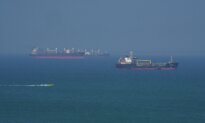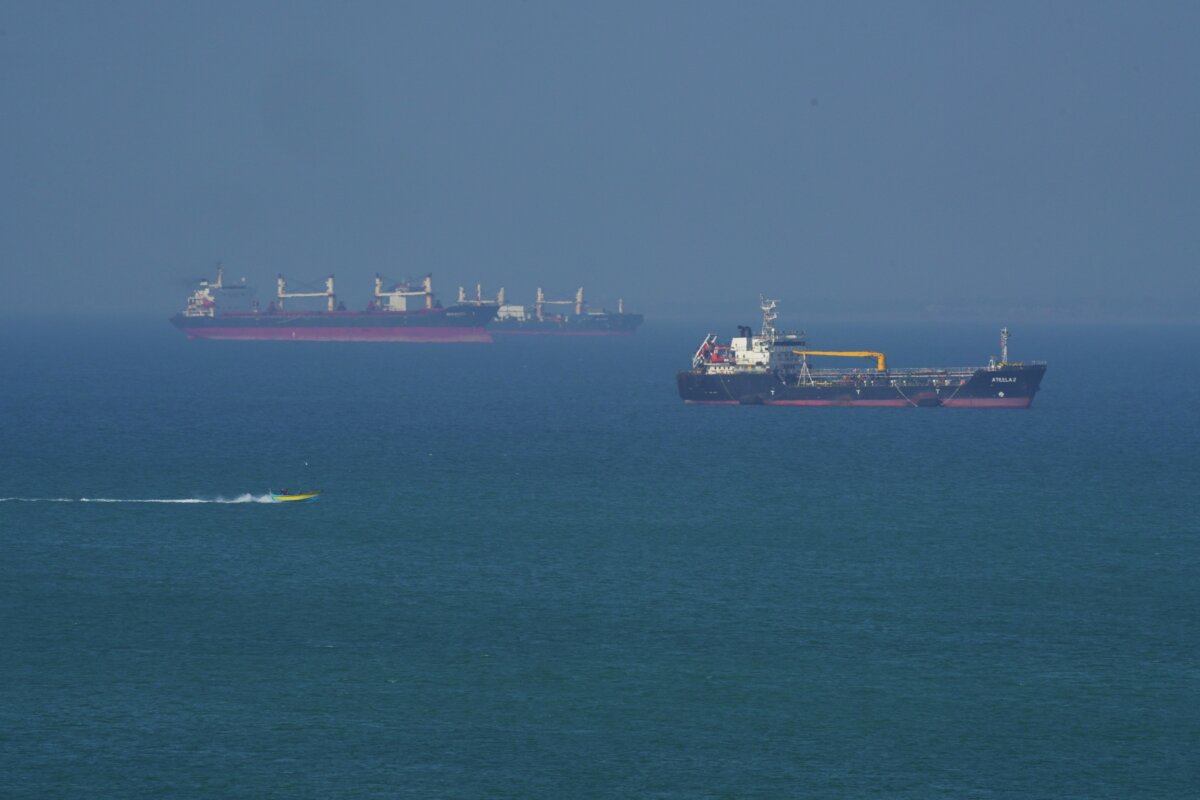

The “Storage Clock” is ticking as tankers that exported 3.2 million barrels per day (bpd) of Iranian crude oil remain bottled inside the Persian Gulf by the United States Navy.
The Gulf of Oman blockade is part of a global vise on Iranian shipping, denying Tehran $13 billion in monthly revenues and strangling Iran’s petroleum industry so it must shut down when it runs out of space to store what it can’t ship.
Since President Donald Trump imposed the blockade on April 13, at least 1.5 million bpd of Iranian oil has been stored each day, every day, because there’s no place to move it outside the Persian Gulf.
Those barrels are adding up. According to industry estimates, including by UK-based Energy Aspects, up to 68 million barrels of Iran’s 122 million barrel maximum storage was full in late April, with space for only 20 to 30 million barrels more.
Time and space are running out. President Trump maintains the blockade will continue unless Tehran meets his demands to terminate nuclear weapons development, end support for terrorist groups, and withdraw its territorial claim—and control—of the Strait of Hormuz.
Make a deal or a “State of Collapse” is imminent, the administration warns.
In a late-April spate of analyses, commodities market and policy experts used “storage clock math” to calculate when Iran will run out of time and space and must shut down its petroleum industry.
Mid to late May, most project. Some analysts say a “State of Collapse” won’t be apparent until June. Others say Iran is already facing “storage saturation.”
When the storage clock expires on Iran’s oil industry, wells must be capped, or “shut-in,” rigs disassembled, field grids unplugged, refineries shut down, men and machines idled. It’s not merely a pause, but a breakdown.
Restoring production to pre-shutdown capacity can take weeks, even months, and the more time oil and gas infrastructure is offline and marginally manned, the more vulnerable it is to structural damage.
Iran isn’t the only Gulf state on the “storage clock.” Reuters reports Goldman Sachs estimated Gulf crude production on April 24 was running 57 percent below prewar 20 million bpd levels, with roughly 14.5 million bpd capacity offline in Saudi Arabia, United Arab Emirates, Kuwait, Qatar, and Bahrain.
Iranian control of the Strait of Hormuz has not only stymied Gulf export economies, but Tehran’s missile and drone attacks on “the Arab side of the Gulf” has caused billions in damage that will require months to restore to prewar production.
The pressure is exposing fissures with some Gulf states supporting the United States’ campaign and others allegedly amenable to negotiating a separate peace with Tehran. Friction came to fracture when the Emirates announced it was exiting OPEC to pursue “sovereign responsibility in a new energy age.”
The standoff is skewering the Trump administration’s domestic agenda. The war has raised U.S. energy costs with the national average for gas topping $4 a gallon and November’s midterms–with slim Republican majorities imperiled–drawing nearer.
Iran believes it can outlast an impatient Trump, some analysts say, even in a “State of Collapse.”
Since 1979, the Islamic Republic “has prioritized survival, coercive leverage, ideological commitments, and internal control over economic welfare,” writes Siamak Namazi in a Middle East Institute analysis. “It has tolerated sanctions, isolation, inflation, capital flight, and deep economic damage when leaders judged those costs preferable to strategic concession.”
Namazi dismissed “countdown narratives” as “dangerous,” warning, “Tehran may be betting its tolerance for pain exceeds that of its rivals in an oil-sensitive global economy, that others will seek relief long before it seeks compromise.”
BOOKMARKS
The FBI conducted a raid on the Portsmouth office of Virginia Senate Leader L. Louise Lucas on Wednesday, but the reason why was unclear. “While we await the full facts of the investigation, it must be acknowledged that this FBI raid occurs in the broader context of President [Donald] Trump’s repeated abuse of the Department of Justice to target his perceived political opponents,” Rep. Bobby Scott (D-Va.) said.
A U.S. fighter jet fired upon and disabled an oil tanker in the Gulf of Oman on May 6, the U.S. Central Command (CENTCOM) announced. According to CENTCOM, U.S. forces notified the tanker that it was sailing in violation of a U.S. blockade, and issued multiple warnings to the vessel.
President Trump said on Wednesday that the United States intends to acquire the enriched uranium from Iran’s crippled nuclear program, but didn’t give more details. The comment came the same day he told PBS that if a deal to end the war could be reached, the U.S. will be “lightening up on Iran with sanctions.”
Tesla has issued a recall of 218,868 vehicles that may be affected by a delayed rearview camera image, which could increase the risk of an accident. The recall encompasses various models from years 2017 to 2023, and you can check out Mary Prenon’s latest report to learn more.
A group of 30 House Democrats want Secretary of State Marco Rubio to clarify whether Israel has a nuclear weapon or not. “We ask that you hold Israel to the same standard of transparency that the United States expects from any other country that may be pursuing or retaining nuclear weapons capability,” the lawmakers said in a joint letter.
—Stacy Robinson
 Friends Read Free
Copy
Facebook
Tweet
Friends Read Free
Copy
Facebook
Tweet