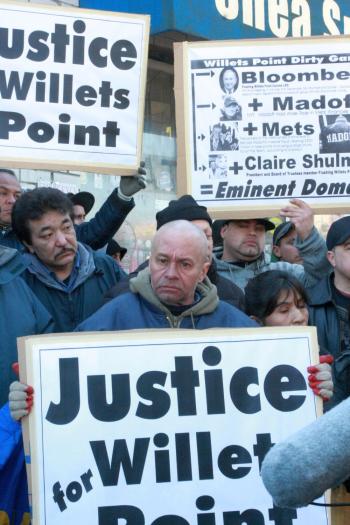
The city's Economic Development Corporation (EDC) will move ahead with the first phase of the Willets Point redevelopment plan in the coming weeks, forcing the remaining tenants to leave. Locals expressed their concern and fear in a frosty press conference on Thursday afternoon.
The gathered crowd comprised scrap yard owners and workers, humble shop keepers, and many who have worked in the same place for decades. Unsure about where they would go if the city begins taking over their property against their will—under the eminent domain law—some of them have scraped together meager funds to hire a lawyer and a lobbyist.
The eminent domain law gives the city the power to force owners into selling private land to the city for public use. Property owners will not be left completely in the lurch, however, as they will be compensated with a fair market value determined by a judge. The EDC has also provided career training and relocation to some owners who have willingly sold their properties.
The crux of the matter remains whether the redevelopment of Willets Point is in the interest of the public, as mandated by the eminent domain law. Local business owners would say it is not.
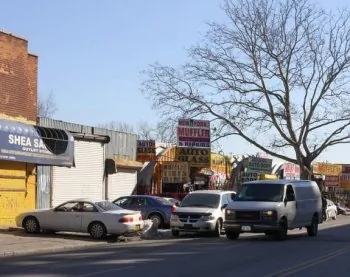
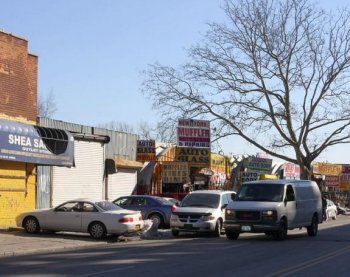
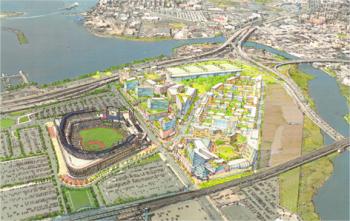
The city plans to replace the mishmash of auto recycling and repair shops with housing developments, retail space, a hotel, and parkland.

“Everywhere would be more profitable as a Costco,” said lobbyist Richard Lipsky, arguing that profitability does not give the city the right to close down small businesses developed through decades of hard work.
Economic returns are not the only variable being considered, however.
“Following its period of use as a disposal site, the district was occupied by a dense cluster of industrial, automotive, manufacturing, and commercial businesses,” reads the city's hazard assessment of the area. “As a result of this history, evidence of contaminants on the site included volatile organic compounds (VOCs), semivolatile organic compounds (SVOCs), polychlorinated biphenyls (PCBs), heavy metals, pesticides, herbicides, and rodenticides, as well as asbestos and lead-based paint (LBP).”
Local business owner Eli Semo concurs that the area is a “cesspool” without any sewage system.
“My workers have to make sure they go to the bathroom before they come to work,” said Semo, who owns an 80,000-square-foot scrap yard and shop space in the district.
The EDC has already purchased 90 percent of the property in the phase-one area, leaving only nine business owners to contend with. While the agency moves ahead with the eminent domain action, it hopes to negotiate with the remaining owners first.
“As we seek to reach agreements with the nine remaining businesses, we will also begin the legal process that gives us the option to condemn these properties if needed, so that we can continue to move forward,” stated the EDC.
Asked if they had considered renovating the area for the existing businesses, the EDC officials said they had not.
The EDC statement concluded: “When this project is complete, it will create a brand new neighborhood with thousands of jobs, affordable housing options, and a vibrant retail sector, and it will remediate decades of environmental damage.”
 Friends Read Free
Copy
Facebook
Tweet
Friends Read Free
Copy
Facebook
Tweet