
A few years ago, U.S. auto executives were hailing their conversion to electric cars and market analysts were predicting exponential growth in electric vehicle sales amid the inevitable extinction of the gas-powered engine.
Executives from General Motors (GM), Ford, Volkswagen, Mercedes, and Volvo pledged that their fleets would be 100 percent electric within a decade.
But the reality has been quite different.
After President Donald Trump ended the $7,500 electric vehicle (EV) tax credit in September 2025, the sales growth of electric cars in the United States went into reverse, falling to 234,000 units in the fourth quarter of 2025, down by 46 percent compared to the prior quarter, according to data from Cox Automotive.
The market share of EVs tumbled from 10.5 percent of all new cars sold in the United States in the third quarter of 2025 to 5.8 percent in the fourth quarter, according to Kelley Blue Book data.
“EVs will only grow very slowly from here on out due to a saturated market and lack of consumer demand,” energy expert Robert Bryce told The Epoch Times.
U.S. and European car manufacturers that had bet heavily on the EV transition are now licking their wounds.
Ford, GM, Mercedes-Benz, and Volkswagen collectively lost $114 billion on EV ventures between 2022 and 2025, according to a recent op-ed by Bryce. Adding a $26 billion write-down on its EV line announced by Chrysler parent company Stellantis on Feb. 6, that total climbs to $140 billion.
In December 2025, Ford announced that it was canceling its flagship electric truck, the F-150 Lightning. Having lost $13 billion on its EV line since 2023, Ford announced a $19.5 billion write-down from EVs in the fourth quarter of 2025.
“The operating reality has changed, and we are redeploying capital into higher-return growth opportunities: Ford Pro, our market-leading trucks and vans, hybrids and high-margin opportunities like our new battery energy storage business,” Ford CEO Jim Farley said in a statement.
In January, GM announced a $6 billion write-down in its EV line, following its decision in October 2025 to take a $1.6 billion loss to scale back its EV investments. GM canceled contracts with electric vehicle battery suppliers, while Stellantis announced that it would cut its entire plug-in EV lineup for 2026, although it still planned to introduce new long-range EV models that use gasoline to charge the car’s battery.
Tesla, once the leading EV producer, recently reported falling sales and profits, and CEO Elon Musk spoke of shifting the company’s focus toward robotics as Chinese manufacturer BYD overtook it in global sales of units sold.
Far from the inevitable demise of the internal combustion engine, other global auto companies’ ventures into electric vehicles now appear to be costly, highly dependent on government support, and vulnerable to fierce competition from China.
“The electric vehicle market in the United States was primarily created by government mandates and government subsidies,” Paul Mueller, economist with the American Institute for Economic Research, told The Epoch Times.
“Even Tesla would not have made it without significant government subsidies—over $3 billion—and regulatory credits bought from Tesla by other car producers—over $13 billion.”
Due to federal emissions regulations, which were tightened under the Biden administration, gas-powered vehicle producers who focused on the most profitable models, such as trucks and SUVs, were compelled to buy emissions credits from EV manufacturers to offset their failure to meet fleet-wide Corporate Average Fuel Economy requirements. This additional multi-billion-dollar subsidy was also curtailed by the Trump administration.
While global EV sales have remained robust—increasing by 20 percent in 2025—the majority of those sales occurred in China, according to Benchmark Mineral Intelligence, an EV research group. In other global markets, by contrast, demand for EVs was uneven, growing where subsidies and regulations incentivized buyers, falling where they did not.
Europe’s EV market, in which buyer incentives remain in place, grew by 33 percent in 2025.
In the United States, by contrast, the One Big Beautiful Bill Act, signed in July 2025, eliminated the $7,500 tax credit on new EVs, as well as the $4,000 credit for used models. In the absence of these incentives, Benchmark predicts that the U.S. market for electric cars and trucks will contract by up to one-third in 2026.
EVs have been attractive for affluent consumers who have shorter commutes and can charge them in their garages.
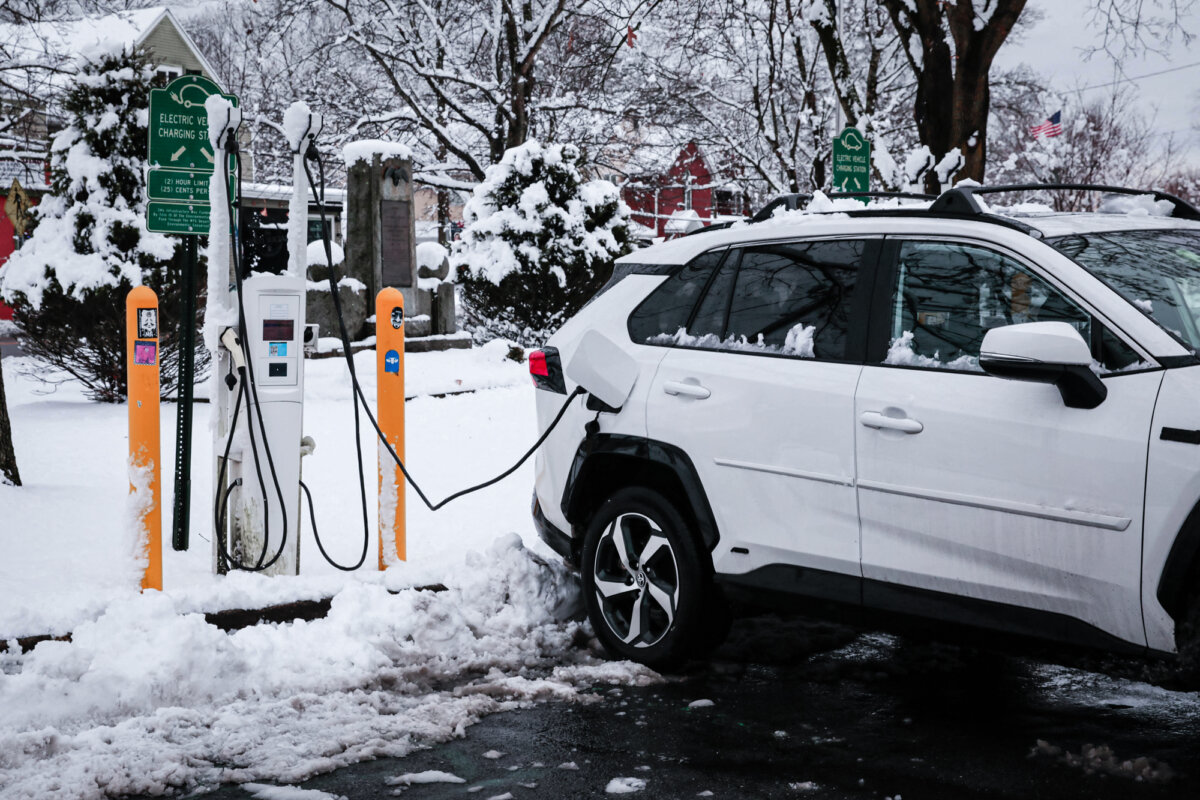
However, as a mainstream product, EVs have been hindered by high sticker prices, range anxiety, long charging times, diminished performance in cold weather, and—as evidenced from power outages during recent snowstorms—an occasional inability to use them during crises.
Another concern for buyers is that EVs don’t hold their value well, according to iSeeCars, an automotive research company.
EVs lose 58.8 percent of their value in the first five years after purchase, compared with the industry average for all vehicles of 45.6 percent, the report states. Trucks and hybrids fared the best, both losing about 40 percent of their value over five years.
Part of this is likely due to the comparatively poor service record for EVs, despite the fact that they were marketed as requiring less maintenance than gas-powered cars. A December 2025 report by Consumer Reports stated that EVs have about 80 percent more service problems on average than gas-powered cars.
On the other hand, hybrids, which combine a gas engine and electric battery, have 15 percent fewer problems on average than gas-only cars. Hybrids have been in production longer than EVs, and this likely has improved the reliability of more recent hybrid models and provides hope that EVs will likewise become more reliable in time.
READ MORE HERE
—Kevin Stocklin
BOOKMARKS
A glove recovered two miles away from Nancy Guthrie’s house “appears to match the gloves of the subject in the surveillance video” recovered outside the 84-year-old’s home, The Epoch Times’ Jacki Thrapp reported. The Pima County Sheriff’s Department found multiple gloves in a field near a road that was not revealed, according to a statement from the FBI.
Recently, the federal government has sought to encourage the production of enriched uranium, offering benefits to companies who assist in the time consuming and expensive process. But The Epoch Times’ John Haughey reported that experts worry a fuel crunch that could hobble Trump’s “nuclear renaissance” initiatives may loom as soon as 2028.
Trump confirmed that member states of his Board of Peace will announce a combined pledge of more than $5 billion towards Gaza humanitarian and reconstruction efforts at a meeting in Washington this week, The Epoch Times’ Jacob Burg reported. More than 20 countries have signed onto the initiative so far.
The Federal Aviation Administration (FAA) is issuing a new mandatory rule that requires all commercial airlines in the country to formally commit to merit-based hiring for pilots, The Epoch Times’ Naveen Athrappully reported. Under the new mandate, all U.S. carriers must certify that the practice of airlines hiring based on race and sex has ended or face a federal investigation.
 Friends Read Free
Copy
Facebook
Tweet
Friends Read Free
Copy
Facebook
Tweet