
Like many Americans who felt burned out and isolated after the government shuttered thousands of small businesses and forced many inside for weeks and months on end during the COVID-19 pandemic, Olivia D’Amico saw the need to forge a new kind of community in her hometown of Bradenton, Florida.
The lockdowns that halted concerts and many other communal activities also closed the church where D’Amico worked, depriving her and so many others of their spiritual sanctuary—not just a house of worship, but also a place for members to gather and bond.
“It was really hard for me to even figure out, like, what’s next for all of us? And at the time, we didn’t know what it looked like; there was a lot of fear,” she told The Epoch Times.
D’Amico crafted a creative solution: the Friendly City Foundation, a nonprofit that hosts concerts, art clubs and festivals, and other community events.
The foundation partners with local businesses to host its events, particularly Oscura, a thriving cafe, bar, and music venue that functions as a “third place” in downtown Bradenton.
Sociologist Ray Oldenburg coined the term “third place” in his 1989 book, “The Great Good Place,” to describe venues or locations where people can gather and socialize outside their “first” and “second” places: home and work.
But as the United States faces a growing loneliness epidemic, third places such as cafes, bars, churches, bowling alleys, barber and beauty shops, bookstores, and recreation centers are in decline nationwide, threatening to isolate Americans further, particularly as social media and smartphone addiction worsen the effects of loneliness.
“Third places are super important to not only people’s wellness, but to community wellness. It’s important to the economy,” D’Amico said.
“If you don’t have third places, and you don’t have places where people can gather—your parks, your coffee shops, and things like that—a city will inevitably die.”
D’Amico, who spends her days running her flower and art store, Kinspoke, which also hosts art events and activities in Bradenton, is not alone in her goal of building more third places within her city.
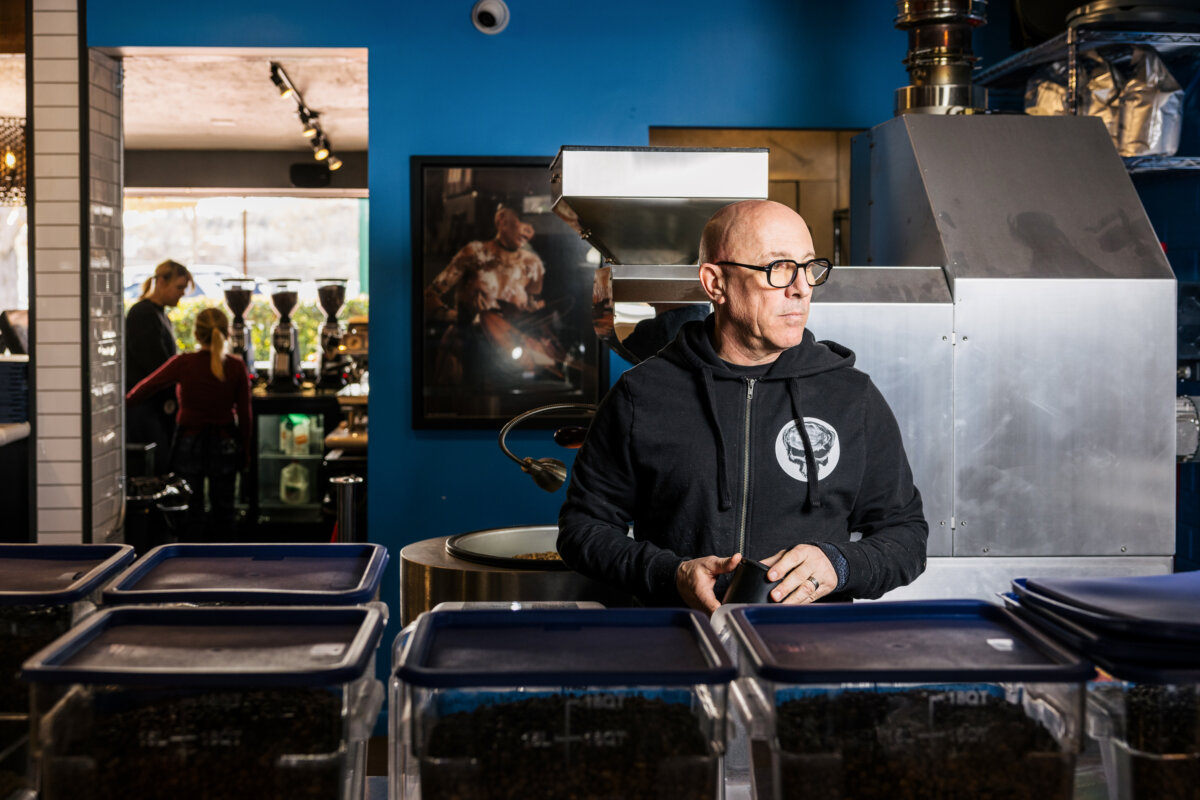
Maynard James Keenan—lead singer of the bands TOOL, A Perfect Circle, and Puscifer—recently opened the Queen B Vinyl Café in Cottonwood, Arizona, with his wife, Jennifer, to offer a welcoming third place for people of all ages to socialize and bond over vinyl records, coffee, creative food selections, wine from Keenan’s vineyard, and live music events.
“So far, everyone seems to be really appreciative and grateful to have the space, because we do try to be so welcoming to all ages,” Jennifer Keenan told The Epoch Times.
“The shows we’ve been holding with live music and movies and gaming nights have been really popular because we are one of the only all-ages venues in the area.”
The cafe also hosts art night, art club, and printing workshops, which have been popular with the younger crowd, she said.
“It’s kind of like they found their home,” Jennifer Keenan said. “And they are the kind of people that maybe when they first come in, and you start talking to them and invite them to something, it’s like, ‘Oh, I don’t really go out much.’ And then you start seeing them a little bit more and a little bit more and just kind of almost becomes like a little family.”
The disappearance of third places is directly linked to the U.S. loneliness epidemic, experts have said, and the trend is hurting Americans’ physical and mental health.
Now, community leaders such as D’Amico and Keenan are creating new spaces to forge community and pull Americans out of social isolation.
Loneliness Surges
The “loneliness epidemic” was highlighted by then-U.S. Surgeon General Dr. Vivek Murthy in 2023, at the tail end of the COVID-19 pandemic.
“Even when they couldn’t put their finger on the word ‘lonely,’ time and time again, people of all ages and socioeconomic backgrounds, from every corner of the country, would tell me, ‘I have to shoulder all of life’s burdens by myself,’ or ‘if I disappear tomorrow, no one will even notice,’” Murthy said.
The forced social isolation during the pandemic only worsened these impacts.
Psychologist Debra Kissen, founder and CEO of Light On Anxiety Treatment Centers, told The Epoch Times that during COVID-19, people weren’t forced every day to get exposures to the thing that “is difficult but good for them”: social interaction.
“A lot of people haven’t caught back up with going to in-person religious activities,” she said.
“[They’re] maybe still working out at home, if they used to work out at the gym. So it really did a lot of damage in terms of getting comfortable creating a life when you don’t really need to be around people.”
Murthy emphasized that isolation was already surging before 2020, citing research showing that roughly one in two adults reported experiencing loneliness years before the pandemic.
And although the pandemic ended, recent studies point to a worsening “loneliness epidemic.”
More than half of U.S. adults reported feeling isolated and “emotionally disconnected” from others, and roughly 62 percent cited “societal division as a significant source of stress in their lives,” according to a November 2025 survey from the American Psychological Association.
An even larger number of adults—69 percent—were craving more emotional support in the past year than what they received, a 4 percent increase from the previous year.
Gallup’s May 2025 survey found that younger American men are among the loneliest demographics in the developed world.
Males are also roughly four times more likely to kill themselves than females, based on the most recent data from the Centers for Disease Control and Prevention.
Kissen said young men sometimes struggle to articulate their feelings of isolation and loneliness, particularly in therapy, often either expressing misanthropic ideas or showing signs of irritation or anger.
“It’s not, ‘I am isolated; I am lonely.’ It’s like: ‘The world is bad. … People are bad,’” she said.
The loss of third places has amplified these emotions for many, according to Brent Woods, who runs Woods Counseling Services in Lake Charles, Louisiana.
Woods saw firsthand the effects of the disappearance of third places when Hurricane Laura devastated the city in 2020.
The storm sliced into Lake Charles as a Category 4 hurricane, flattening homes and businesses with howling winds and a catastrophic storm surge. It was the strongest hurricane to hit Southwest Louisiana since recordkeeping began in 1851.
“It completely destroyed us,” Woods told The Epoch Times.
“We lost a lot of third places here, and so I get clients that come in and just share a lot of discouragement with really nothing to do … and the inability to be able to connect with other people.”
Although the pandemic accelerated the trend, third places have been waning much longer than the past six years, research shows.
More than a decade before COVID, the economic hardships brought on by the 2007–2009 Great Recession contributed to a sharp decrease in third places in countless communities nationwide, particularly independent coffee shops and grocery stores.
As online shopping began dominating and forced many brick-and-mortar stores out of business, third places declined further.
After analyzing the availability of third places across U.S. communities between 2010 and 2021, researchers found a significant downturn in all categories, including coffee shops, libraries, grocery stores, fast-food outlets, beauty and barber shops, art galleries, recreation and senior centers, and social organizations, according to a November 2025 study in Health and Place.
Health Effects
When Murthy referred to America’s loneliness wave as an epidemic in 2023, he said the emotion goes beyond being a mere “bad feeling” for those who experience it.
He said loneliness leads to a “greater risk of cardiovascular disease, dementia, stroke, depression, anxiety, and premature death,” and the mortality rate of those experiencing social disconnection is similar to that of people who smoke 15 cigarettes a day.
Adults reporting high levels of loneliness were found to be significantly more likely to also experience chronic health issues—including depression, anxiety, and chronic pain—in the American Psychological Association’s survey late in 2025, in which high levels of loneliness were linked to premature mortality, poor sleep, and cognitive issues.
On the flip side, strong social connections are positively correlated with increased physical and mental health, including lower rates of depression, anxiety, and cardiovascular disease.
“If we look at studies of vitality and what helps with well-being, it’s engagement in community; it’s less time with just our thoughts,” Kissen said.
“When we’re engaged, the world is bigger than our tiny selves, and when we just kind of are recycling, considering our own situation, it’s not good for anyone. We humans are really meant to be pack animals.”
Finding Solutions
Despite the increase in loneliness nationwide—affecting both urban and rural communities—some of the solutions may already be within grasp.
Being able to see and diagnose “the social isolation loneliness epidemic, is [possible] because people are realizing they’re in pain,” Kissen said.
“With the pain comes change,” she said.
“So many people are feeling that way and are actually talking to each other at bars and talking to each other at the line at Trader Joe’s that maybe five years ago weren’t.”
She likened the process to acclimating to swimming in cold water; while at first it may feel jarring and uncomfortable, a person’s brain will quickly adjust.
“If the thing that’s stopping you is that it feels so hard, it gets easier with repetition,” Kissen said.
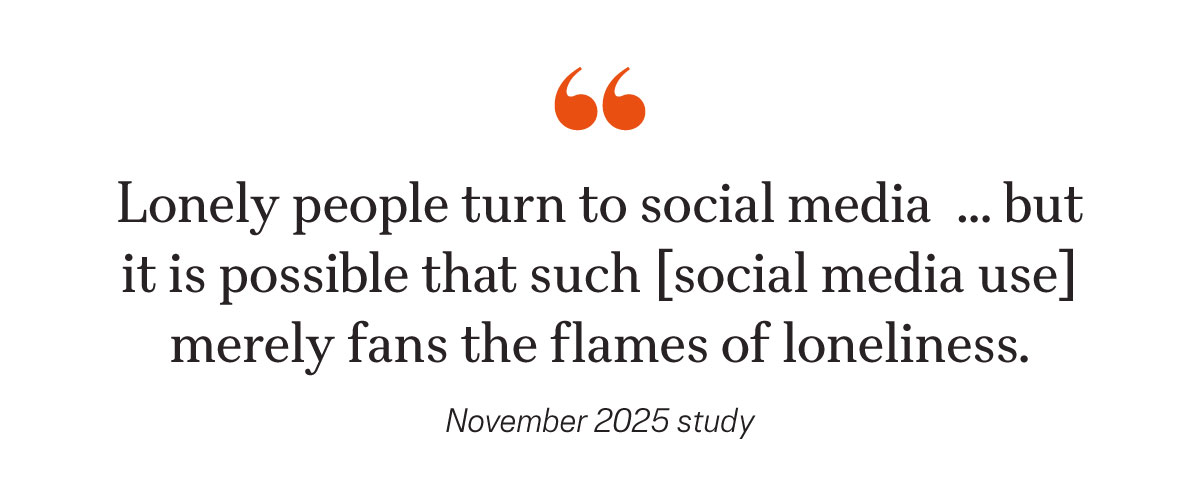
Loneliness is also linked to time and frequency of social media use, according to a 2025 study published in Environmental Research and Public Health. Researchers determined that limiting screen time could help curb some of the technology’s negative effects, including feelings of isolation.
And there may be a solution with more lasting effects: building more third places, which, aside from fostering social interaction and community, also lead to increased entrepreneurship in individual communities, according to a 2024 study from Columbia Business School.
Samuel J. Abrams, a nonresident senior fellow at the American Enterprise Institute, reflected on the loss of third places in a December 2025 article.
He advocates prioritizing local ownership in zoning and permitting in towns and cities, lowering the barrier to entry for local entrepreneurs, and increasing funding for existing civic institutions such as libraries, parks, YMCAs, and recreation and community centers.
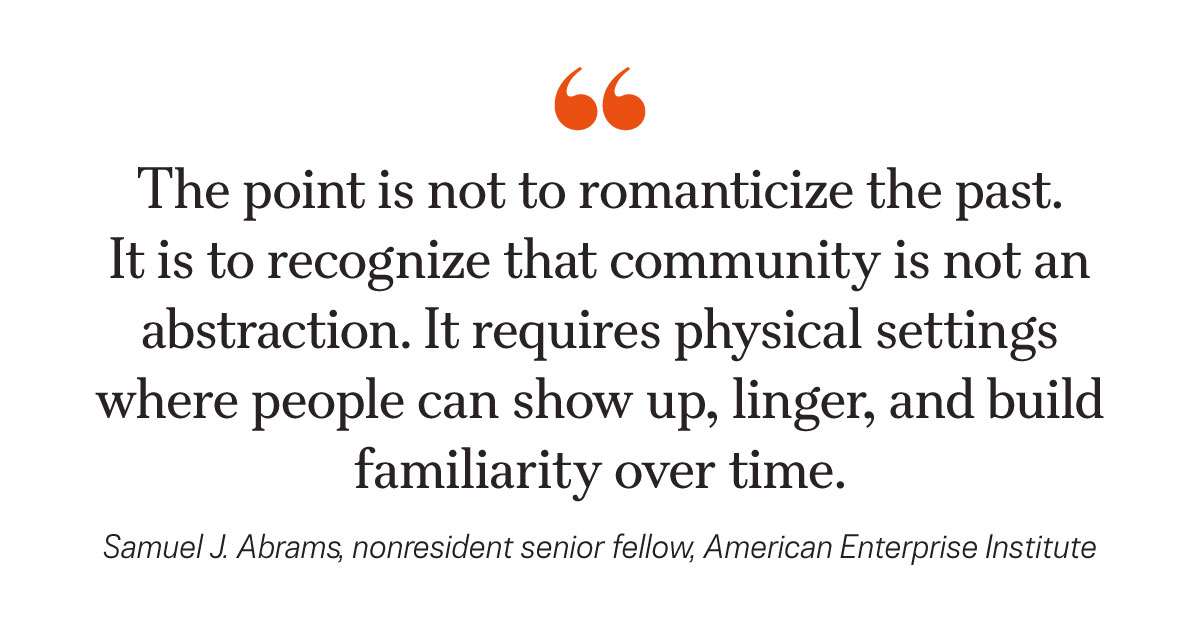
“The point is not to romanticize the past,” Abrams wrote. “It is to recognize that community is not an abstraction. It requires physical settings where people can show up, linger, and build familiarity over time.”
D’Amico similarly advocates local priority in zoning and planning, at both the city and county levels, in Southwest Florida.
“I would love to see a support of actual small businesses who are here,” she said, “because I think as we watch corporations move in, and there is a lot of development, a lot of that has gone towards these large corporations.”
Creative or collective industries—such as certain restaurants, artists or farm cooperatives, nonprofits, or worker-owned companies—“are the industries that actually will, in the future, be building the cities,” she said.
Oldenburg observed in 2023 that virtual spaces online are no replacement for the socialization people receive in real life, and D’Amico said she believes real third places are more important now than ever.
“I think it’s super important—even in the age of [artificial intelligence] and social media and all these different things—that we gather and we don’t think that those things can replace it,” she said.
‘The Longest Table’
Like D’Amico and Jennifer Keenan, Maryam Banikarim saw a need for offering a place for people to gather and bond, particularly after a lockdown forced so many inside in her local community in New York City.
Inspired by a photo of people enjoying a meal together at a long table in Egypt, Banikarim—formerly senior vice president at NBCUniversal and chief marketing officer of Hyatt, Gannett, and Univision—started a novel project in 2022.
“I take the picture, I post it onto my personal Nextdoor [app], and I say, ‘What if we did this?’ And I got lots of reactions and lots of comments, very positive,” she told The Epoch Times.
What started as a “simple idea” soon blossomed into a massive gathering of hundreds, and now thousands, of neighbors in her community in the city’s Chelsea neighborhood. Banikarim and her nonprofit, New York City Next, provide the tables and chairs, and residents bring food in a large-scale collective potluck.
Now her yearly gathering, known as “The Longest Table,” has spread to dozens of cities nationwide; anyone interested in hosting such a gathering is offered a toolkit and coaching to get the project off the ground.
Last year, Barnard College ran a study on Banikarim’s Longest Table in Chelsea and found that 87 percent of participants reported meeting new neighbors and 79 percent felt less lonely. Almost all who attended, 90 percent, said they felt good about their neighborhood, and 82 percent expressed interest in joining community activities.
“The thing I realized is it’s a way to rebuild trust from the grassroots level, and it creates belonging, but also gives us all a sense of agency that we have some power to stitch our world back together,” she said, describing the process as a “ripple effect.”
“I’m all for technology, but you need, in real life, community. And I think our hope is that this leads to everybody having a neighborhood that feels like home, where they belong, and where they trust, and where they can feel like they can act together. And I think we could all use a world like that.”
 Friends Read Free
Copy
Facebook
Tweet
Friends Read Free
Copy
Facebook
Tweet