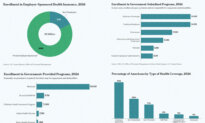

Nearly everyone who receives health care in the United States benefits from a government subsidy. Federal, state, and local governments assist in paying for the health coverage of nearly every American through a variety of subsidies, tax deductions, and tax exemptions.
Major programs such as Medicare, Medicaid, and Obamacare receive perhaps the most attention, but those programs combined cover less than 45 percent of Americans. In 2024, federal, state, and local governments paid at least 58 percent of all health spending, amounting to $3.1 trillion.
Employers and individuals spent another $2.2 trillion, although about three-quarters of that amount was supported by tax exemptions.
Here’s a look at all the ways taxpayers defray the cost of health care, and all the people who benefit from it.
Government-Provided
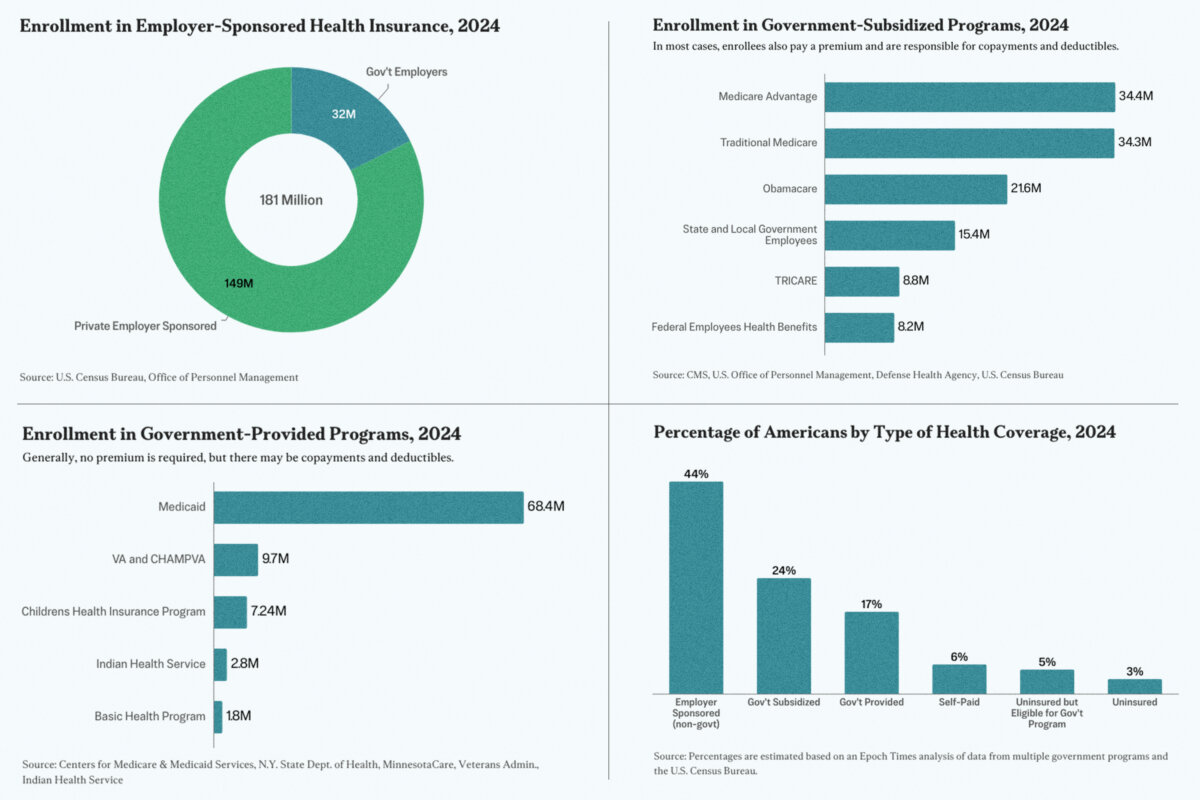
The government directly provides health coverage for about 18 percent of Americans through Medicaid and other programs.
People covered under these programs may still be responsible for deductibles and copayments. But there are no premiums for enrollees.
Medicaid and the Children’s Health Insurance Program are primarily intended for people with household incomes at or below the federal poverty level or, in states with expanded Medicaid, 138 percent of the federal poverty level. The federal and state governments share the cost of these programs.
The Basic Health Program is an alternative to Medicaid used by New York, the District of Columbia, Oregon, and Minnesota.
CHAMPVA is for spouses, dependents, and survivors of veterans who meet certain disability related criteria. The Veterans Health Administration provides health care for veterans.
Indian Health Services provides federal health services to American Indians and native Alaskans.
Surveying all types of coverage, the total number of people listed as eligible or enrolled is greater than the population of the country. There are several reasons for that. Many people qualify for coverage in multiple programs and may purchase commercial insurance in addition to a government-provided health plan.
Enrollments change month by month but are generally reported as an average for the year. And some people decline coverage for which they are eligible.
Unless otherwise noted, enrollments listed in this report are for 2024, the latest year for which federal statistics are available.
Government Subsidized
Some other government programs pay a large share of the cost of coverage for about 25 percent of Americans. In most cases, enrollees also pay a premium and are responsible for copayments and deductibles.
Often, this coverage is provided using commercial insurance carriers, and the government pays a share of the premium.
Medicare is a federal health care program for retirees, disabled people, and those with certain diseases. Medicare beneficiaries pay premiums.
Medicare does not cover eyeglasses, dental work, hearing aids, or prescription drugs. Beneficiaries can purchase additional Medicare coverage for prescription drugs or commercial insurance coverage for other services.
In traditional Medicare, the federal government pays providers directly for their services. For those enrolled in Medicare Advantage, the government pays a set fee to a commercial insurer, which then pays for all care needed by the beneficiary. In both cases, enrollees are responsible for copayments and deductibles.
Obamacare is intended for people who make up to 400 percent of the federal poverty level and do not have employer-sponsored health insurance. It is commercial health insurance, and some or all of the premiums are paid by the federal government.
Health coverage for more than 8 million current and retired federal employees and their family members is provided by the Federal Employees Health Benefits program, which is managed by commercial insurance carriers.
TRICARE is a health care program for active duty service members, military retirees, National Guard members, and their families and survivors.
State and local government employees include educators, court personnel, police and fire department employees, and other agency or department staff members. About 77 percent of these state and federal workers are covered by plans self-insured by the government entity they work for. Others receive employer-sponsored health insurance with part of the premium paid by taxpayers.
Employer-Sponsored
About 42 percent of Americans have commercial health insurance either sponsored by a nongovernment employer or purchased by an individual.
Many employees may not realize that this coverage is also subsidized by the government in the form of a tax deduction for employers.
Premium payments made to commercial insurers by employers on behalf of employees are not subject to corporate income tax. Individuals who are self-employed and purchase commercial insurance for themselves can also deduct the cost of those premiums.
Employer payments for health insurance are considered part of employee compensation, but their value is not reported as income and is not subject to individual income tax.
The average individual premium per year for commercial health insurance is about $9,300. The average premium for family coverage is nearly $27,000.
Employers paid an average of 84 percent of the premium cost (about $7,800) for single coverage and 73 percent of the cost (about $20,000) for family coverage.
Federal tax subsidies for employment-based health insurance totaled $348 billion in 2023, according to the Congressional Budget Office.
Tax Exempt or Deductible
Taxpayers also support hospitals through tax exemptions. Seventy-six percent of the nation’s general hospitals are either nonprofit or government-owned.
Nonprofit hospitals are required to provide need-based, discounted, or free care to individuals who meet their criteria.
All hospitals participating that offer emergency services and participate in the Medicare program are required to provide emergency assessment and stabilizing treatment to patients, regardless of their ability to pay.
Half of all hospitals reported that charity care accounted for 1.2 percent of their operating budget in 2023, according to health research organization KFF.
Although this care is not complete health coverage, it benefits some of the 8 percent of Americans who do not have health insurance.
The Congressional Budget Office estimated in 2023 that 60 percent of uninsured people qualified for a government health coverage program but were not enrolled.
 Friends Read Free
Copy
Facebook
Tweet
Friends Read Free
Copy
Facebook
Tweet