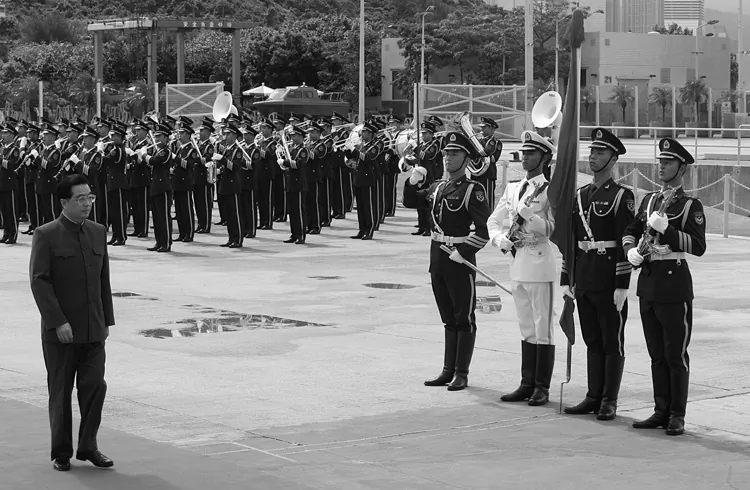

Choosing Beijing’s new Party Secretary is proving to be a political tussle in China. The Communist Party’s 11th Beijing Municipal Party Congress was pushed back to the end of June, after being originally scheduled for May.
The congress will determine both the leadership for Beijing and the delegates for the CCP’s 18th National Congress.
Political commentators said the delay was likely caused by fierce competition for Beijing Party Secretary Liu Qi’s position. The position is highly sought-after, as the secretary also earns a seat in the Politburo, the 25-member body that runs China.
Liu, 70, is two years older than the official retirement age of 68.
Beijing’s congress will now be held from June 29 to July 3, according to state-run Xinhua on Friday.
Outgoing Liu is Jiang Zemin’s Ally
A series of scandals weakening former regime head Jiang Zemin and his allies may have given Party leader Hu Jintao leverage to replace outgoing Liu with his own political ally. This would also strengthen Hu’s position as he exits the Party during the once-a-decade leadership transition.
Domestic security chief Zhou Yongkang, another key ally of Jiang, recently lost his position as head of the Political and Legislative Affairs Committee (PLAC) in Beijing, high-level sources reported.
Possible Candidates for Beijing
Current Beijing Mayor, Guo Jinlong—an ally of Hu Jintao—is likely to become the next Party Secretary of Beijing, according to several foreign news sources.
Guo served as Party Secretary in Hu Jintao’s home province of Anhui from 2004 to 2007. Hu later transferred Guo to Beijing to work alongside Liu Qi. Guo became mayor of Beijing in 2008—a position ranked just below Party Secretary.
Another close ally of Hu Jintao, Inner Mongolia’s Party Secretary Hu Chunhua, is a possible candidate to succeed Liu, reported Reuters.
Previous Party leaders Deng Xiaoping and Jiang Zemin set a precedent by placing their trusted allies, Chen Xitong and Liu Qi respectively, in the Beijing Party Secretary position.
Military Control Over the Capital
Controlling the Beijing Military Region (BMR) is another key issue for the Party’s leaders, as it provides a countermeasure against possible coup attempts.
News sources outside of China reported rumors that Zhou Yongkang had attempted a coup on March 19, as a result of Wang Lijun’s defection. It was said that the 38th Army entered Beijing, assisting Hu Jintao and Wen Jiaobao, and stamped out Zhou’s coup attempt.
The 38th Army (also known as the 66393 unit) is a military unit under the BMR.
A report published March 17 by the Baoding Daily, said Xu Linping—also an ally of Hu–was recently made commander of the 38th Army.
Incumbent BMR Commander Fang Fenghui is considered Hu’s protégé. In 2007, when Hu promoted him to commander, Fang was the youngest commander of all seven military regions. In July 2010, Hu promoted Fang to the rank of general.
Xinhua reported in May that Vice Chairman of the Central Military Commission Guo Boxiong urged armed police to “resolutely obey the order of the Party Central, the Central Military Commission, and chairman Hu,” during an inspection of the Armed Police in Beijing.
Read the original Chinese article.
chinareports@epochtimes.com
The Epoch Times publishes in 35 countries and in 19 languages. Subscribe to our e-newsletter.
Click www.ept.ms/ccp-crisis to read about the most recent developments in the ongoing crisis within the Chinese communist regime. In this special topic, we provide readers with the necessary context to understand the situation. Get the RSS feed. Get the new interactive Timeline of Events. Who are the Major Players? 
 Friends Read Free
Copy
Facebook
Tweet
Friends Read Free
Copy
Facebook
Tweet