
Arabella Puckett was in pre-kindergarten when she watched classmates jump off tables and chairs, imitating video footage they saw of the burning World Trade Center on Sept. 11, 2001.
A second grader in the same district repeatedly attempted to watch porn in school, and pregnant teenage girls asked teachers for rides to the doctor because their parents would not help them, said Arabella’s father, Justin Puckett.
“That 9/11 footage—it’s not a conversation you should have with a 6-year-old, let alone those things in the other grades,” he told The Epoch Times.
His wife, Jennifer Puckett, taught various grades in the same rural Georgia district. Her full-time job was controlling bad behavior, not educating kids, he said.
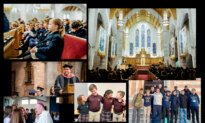
Five years later, the couple and both of their children are part of a growing family at the nearby Providence School of Tifton, Georgia, which had just started up when they had had enough of public schools. Jennifer Puckett now teaches there, and Justin Puckett is a volunteer board member.
Arabella, 11, and Gideon, 9, are thriving. They love learning Latin and showing off their detailed knowledge of the Bible, ancient Greece, and American history.
They joined one of the fastest-growing segments in American K–12 education.
As the 2025–2026 academic year winds down, classical school enrollment exceeds 677,500 across 1,551 schools and is easily on track to surpass the 1 million student mark within a decade.
Demand to Expand
All told, classical academies, the majority of them Christian evangelical, have increased tenfold in 16 years, from just 150 schools in 2010.
Industry leaders say they are focused on careful growth to ensure that teacher training programs nationwide keep pace with demand.
“It’s been explosive,” Eric Cook, president of the Society for Classical Learning, told The Epoch Times. “It’s been pretty remarkable to watch.”
His organization accredits schools and provides support services. It recently announced a $60 million fundraising initiative to open more schools.
Private classical Christian academies will benefit from a new federal scholarship tax program authorized by Congress last year. It allows each American taxpayer to receive up to a $1,700 dollar-for-dollar credit for contributing to a private school scholarship-granting organization in his or her state.
Leaders in 30 states so far—most recently, New York Gov. Kathy Hochul—have officially opted into the federal program or announced intentions to do so. It will provide taxpayers with the option to contribute to a specific private school choice option in the state where they live, if their governor signs on to the federal initiative.
The American Federation for Children, a national organization that tracks and advocates for universal school choice, will contribute $10 million to support the federal program.
“The federal tax credit could be very short-lived, or it can be another mechanism to provide more access,” Cook said. “That’s why the supply issue is so important. Build more incredible schools, and it will be hard to scrape away from families who really value it.”
What Is Classical Education?
Brick-and-mortar classical education in the United States consists of 1,024 Christian evangelical schools, 308 classical Catholic schools, and 219 nondenominational classical public charter schools that by law cannot include a religious component, according to consulting firm Arcadia Education.
Classical education is rooted in Christianity and Western thought, although it dates back to ancient Greece. It promotes moral development and emphasizes classical literature, such as Aristotle and Shakespeare, rather than contemporary texts, according to the Association of Classical Christian Schools.
This model holistically applies three pillars of learning—grammar, logic, and rhetoric—to all subjects to obtain wisdom, not just understanding. Typical classical schools still teach reading through phonics, in addition to Latin and cursive handwriting. Classroom instruction is more likely to provide information sources—such as the periodic table, the Declaration of Independence, and classic novels—on paper, rather than on digital devices.
Mathematical instruction also goes much deeper. Its roots are described as a language of the universe, and students develop real-world ways of looking at ratios and proportions rather than just drilling for correct answers, David Goodwin, president of the Association of Classical Christian Schools, previously told The Epoch Times.
A 2019 study led by the University of Notre Dame found that nearly 90 percent of graduates from schools accredited by the Association of Classical Christian Schools went on to complete a four-year degree or higher, exceeding the rates of other types of schools.
Justin Puckett said the Christian element solidifies an objective truth free from “chaos, immorality, and confusion.”
“Teachers cannot tell a student that violence, theft, or cheating is wrong without a standard of morality and ethics,” he said. “Parents cannot hold schools accountable without a standard of morality and ethics.”
The Network for Public Education, which opposes public charter schools and voucher initiatives, previously denounced classical Christian schools as institutions that serve white Christian nationalism and “the Conservative agenda.”
“If we continue to divert public money to privately managed charter schools, religious schools, and home schooling, we put our nation at risk,” Diane Ravitch, the network’s president, said in a public statement posted on the organization’s website.
Public School Exodus
In a 2024 report, Arcadia Education forecast that enrollment in classical curriculum institutions, whether private and religious or public charter schools, would exceed 1.4 million students across nearly 2,600 schools by 2035. This comes at a time when public school enrollment is decreasing nationwide.
Cook said the biggest spikes took place after the COVID-19 pandemic, when public school parents across the nation got a closer look at what their children were—or were not—learning. Private school vouchers, educational savings accounts, and other school-choice incentives followed in various states.
“People thought about their choices and didn’t default to big box public schools,” he said.
Cook, who previously taught in public schools, said he has witnessed the vastly different approaches firsthand.
“The learning wasn’t anchored in thoughtful, philosophical constructs, and there was so much passive test-taking,” he said. “It just seemed very thin.”
The Expanding Catholic Sector
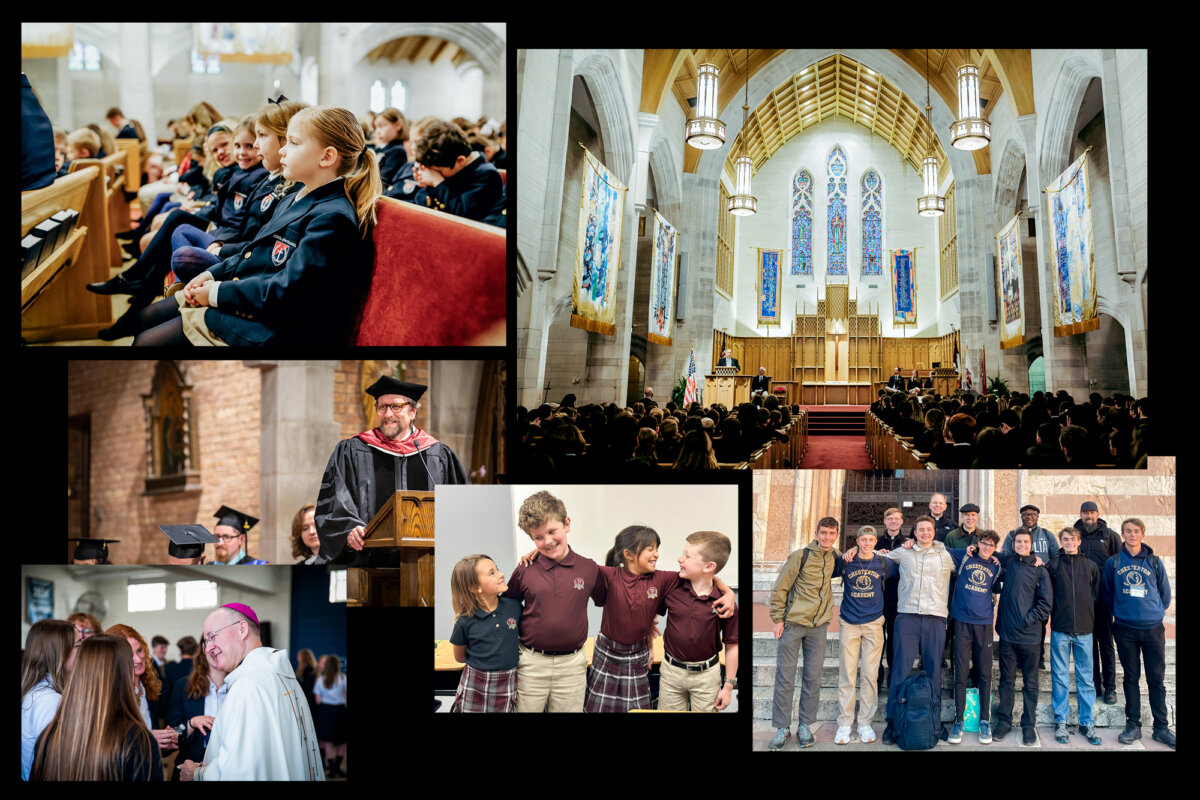
The Chesterton Schools Network of classical Catholic education opened its first school in 2008. Four more were added in 2014. Today, the network has 71 schools, with another 18 planned across the United States and Canada and 12 in Europe and Africa, said Dale Ahlquist, the program’s founder.
Chesterton, unlike other classical Catholic organizations, is limited to grades nine to 12. Student bodies are made up of those who attended traditional Catholic schools through eighth grade, as well as former public school and homeschooled students. The schools have a similar approach to that of their evangelical counterparts, focusing on great literature as the vehicle for telling the human story—but require daily Mass. Annual tuition is less than $10,000.
“We’re astounded by this growth,” Ahlquist told The Epoch Times. “We had a good model, and the word got out without us doing any publicity.”
Chesterton was awarded the $1 million Yass Prize from the Center for Education Reform last year. Ahlquist said the money will be used to train more teachers.
Classic Learning Test
The Classic Learning Test, introduced in 2015, is an alternative to the SAT and ACT for college admissions. It also measures verbal and mathematical reasoning, but the reading passages are longer, and students are not allowed to use calculators.
Today, it is accepted by more than 300 institutions, including private religious colleges, the U.S. military service academies, and entire state university systems in Florida, Georgia, Arkansas, North Carolina, and Indiana.
The Common Core curriculum adopted by most state education departments replaced whole books with shorter passages for summarizing on laptops. The SAT was modified to reflect that change, along with the allowance of calculators.
Many colleges and universities stopped requiring the SAT in recent years, either because of COVID-19 pandemic-related learning loss or to boost racial diversity. Advocates of the Classic Learning Test say their preferred exam reflects a better way to teach, learn, and assess aptitude for a more rigorous higher education.
In an April report provided to The Epoch Times, Classic Learning Test administrators said research across a variety of colleges and universities in Pennsylvania, Ohio, and Texas indicated that students who took the test had maintained grade point averages 5 to 10 percentage points higher than their peers who took the SAT.
The Future of Classical Learning
Justin Puckett said his school in Georgia began as pre-K through fifth grade but will add a grade each year to accommodate local demand. Without middle and high school classical Christian programs in Tifton, families would otherwise have to drive their children more than 40 miles to continue that curriculum.
At less than $8,000 per year, the Providence School costs less than other private institutions in the region, and state and federal school-choice initiatives could help scores of families.
“It’s become very popular because people see how the kids act in the classroom, and they’re engaged with what’s going on around them, not just memorizing things,” Justin Puckett said.
The American Enterprise Institute reported that the supply of teachers trained in classical (Christian) instruction will not keep up with demand unless a pipeline specific to this approach is established to provide between 70,000 and 117,000 teachers by 2035.
“Classical education demands an unusual synthesis: a teacher who is intellectually serious, well-versed in the great books, morally grounded, and pedagogically effective in techniques such as explicit instruction and Socratic seminars,” the August 2025 report states.
Meeting that demand requires less of an institutional approach and more of a grassroots effort led and spread by the classical education community, said Brad Dolloff, dean of the School of the Ozarks, a classical Christian academy located on the campus of the College of the Ozarks in Missouri.
The tuition-free school is funded by the college, which offers a minor in classical Christian education and allows undergraduates a live look at this educational approach. The institutions hold an annual summer training program for established teachers and other professionals interested in this specialty, as well as a spring conference that provides training and networking opportunities.
“They’ve filled up just by word of mouth,” Dolloff told The Epoch Times, noting that alumni include people involved with a new great books program planned at Pepperdine University. “We no longer have to advertise it.”
Dolloff was a public school teacher for 25 years before helping open the school in 2012.
As a middle-aged adult, he had to learn what he would be teaching in this new institution and read dozens of classic novels. Now he is helping experienced engineers who want to teach math at classical schools and nurses who want to share their knowledge of biology.
“People are set free to do education the way they always wanted to,” he said.
 Friends Read Free
Copy
Facebook
Tweet
Friends Read Free
Copy
Facebook
Tweet