
Israel said on Dec. 30 it suspended more than two dozen international humanitarian organizations from operating in the Gaza Strip and parts of the West Bank, saying they failed to comply with new registration requirements.
The announcement was made by Israel’s Ministry of Diaspora Affairs and Combating Antisemitism, which said more than 30 organizations had not met the criteria. Those affected include major aid providers such as Doctors Without Borders, also known as Médecins Sans Frontières (MSF).
“The message is clear: humanitarian assistance is welcome—the exploitation of humanitarian frameworks for terrorism is not,” said Diaspora Affairs Minister Amichai Chikli.
Israeli officials say the rules are designed to increase transparency around staffing, funding and operations in Gaza, where Israel has long accused Hamas of diverting aid, embedding operatives within civilian institutions and using humanitarian infrastructure for military purposes.
The Coordinator of Government Activities in the Territories (COGAT), the Israeli defense body responsible for implementing government policy in Gaza and the West Bank, said in a Dec. 30 statement on X that the suspensions would not reduce humanitarian assistance.
“It should be clarified that the organizations that received notice regarding the suspension of their activities in the Gaza Strip did not bring aid into Gaza throughout the current ceasefire,” COGAT said, adding that their combined contribution in the past had amounted to “only about 1% of the total aid volume.”
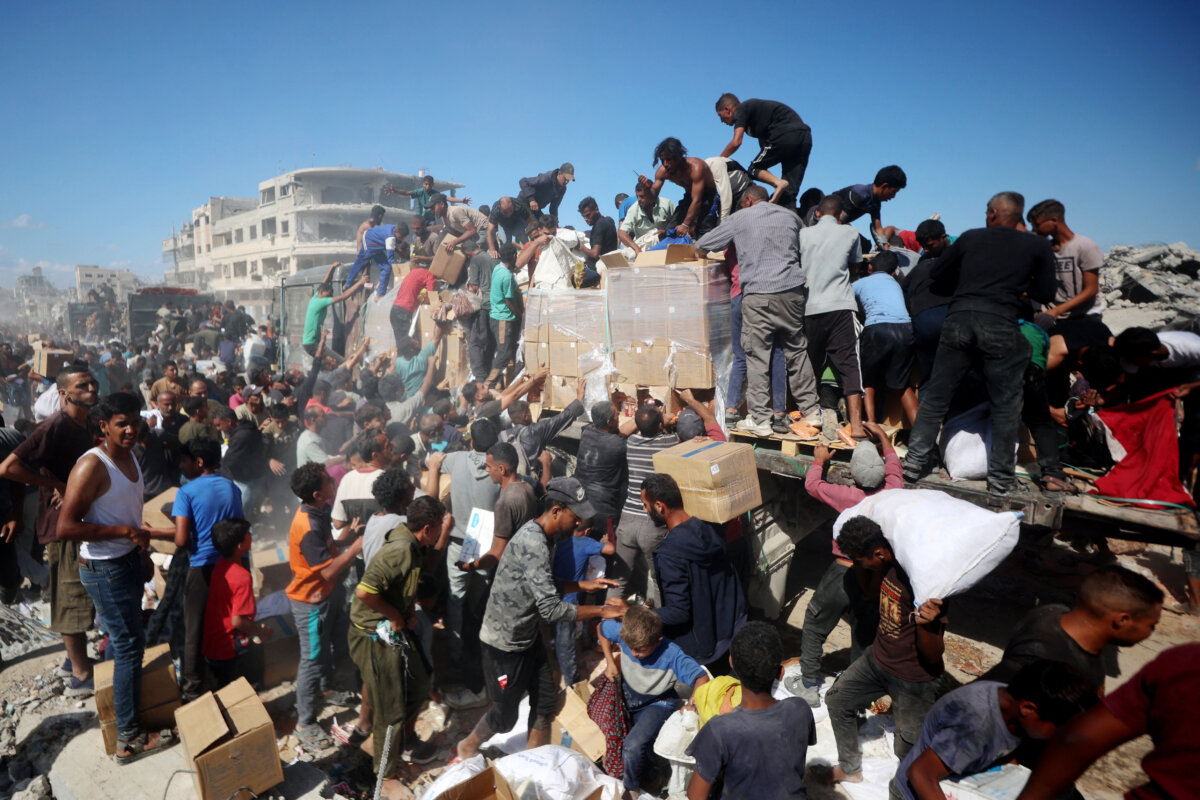
COGAT said about 4,200 aid trucks would continue to enter Gaza each week via the U.N., donor countries, the private sector, and international organizations that remain registered and approved.
“We emphasize that the registration process is intended to prevent the exploitation of aid by Hamas,” COGAT said on Dec. 30, adding that the refusal by some organizations to cooperate with transparency and security checks “raises genuine concern regarding the nature of their activities and the entities with which they operate.”
In a follow-up statement on Dec. 31, COGAT said the rules were meant to protect aid rather than restrict it.
In another X post the same day, the agency said: “Registration requirements exist for one reason: To stop Hamas from exploiting aid, including diversion, terror-linked financing, and use of local NGO workers to further their terror activity. This has been documented repeatedly. Transparency isn’t oppression. It’s protection.”
Western Allies and EU Criticize Move
The suspensions drew swift criticism from Western governments and humanitarian officials.
In a joint statement on Dec. 30, the foreign ministers of the United Kingdom, France, Canada, Denmark, Finland, Iceland, Japan, Norway, Sweden and Switzerland said international NGOs were essential to Gaza’s humanitarian response.
“Without them, it will be impossible to meet all urgent needs at the scale required,” they said, calling any attempt to curb their operations “unacceptable” and Israel’s registration requirements for NGOs “restrictive.”
The ministers called for the United Nations and its partners, including the U.N. Relief and Works Agency for Palestine Refugees (UNRWA), to be allowed to continue their work across Gaza. The call follows a broader Israeli dispute with the aid agency, which Israel earlier this year accused of being infiltrated by Hamas.
Jerusalem alleged that several UNRWA staff members participated in or supported the Oct. 7, 2023 attacks. UNRWA investigated 19 staff over Oct. 7 allegations, and nine were dismissed over possible links. Of the other 10 staff, one was cleared, and nine lacked sufficient evidence.
The joint statement also called for crossings to be opened and humanitarian flows sharply increased, noting that while the Allenby crossing has partially reopened, key routes such as Rafah Crossing remain closed or severely restricted.
Aid targets, including 4,200 trucks per week, should be treated as a minimum, not a cap, and bureaucratic delays must be reduced to allow supplies in at the scale required, the ministers said.
In response, Israeli Foreign Ministry on Dec. 30 described the joint statement as “false but unsurprising.”
“It reflects a recurring pattern of detached criticism and one-sided demands on Israel, while deliberately ignoring the essential requirement of disarming Hamas—a prerequisite for the security of Israel and the region,” the ministry said.
European Union humanitarian aid chief Hadja Lahbib also condemned the NGOs suspension in a Dec. 31 post on X.
“Israel’s plans to block INGOs in Gaza means blocking life-saving aid,” she said. “The EU has been clear: the NGO registration law can not be implemented in its current form. All barriers to humanitarian access must be lifted.”
COGAT has rejected claims that Israel was undermining the humanitarian system, saying hundreds of international staff are currently operating in Gaza, most of them affiliated with the United Nations and the International Committee of the Red Cross.
“Three international NGOs—including organizations from the United States, United Kingdom, Germany, and France—have been approved and are operating in the Gaza Strip. Humanitarian assistance to Gaza continues uninterrupted,” it said in another Dec. 31 post on X. “Some NGOs refuse transparency. That raises a simple question: What are they hiding?”
Last week, MSF alleged that the new registration requirements could have severe consequences for civilians.
In a Dec. 22 statement, the organization said the rules risk leaving “hundreds of thousands of people in Gaza, Palestine, without lifesaving healthcare in 2026,” as registration withdrawals could take effect on Jan. 1.
MSF said its operations support nearly half a million people in Gaza through emergency care, water provision and assistance to a shattered health system, warning that loss of access would deprive civilians of critical medical services.
COGAT said on Dec. 30 that MSF “chose not to cooperate” with the registration process and refused to provide Israeli officials with a list of its employees, as required by a government decision.
The Associated Press contributed to this report.
 Friends Read Free
Copy
Facebook
Tweet
Friends Read Free
Copy
Facebook
Tweet