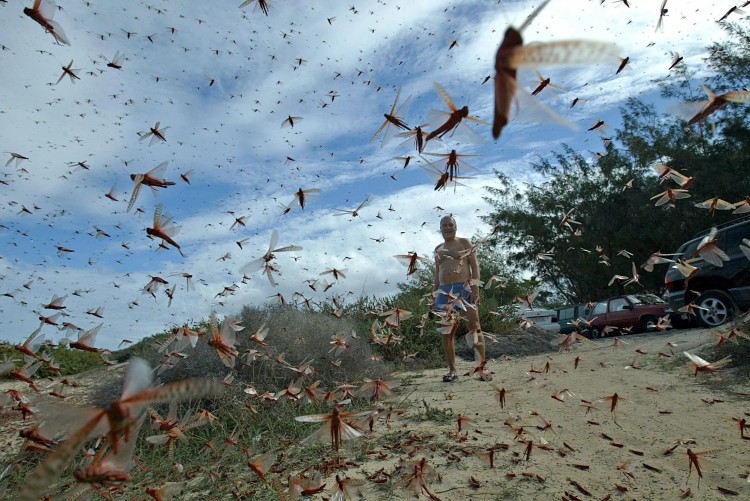

Locusts swarm Egypt: A typical swarm of locusts can eat as much food as 2,500 people can eat in a single day, according to the UN.
The estimated 30 million locusts landing in Giza, near southern Cairo, last weekend is not the only time the area has been plagued by the insects.
In 2004 a large-scale locust swarm hit 15 of Egypt’s 27 government regions, which reported infestations and extensive crop damage, according to the Albawaba. Much like the response this time, locals responded by burning tires, hoping the smoke would drive the swarms away.
In January this year, locusts began to infest Egypt’s southeast after heavy rainfall—and it was the start of a new locusts breeding season, according to Albawaba. The Egyptian Ministry of Agriculture used pesticides to clear 11,000 hectares of land of locusts. But the numbers continued to climb.
A typical swarm of locusts can eat as much food as 2,500 people can eat in a single day. One adult locust can eat its own weight in food every day—about 2 grams, according to the Food and Agriculture Organization of the United Nations.
“At these rates, the locusts consume most vegetation in their path and then must migrate to find new sources of food,” according to the NASA Earth Observatory.
Egyptian Agricultural Minister Salah Abad Almoman said that the armed forces and the Egyptian border units are trying to battle the swarm with various means at their disposal, according to Albawaba.
Almoman asked families living in areas afflicted to not set fire to car tires, expressing concern if a fire were to spread.
He said strong winds predicted for the coming days are expected to blow the insects in the direction of Saudi Arabia and the Red Sea, according to Albawaba.
Here is a look at locust swarms that caused large-scale damage in the past 100 years.
The 1915 Locust Plague
The 1915 Locust Plague stripped Jerusalem and Syria of almost all vegetation. As a result, food prices in the area soared. Residents in the region were already experiencing food shortages due to a war.
“Witnesses to the locust invasion that befell Jerusalem and the nearby Syrian region in 1915 agreed that they had seen nothing to equal it in their life-times. It was truly a natural disaster of biblical proportions,” reported the Library of Congress. “With vineyards and summer vegetable crops destroyed, wine and produce were available only to the rich and those with access to foreign imports. Peasants in rural areas were denied both their livelihoods and means of providing important sources of nutrition to their families.”
The 2004 Desert Locusts Outbreak
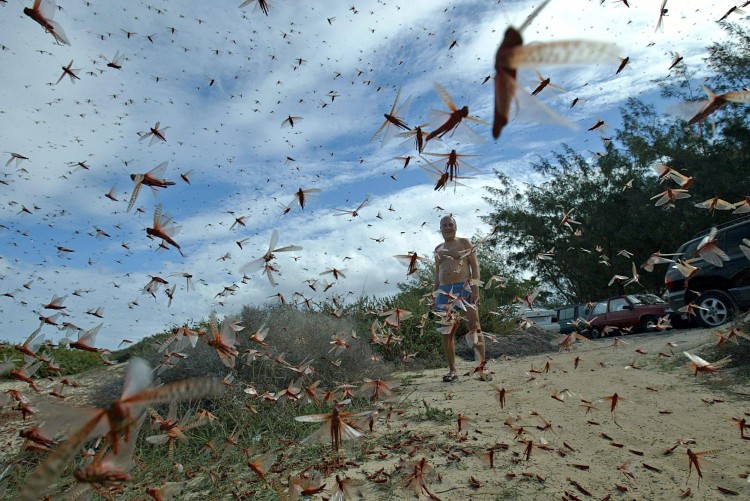
The 2004 desert locust outbreak began in Morocco and Algeria in northwestern Africa. Mauritania was badly affected, as was Senegal, Mali, Burkina Faso, Niger, Chad, and the Cape Verde Islands.
On Oct. 1, 2004, three to four million hectares of land were infested with locusts, according to the NASA Earth Observatory.
Swarms of locusts can reach up to 80 million locusts per square kilometer.
The NASA Earth Observatory showed satellite images of before and after the 2004 desert locust outbreak. NASA pointed out that there was clearly more vegetation available in the region before the outbreak.
The Australian Locust Infestation
Australia’s locust infestations involve one species of locusts called the “Australian plague locust.”
“The Australian plague locust is the most serious pest species in Australia due to the frequency of outbreaks (gregarious population increases) and the large areas infested,” according to the Australian Government’s Department of Agriculture, Fisheries, and Forestry (DAFF).
Extensive outbreaks were first recorded in the 1870s, affecting areas of New South Wales, South Australia, and Victoria.
“In Western Australia outbreaks were less frequent, but in recent decades major outbreaks have occurred in 1999-2001, 2004, 2006, 2009, and 2012,” according to the DAFF.
Australia has been impacted by at least five major locusts plagues since 1992, according to a chart from the DAFF. A “major plague” is categorized as having over 500,000 hectares infested by swarms in the agricultural regions.
“The Australian plague locust can reach plague proportions within a year if a sequence of widespread heavy rains occurs in inland areas, particularly during summer, allowing them to complete several generations of increase,” according to the DAFF.
 Friends Read Free
Copy
Facebook
Tweet
Friends Read Free
Copy
Facebook
Tweet