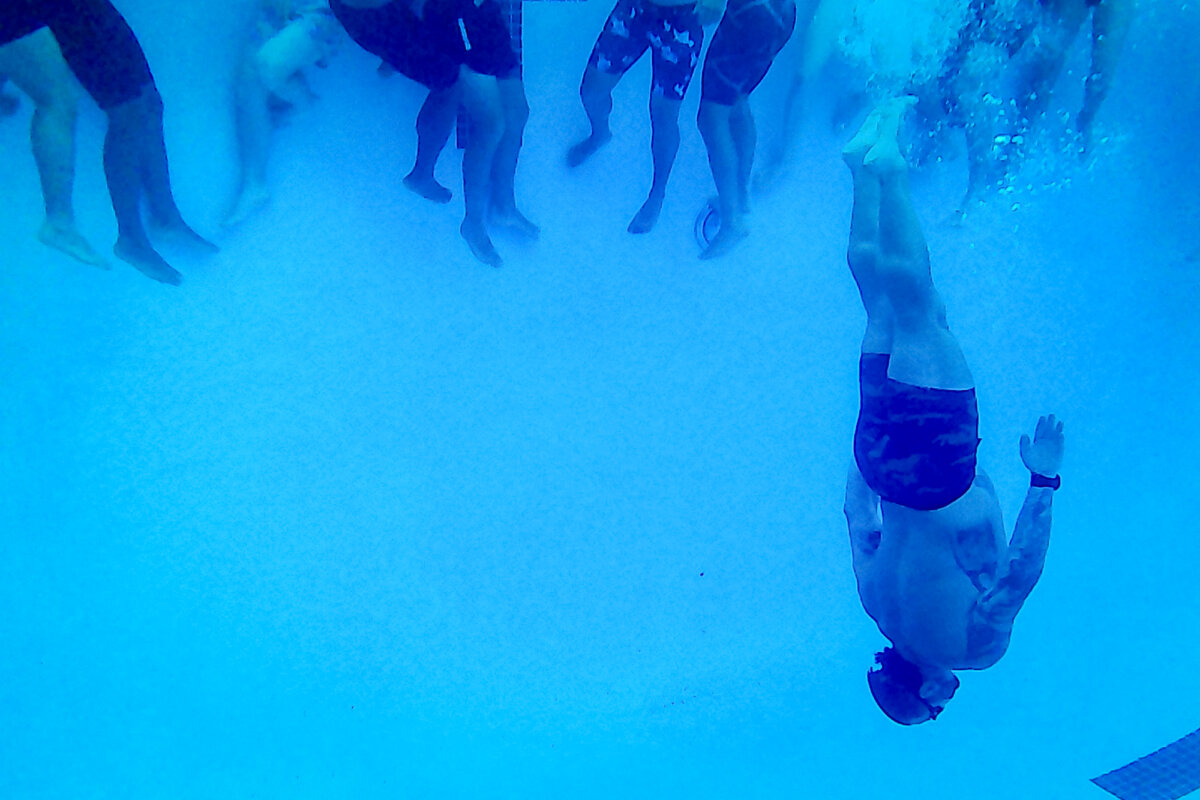

SCOTTSDALE, Ariz.—Connor Schutza broke the surface of the pool, breathing hard, his muscles burning after another deep-end drill designed to test more than physical endurance.
Each descent had a purpose for the 22-year-old Scottsdale resident. He wasn’t training for a race or fitness competition.
He was preparing for a shot at the Air Force’s elite special warfare community—one of the military’s most demanding career fields.
The path requires more than strength. It demands composure under pressure, the ability to push through exhaustion, and the discipline to silence the urge to quit.
Over the past several months, Schutza trained with senior instructors at Deep End Fitness Scottsdale, a veteran-designed program that uses the pool as a proving ground for mental toughness and physical endurance.
“The main thing of the program is mental resilience, which translates into physical resilience,” Schutza told The Epoch Times.
On June 2, Schutza shipped out for Air Force basic military training under a six-year enlistment contract.
He left Arizona carrying confidence forged through months of grueling preparation—an edge that could prove decisive in a field where many candidates fall short.
For special operations recruits, physical fitness is only the start. Success depends on performing under stress, managing fear, and staying focused when exhausted. Deep End Fitness builds those traits through water-based training that sharpens resilience, confidence, and mental endurance.
The Scottsdale chapter has become a destination for athletes, military-bound young adults, and aspiring first responders looking for an edge before entering demanding training pipelines.
Preparing for the Challenge
When it comes to preparing for these roles, everything begins with a strong physical foundation—something modern lifestyles often undermine.
The Centers for Disease Control and Prevention’s “Unfit to Serve” report found that, in 2018, an estimated 71 percent of young Americans were ineligible for military service. Obesity, educational deficiencies, and criminal or drug-related histories were among the leading factors.
The report found that only about two in five young adults were both physically active and within military weight standards. Young adults ages 17 to 24 account for roughly 90 percent of military applicants, making the shrinking pool of eligible recruits a growing concern for military leaders.
To address the problem, the Arizona Army and Air National Guard have launched programs designed to help recruits close the fitness gap before basic training.
For candidates pursuing elite military assignments, however, the preparation often extends beyond standard requirements.
That is where Deep End Fitness enters the picture.
Veterans Teaching Resilience
Founded in Southern California in 2017 by military veterans Prime Hall and Don Tran, Deep End Fitness was created with elite athletes and military-bound recruits in mind.
The Scottsdale chapter opened in 2021.
The program’s philosophy is rooted in a simple premise: People discover their capabilities when they are forced outside their comfort zones.
Travis Haley, a senior instructor at Deep End Fitness Scottsdale, believes those lessons are becoming increasingly valuable.
Haley, 50, is a former Marine reconnaissance operator who served from 1993 to 2009. During his military career, he completed 14 combat tours during Operation Iraqi Freedom and deployed to Somalia, Kosovo, the Balkans, Afghanistan, and other locations.
“Whether it was equipment, weapon systems, training, foreign weapon systems, airborne operations, and dive supervisor type missions, I would be kind of the go-to guy for that,” Haley told The Epoch Times.
He credits much of his adaptability to growing up on a farm in Florida.
“Just improvising and overcoming and adapting to most situations,” he said.
After leaving the military, Haley worked as a contractor developing weapons and tactics training programs before launching Scottsdale-based Haley Strategic Partners in 2011.
His connection to Deep End Fitness came through his son Hayden, who joined the program while preparing to enter the Marine Corps.
Through Hayden, Haley met Scottsdale chapter founder Lysander Caligo, a former Marine and Iraq War veteran.
“We all hit it off and watched my son turn into a whole man throughout those two years in the program,” Haley said.
“He joined the Marines and was top dog. We haven’t stopped since we started this.”
A Different Kind of Training
Caligo, 41, said the Scottsdale chapter’s membership reflects the program’s growing reputation among military hopefuls. Roughly 60 percent of the chapter’s 40 core members are pursuing military careers, many with ambitions of entering special operations communities.
“So these are serious goals, serious people,” Caligo said.
Recruiters from different military branches regularly visit the program to observe trainees and evaluate their readiness, he said.
“They see what we’re doing here and want to know if they’re ready. Most of the time, students arrive very young, not fully in shape, and they’ve never really faced much hardship,” he said.
But Caligo said the program often attracts people looking for challenges beyond traditional fitness training.
“Those are the people that are looking to go down the special operations pipelines in all five branches,” he said.
Training sessions are held at Scottsdale’s Eldorado Aquatic Center and Cactus Aquatic Center.
Each session begins with what instructors call a “circle of trust,” where participants introduce themselves, discuss goals, and practice controlled breathing exercises before entering a 14-foot-deep pool.
The atmosphere is supportive yet demanding. But Deep End Fitness training leaves little room for the shallow end.
Foundation and screen drills are used to gauge basic aquatic fitness and build comfort in deep water. Students tread water for up to 10 minutes, pushing their endurance to the limit while remaining calm under pressure.
Drills grow more demanding. Trainees dive to the bottom of the pool, hands locked behind their backs, to retrieve goggles or a diving brick. Others perform water walks, carrying 45-pound dumbbells from shallow to deep water.
Core sessions fuse conditioning with controlled breathing as heart rates climb under stress.
Exercises such as the “brick fish” test single-arm strength and composure under load, using a rubber diving brick. The “brick tow” adds distance: a 25-meter sidestroke swim while towing the brick.
“Bobs” and “bottom outs” push breath control further, training swimmers to increase underwater tolerance and manage rising carbon dioxide levels. The objective is not simply to build stronger swimmers.
Instead, instructors aim to teach participants how to remain calm when their bodies and minds are urging them to panic, Caligo said.
Repeated exposure to controlled stress helps students develop confidence in situations that initially feel overwhelming.
Sessions conclude with a second circle of trust, where participants review their performance, discuss lessons learned, and identify areas for improvement.
Building Confidence
For Caligo, success is measured less by physical performance than by personal growth.
“If I can teach you how to set up in your mind, how to create a process for you to be successful, the outcome is going to occur, however it unfolds,” he said.
That lesson resonated with Schutza.
Like many young men preparing for military service, he arrived with physical ability but limited experience operating under sustained stress.
Over time, the underwater exercises forced him to confront self-doubt and develop greater confidence.
“When I first got here, I was kind of unconfident,” Schutza said. “The program taught me to be upfront and confident in the way I speak and all that.”
Instructors said the change was visible beyond the pool. Trainees gained not only physical stamina and better focus, but confidence as well.
As his departure date approached, Schutza viewed the training as preparation for the challenges he knew awaited him.
The Air Force special warfare pipeline is known for its high attrition rates and demanding standards, he said.
Candidates are expected to perform under conditions that test both physical endurance and mental resolve.
While no program can guarantee success, Schutza believes his months at Deep End Fitness gave him a foundation many recruits lack.
The lessons learned underwater, he said, went far beyond swimming.
They taught him how to continue moving forward when quitting seemed easier.
For aspiring special operators, Caligo said, those traits can mean the difference between joining an elite unit and washing out before the finish line.
 Friends Read Free
Copy
Facebook
Tweet
Friends Read Free
Copy
Facebook
Tweet