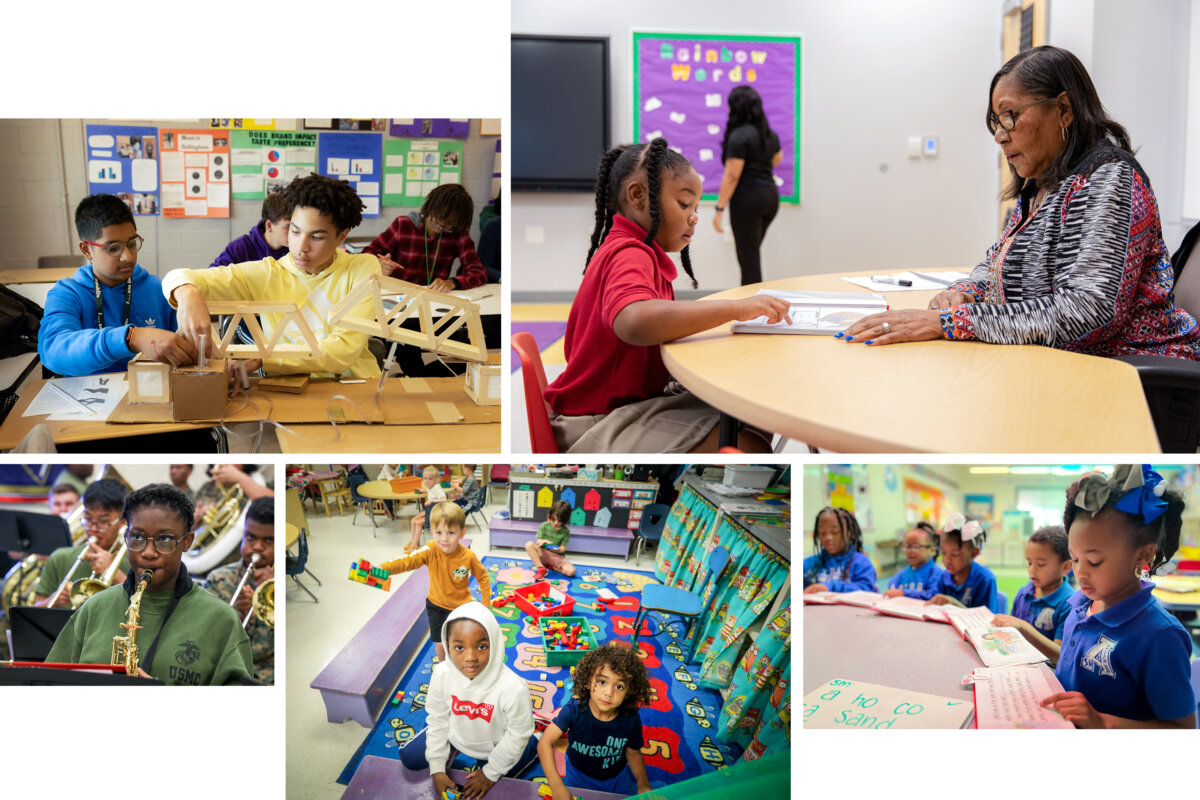

In the 1990s, New Orleans schools provided little respite from the lockdowns, the arrests, the drug use, and the violence seen and heard at home, Oscar Brown recalls.
Brown grew up in what was then among the poorest, most densely populated public housing projects in the nation. Most of its teenagers attended one crowded high school: George Washington Carver.
“The teachers cared about us and did the best they could,” Brown told The Epoch Times.
“But there was always a whole lot of disruptions. The teachers didn’t get enough time to educate us. Life skills—survival—were always more important.”
Fast-forward two decades—and past one of the most catastrophic weather events in U.S. history—and Brown’s son had earned an associate’s degree at the rebuilt high school on the very same lot in the Ninth Ward in 2020. That was even before he was handed his high school diploma.
Brown’s daughter, a rising senior at the school, is on track to complete a nursing certification that both qualifies her for a good-paying job immediately after graduation and helps contribute toward a four-year college program.
“It’s a clear night and day difference,” Brown said. “Schools here really dive deep into education now—they’re not just there to be your mom or your dad.”
The 2025–2026 academic year marked the 20th anniversary of Hurricane Katrina. In unison with the city’s physical recovery that began after the 2005 disaster, the city’s K–12 learning institutions experienced a sea change of their own, becoming the first all-charter system in the nation and potentially a model for others to follow.
High Marks in 2026
The most recent public education scorecard, released by researchers from Harvard, Stanford, and Dartmouth College on May 13, indicates that NOLA Public Schools consistently ranked in the 99th national percentile for reading growth between 2022 and 2025, and the 98th percentile for math during the same period.
Louisiana is the only state to surpass pre-COVID-19-pandemic performance levels in both subjects, according to the report.
Fateama Fulmore, NOLA Public Schools superintendent, said her students are accelerating at about 1.35 grade levels per year. She credits the children, families, and teachers for their “relentless focus.”
“While we still have work to do to close longstanding achievement gaps, the trajectory is clear: NOLA Public Schools is moving in the right direction, and our students are growing, achieving, and thriving at higher levels than ever before,” she said in a news release.
In 2005, more than 60 percent of the city’s public schools were considered “failing” and among the Bayou State’s lowest performing. Today, none of its public schools are failing; 92 percent of them have an A or B grade from state and national organizations that rate academic progress, and the district overall just finished the academic year with a B grade, its highest ever, said Caroline Roemer, executive director of the Louisiana Association of Public Charter Schools.
“This progress reflects what is possible when autonomy, accountability, and innovation are sustained over time,” she told The Epoch Times.
The Rebuild
New Orleans’s move to an all-charter system was prompted by Hurricane Katrina, after which the state Legislature authorized its Department of Education to take over most of the city’s worst-performing schools.
Federal disaster relief and private foundation money helped reopen the 100-plus schools in the wake of the disaster. Local leaders at that time seized that moment to address the long-struggling public institution and low graduation rates.
Union contracts were allowed to expire, more than 7,000 teachers and staff were fired, and the attendance zones for neighborhood schools were eliminated, allowing families to choose any publicly funded school in the city.
By 2018, all of the city schools taken over by the state 13 years prior were converted to charters, said Jamie Carroll, managing director at Tulane University’s Education Research Alliance for New Orleans.
“To be fair, there was a very low bar, and there was so much corruption pre-Katrina—embezzlement, financial mismanagement, under-the-table dealings,” she told The Epoch Times. “But the fact that this has been sustained is amazing.”
Eighth-grade English standardized test scores rose drastically, according to an Education Research Alliance report; 48 percent of students reached mastery levels or above in 2016, compared with 20 percent before 2014. In eighth-grade math, 35 percent of students reached or exceeded mastery levels in 2015, compared with 14 percent the year prior. Scores declined during the COVID-19 pandemic but rebounded again after 2021, the report found.
All told, the district improved across the board, climbing up from the bottom to near or above the state average in every category, and the gains were sustained after the COVID-19 pandemic, the report said.
A Different System
Charters, often formed by parents or teachers dissatisfied with their neighborhood schools, operate independently of local districts but still adhere to state and federal conditions to receive public funds. A charter school can be closed quickly because of poor performance.
They cannot charge tuition, and student admission is often based on a lottery if interest exceeds available slots. In districts where multiple charter schools are available, families can ideally choose based on their preference for location or programming. Charter schools can be fully self-managed by their own staff and community members, or by either nonprofit or for-profit organizations.
In the Big Easy, varying groups manage 69 schools but still answer to NOLA Public Schools and its voting body, the Orleans Parish School Board, on matters of appropriations and charter applications.
New Orleans, with more than 46,000 students, is mostly black and reflects a national trend: The National Alliance for Public Charter Schools previously reported that 60.5 percent of charter school students are black or Hispanic, compared with 41.9 percent of traditional public school students, and it reported that charter schools receive, on average, about $3,500 less per pupil in total taxpayer funding than public schools.
Charters also provide, on average, 16 more days of reading instruction and six more days of math instruction per year than traditional public schools.
Mixed Feelings
The mass firings were unsettling, considering that so many displaced teachers were local and black and their replacements were disproportionately white and from other areas. Parents were angry about the loss of neighborhood schools and lack of community input and control. Arts were cut to focus on academic improvement, Carroll said.
“The pushback you heard from many—‘This was done to us, not with us,'” she said.
Brown said that although he applauds the schools today and believes drastic changes were necessary, many families never bought into the charter system “and never will.”
Carol Burris, executive director of the Network for Public Education, in an edition of The Progressive Magazine, said families wanted schools with arts, science labs, and strong community roots but instead received “no excuses discipline policies and endless test prep.”
The National Center for Charter School Accountability criticized the changes and questioned whether improvements were seen districtwide. In a November 2025 report, the center said that high scores from mostly white schools skewed the data and that the spotlight on growth rates in reading and math across the city masks the deficient performance and inequities in individual schools.
“Two decades after Hurricane Katrina, New Orleans stands as a warning—not a model,” the report reads. “The ‘achievement gains’ so loudly proclaimed have not delivered dignity, equity, or justice for black students. A system that prizes statistical measures over the flourishing of our youth is not promising; it is destructive.”
Can It Work Elsewhere?
Carroll said education leaders from across the nation have reached out to her, but she cautions that the New Orleans system can’t be templated, largely because of the amount of money that became available to it following Hurricane Katrina, in addition to the extreme circumstances that allowed the state Legislature to quickly rewrite laws governing a local school district.
Other tradeoffs, Carroll said, should be considered: Transportation costs more than doubled with school choice, and the average bus ride increased to about 35 minutes one-way. The charters have more ability to remove low-performing teachers, but there has also been significant turnover, as high-performing teachers have moved to public schools with generous union contracts and shorter workdays.
Brown said this model can work in other places if residents are willing to consider input and collaboration from outsiders.
It won’t work, he said, if too many people automatically abandon their communities for the highest-performing institutions. Brown’s children stayed with their neighborhood school, and he remained in the Ninth Ward to lead its community center.
“You must have the integrity to stay,” he said. “I wanted to practice what I preach.”
Accountability, family engagement, and community trust are key. Districts must intervene quickly when there are academic or operational failures, and charter school operators require stability and predictability, Roemer said.
“The goal should always be fair, transparent standards that protect students and families,” she said, “not uncertainty that discourages strong operators from serving communities.”
 Friends Read Free
Copy
Facebook
Tweet
Friends Read Free
Copy
Facebook
Tweet