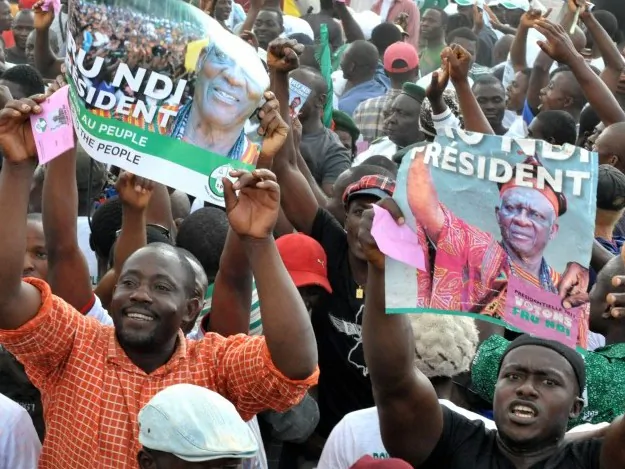
Paul Biya’s sixth straight presidential victory in Cameroon last month—extending his 29-year rule by another seven years—may not be an indication that all is well in the republic, and that there is no will for change. Low voter turnout and opposition accusations of electoral fraud indicate that people in Cameroon have become apathetic. More and more, they are turning their hopes toward the diaspora to bring an end to three decades of stagnation under Biya. But although the diaspora could pull the trigger, experts say that the real change has to come from citizens inside the country first.
The election outcome has had a positive result in terms of the prospects for reform: civil society and overseas Cameroonians have come to realize that real change can be brought about only if they act in unity and coordination.
Cameroon’s diaspora, amounting to 2.5 million to 4 million around the world, have been rejected as a voice in their homeland for many years and seen as an enemy since the establishment of the republic in 1960.
“That is why the first president, Ahmadou Ahidjo, forbade the double nationality for Cameroonian citizens, and did not grant citizens of the diaspora with the right to vote,” Julie Owono, a Cameroonian blogger for Global Voices, said in a telephone interview from Paris.
This year for the first time, however, Cameroonians living overseas were allowed to vote in the presidential elections. The decision, although viewed as a positive step, may be rooted in economic interests.
According to a 2011 World Bank report, “Diaspora for Development in Africa,” the potential savings of Cameroonian migrants within Cameroon is equivalent to 3.8 percent of the Gross Domestic Product (GDP). Moreover, bank and other informal money transfers amount to between 9 and 24 percent of the GDP.
But despite bringing fresh money into Cameroon, the diaspora has not been forgiven by the government for infusing a rebel spirit in Cameroonian nationals.
At a press conference in February, Minister of Communications Issa Tchiroma lashed out at overseas Cameroonians for using Facebook and Twitter to try and launch Egypt-type protests in Cameroon.
“They are quietly living abroad and it is easy to send messages through the Internet or Facebook, instigating people to demonstrate. If they are sincere, let them come back to the country and compete within the ambit of the law for political positions. Government is aware … these same Cameroonians in the diaspora have been disenfranchised because of their treacherous behavior.”
Tchiroma added, “Cameroonian families would not allow their children to go to the streets to be massacred.”
Dibussi Tande, a Cameroonian blogger and writer living in Chicago, wrote on his website: “The Minister did not explain why citizens exercising their constitutionally protected right of freedom of assembly and free speech would be ‘massacred’ and by whom.”
In fact, demonizing the diaspora is a longstanding tradition of Cameroonian authorities beginning with the Ahidjo regime, which made a national hobby of lashing out at “anti-nationalists” and “subversives” abroad, says Tande.
“And a lot of people bought this,” noted Tande in a telephone interview.
It is the diaspora’s criticism of the regime that has led the Cameroonian authorities to fear them so strongly.
“Most diaspora members I have met are not supporters of the government, so that would put them at odds and prompt [the] government to see them as enemies,” writes Steven McDonald in an email. McDonald is director of the Africa program at the Woodrow Wilson Center for International Scholars, based in Washington, D.C.

Diaspora disorganized
However, overseas Cameroonians are not exactly a unified group.
“Unfortunately the diaspora is so mixed and so disorganized, and this is because there are many people who are disruptive and are blocking any initiatives aiming to bring change to Cameroon,” said Peter Ade, secretary-general of the Cameroon Diaspora for Change (CAMDIAC).
Ade explained that those against change claim to have been persecuted by the regime and applied for political asylum in the United States and in Europe. Yet they defend the regime and engage in talks that attack Cameroonians who want to help the people in their home country.
Still, Cameroonians rely on the diaspora in efforts to get rid of the current political and social system. Some say the problem is not that the diaspora is not active, but that people inside Cameroon are apathetic and afraid to act openly for change.
“A lot of information and messages published by the diaspora seem to fall on deaf ears, as those who claim to want to fight at all costs still lack the guts (and perhaps also the means) to take to the streets. It is perhaps unfortunate, but true,” said Philippe Menkoue, a blogger living in Yaounde, the capital of Cameroon.
Menkoue believes that the diaspora is strong enough to cause a wave of protests, although there is an important limitation to their influence: the extremely low Internet penetration in Cameroon, reaching only 2 percent of the population.
He also points out another problem.
“Diaspora has to partner with credible grass-roots organizations in its efforts to bring change to Cameroon. Sadly, even in the civil society, some key figures are sometimes the partisans of the regime.”
But Kah Walla, one of the 22 opposition leaders and one of two women who ran for president in last month’s election, tends to disagree.
“If the diaspora organizes much better than now and does its homework, it will be instantly clear who are its partners on the ground,” said Walla by telephone from Yaounde.
Leader of the Cameroon O Bosso (Cameroon Let’s Go), Walla sees the role of the diaspora in four main directions: to convey to the outside world information emerging from inside Cameroon; to lobby and advocate Cameroon’s partner countries; to carry out civil protests abroad and thus encourage their counterparts in Cameroon; and to provide financial help in the efforts for change.
However, Walla notes the push for change should really come from inside the country, because only then it will be effective.
“The transition has to be led by the people. This is the only pressure that the government will succumb to,” she said.
The biggest challenge is to educate and inform people on a grass-roots level, she adds, which is hard because of the violence with which the government responds to protests.
After the coup in April 1984, about 50 people were executed with another 1,000 secretly killed, and some 300 imprisoned. During the 1990s “dead cities campaign” rallies, about 400 people paid with their lives. In the February 2008 hunger strike demonstrations, about 150 young people were killed for protesting against the manipulation of the constitution and the cost of living.
Agnes Taile, an exiled Cameroonian journalist living in the United States, is confident that the diaspora can be united and undertake the necessary steps to bring an end to the current regime.
The people in Cameroon in turn have to “read the signs of the time,” “stop hiding behind selfish interests” and simply act, she said.
“The wind of revolution that swept North Africa must not stop until all these African dictators are put out of harm’s way. There will inevitably be collateral damage but as you know, you can’t make an omelet without breaking eggs. We need every Cameroonian to take the future of Cameroon in hand. It’s now or never.”
 Friends Read Free
Copy
Facebook
Tweet
Friends Read Free
Copy
Facebook
Tweet