
U.S. debt has surpassed $40 trillion, hitting a historic milestone, with publicly held debt approaching 100 percent of the gross domestic product for the first time since World War II.
The U.S. Treasury borrowed most of its money from global bond markets, including individual investors, pension funds, banks, and foreign governments.
Foreign officials and private investors together held some 40 percent of outstanding U.S. Treasury securities as of mid-2025, according to Brookings.
Brookings said foreign investors’ willingness to buy and hold Treasuries has direct consequences for U.S. borrowing costs, the dollar, and financial stability.
Some believed $40 trillion isn’t just a warning about the future but an explanation for the current cost-of-living crisis.
Epoch Times readers also evaluated the economic risks, ultimate responsibility, and solutions for the national debt.
Risks
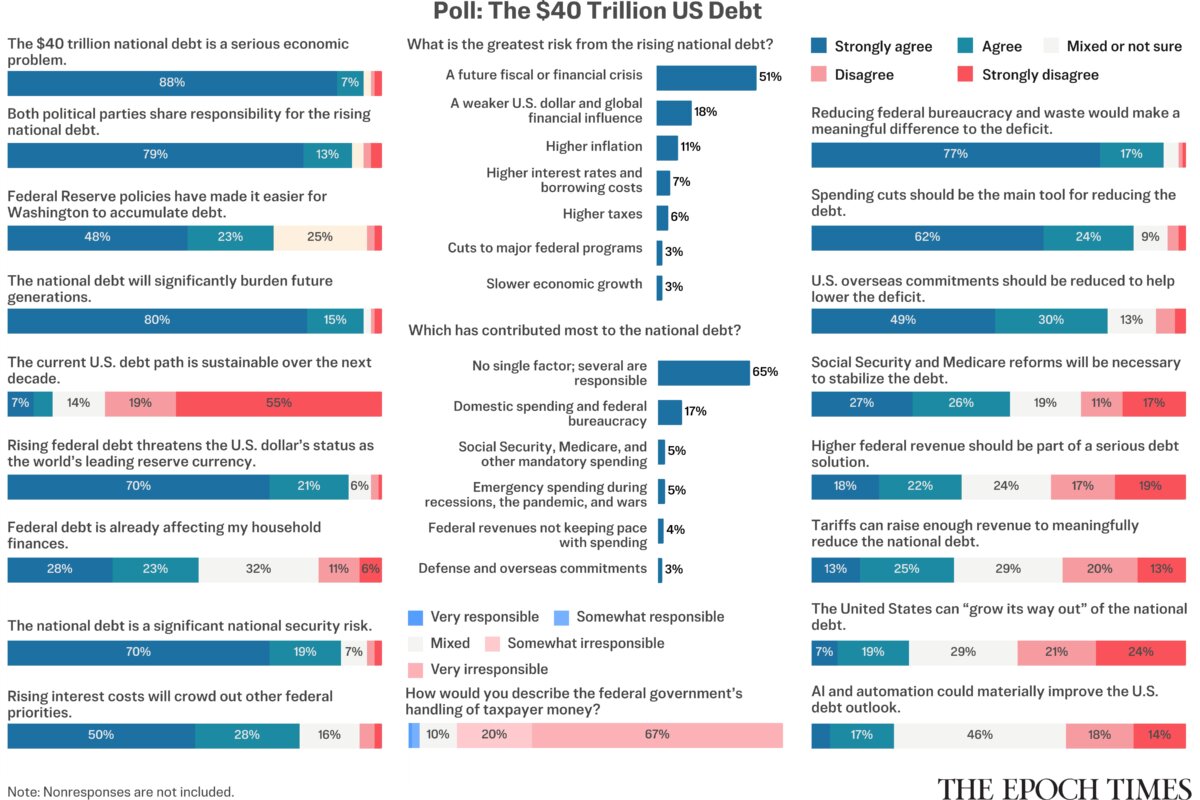
An overwhelming 95 percent of survey takers agreed that the national debt is a serious economic problem.
More than 50 percent of respondents believed that a future fiscal or financial crisis is the greatest risk from the rising national debt, with the same 95 percent saying the national debt will significantly burden future generations.
About three-quarters of readers disagreed that the current U.S. debt path is sustainable over the next decade.
A weaker U.S. dollar and global financial influence ranked as the second-greatest risk according to the survey results, after gaining nearly 20 percent of votes from readers.
And more than 90 percent agreed that rising federal debt threatens the U.S. dollar’s status as the world’s leading reserve currency.
A combined 24 percent pointed to higher inflation, higher interest rates and borrowing costs, and higher taxes as the greatest risk.
More than half of respondents said federal debt is already affecting their household finances, while 17 percent did not feel the impacts and nearly one-third were unsure.
Nearly 90 percent of those asked agreed that the national debt is a significant national security risk.
Another majority (78 percent) believed rising interest costs will crowd out other federal priorities.
Responsibility
Ninety-two percent of survey respondents agreed both major political parties share responsibility for the rising national debt, with 79 percent strongly agreeing.
When asked if Federal Reserve policies have made it easier for Washington to accumulate debt, 71 percent agreed, about one quarter were unsure, and just 4 percent disagreed.
A hefty 87 percent described the federal government’s handling of taxpayer money as irresponsible, with 67 percent saying very irresponsible. Ten percent felt mixed, and three percent reported responsible.
When asked which factors have contributed most to the national debt, 65 percent of readers said that multiple factors have driven it.
Seventeen percent said domestic spending and federal bureaucracy led to the national debt.
A combined 10 percent suggested that mandatory spending such as Social Security, Medicare, and emergency spending during recessions, the pandemic, and wars give rise to the national debt.
Solutions
Most readers suggested bureaucracy reduction and spending cuts as solutions to the national debt.
A majority of respondents (94 percent) said that reducing federal bureaucracy and waste would make a meaningful difference to the deficit.
Eighty-six percent agreed that spending cuts should be the main tool for reducing the debt.
Nearly 80 percent proposed reducing U.S. overseas commitments to lower the deficit.
More than half said Social Security and Medicare reforms will be necessary to stabilize the debt.
Readers were mixed when asked if higher federal revenue should be part of a serious debt solution, with 40 percent agreeing, 36 percent disagreeing, and the rest remaining unsure.
Readers were also divided on raising tariffs to reduce debt. Thirty-eight percent agreed that tariffs can raise enough revenue to meaningfully reduce the national debt, 33 percent disagreed, and 29 percent were not sure.
Notably, 26 percent of those who took the survey agreed that the United States can grow its way out of the national debt, while 45 percent disagreed and 29 percent had mixed feelings.
Nearly half of readers were unsure whether AI and automation could materially improve the U.S. debt outlook. Meanwhile, 22 percent agreed and 32 percent disagreed.
 Friends Read Free
Copy
Facebook
Tweet
Friends Read Free
Copy
Facebook
Tweet