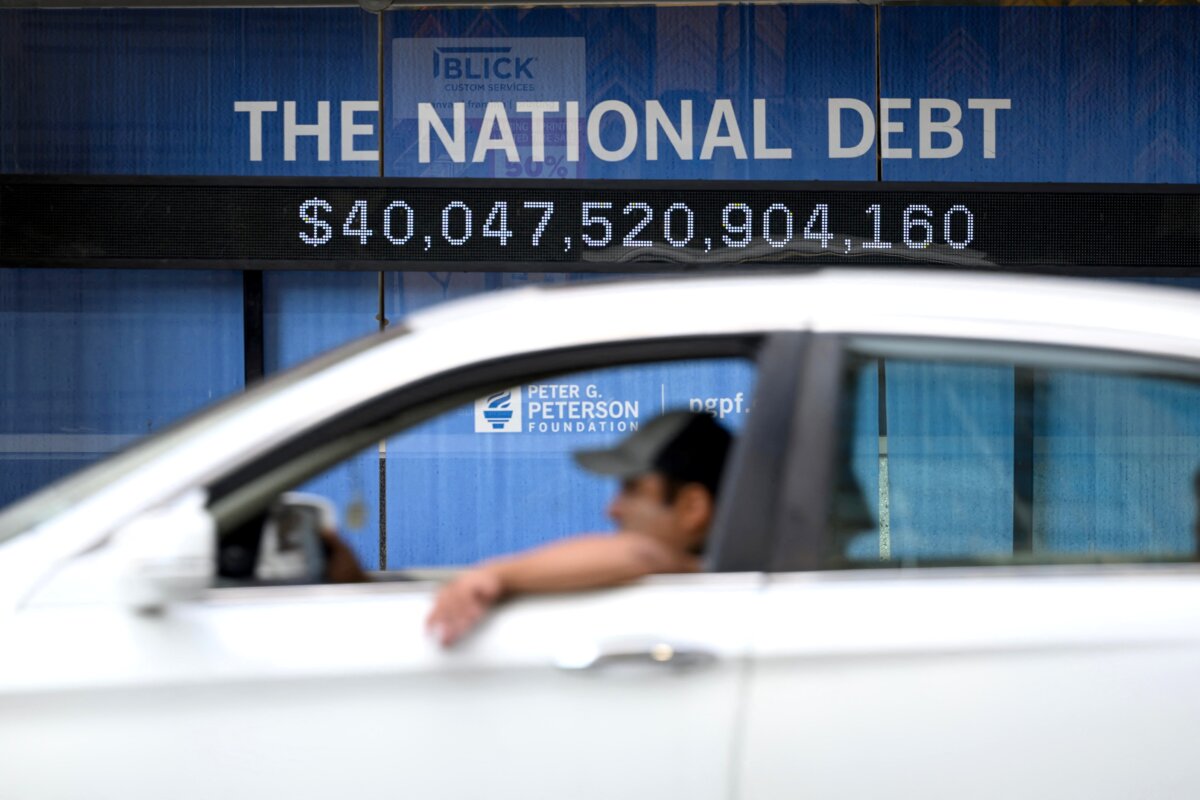

The national debt crossed a historic milestone of $40 trillion this week.
It has been about three months since the federal government’s debt hit $39 trillion, according to the Treasury Department’s debt-to-the-penny dashboard.
Debt held by the public is about $32.2 trillion, and intragovernmental holdings are close to $7.8 trillion.
Hitting this milestone comes firmly ahead of the Congressional Budget Office’s baseline estimate of 2027.
Looking ahead, using the nonpartisan budget watchdog’s 7 percent growth rate scenario, the national debt could barrel toward the $50 trillion mark by 2030.
The U.S. government is collecting a record $5 trillion in revenue (nominally), but it is spending approximately $7 trillion, resulting in annual budget deficits of $2 trillion.
Mandatory entitlement programs—Social Security and Medicare, for example—and surging net interest payments are accounting for a greater share of federal outlays.
Fiscal year-to-date, cumulative spending on Social Security and Medicare has already exceeded $2 trillion. Net interest costs are north of $900 billion and are forecast to surpass $1 trillion.
Since spending is larger and growing faster than revenues, the Congressional Budget Office estimates that outlays will exceed $11 trillion by 2036, accounting for almost one-quarter of U.S. gross domestic product. Interest costs will represent about 20 percent, or $2.1 trillion, in the next decade.
Federal debt as a share of the economy is approaching 100 percent for the first time since World War II. It is projected to reach 120 percent of gross domestic product by 2036 and eventually 175 percent by 2056.
Economic Risks
A plethora of signals indicate that economists, markets, and voters are increasingly worried that long-term financial conditions will worsen.
The Peter G. Peterson Foundation’s U.S. fiscal confidence index clocked in at 39—well below the neutral level of 100—suggesting that voters are concerned about the growing national debt ahead of the midterm elections in November.
With less than three months until Election Day, candidates could propose policies that would prioritize the national debt and put the United States on a better fiscal path, said Michael A. Peterson, CEO of the Peterson Foundation.
“As Congress considers election year budget proposals, the national debt keeps rising and American families are paying the price through higher interest rates and inflation,” Peterson said in a July 31 statement.
“Voters understand that the growing debt adds to their cost of living, and they are calling for a more responsible approach that will improve our economic future.”
Long-term interest rates touched their highest level since June 2007 this week.
The 30-year Treasury yield climbed to 5.31 percent on Aug. 17. Additionally, yields have risen steadily across the board. The benchmark 10-year sits at 4.7 percent. The two-year, which reflects Federal Reserve policy expectations, is firmly above 4 percent.
 Treasury Secretary Scott Bessent testifies before the Senate Committee on Appropriations in Washington on June 3, 2026. (Madalina Kilroy/The Epoch Times)
“Lenders respond by demanding higher returns on long-term debt as compensation,” they wrote in an Aug. 18 paper.
This can also have implications for the broader U.S. economy.
Persistent federal deficits cut into national saving, and heavier government borrowing pulls capital away from private investment, they noted. The crowding-out effect, especially as tech companies tap capital markets to fund the artificial intelligence buildout, raises interest rates as firms and households compete for the remaining capital.
Shortly after the Congressional Budget Office released its long-term projections, the Committee for a Responsible Federal Budget warned that ballooning debt poses dire economic and national security risks.
“High and rising debt levels present significant risks and threats to the economy and the nation as a whole,” the independent policy organization said in an analysis earlier this year.
“This includes slower economic growth, higher interest rates, increased inflationary pressure, heightened national security risks, reduced fiscal space, growing debt service payments, and greater risk of a fiscal crisis.”
But the United States is not the only country swimming in an ocean of red ink.
Across advanced economies, national governments are contending with high debt, persistent deficits, and elevated interest rates.
This past spring, global debt hit a record of almost $353 trillion, according to the Institute of International Finance.
 Friends Read Free
Copy
Facebook
Tweet
Friends Read Free
Copy
Facebook
Tweet