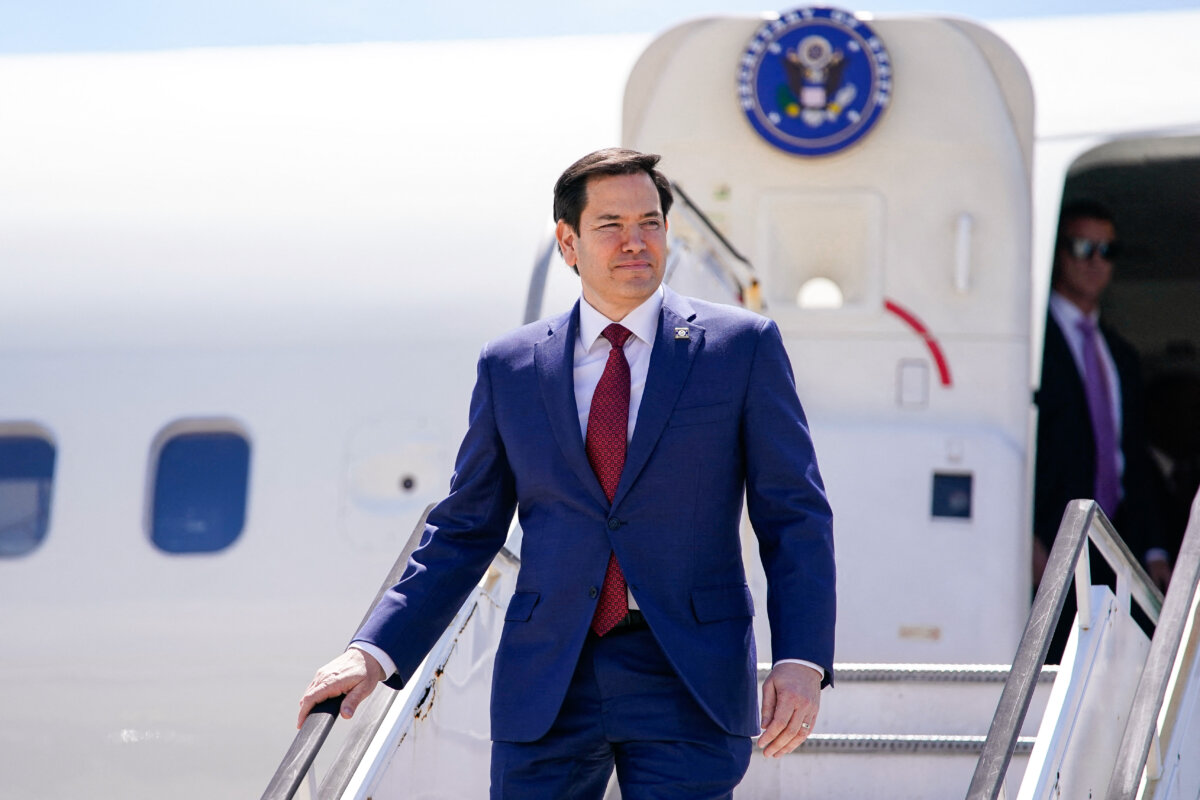

President Donald Trump often praises his Cabinet members, but in recent weeks, no one has drawn more public attention than Secretary of State Marco Rubio.
At the World Economic Forum in Davos, Switzerland, on Jan. 21, Trump joked, “I became a diplomat for the first time.”
“You know who taught me that—Marco Rubio,“ Trump said. ”He said, ‘Let me teach you about diplomacy.’”
Rubio, who also serves as national security adviser, is increasingly viewed in Washington as a rising force within the administration. Some have compared him to Henry Kissinger, who served first as national security adviser and later as influential secretary of state under Presidents Richard Nixon and Gerald Ford.
Alex Gray, who served on the National Security Council during Trump’s first term, said he views Rubio as effective and strongly aligned with the president on foreign policy.
Unlike previous secretaries, Gray said, Rubio does not try to change Trump but instead focuses on translating the president’s goals into successful policy.
“He’s an extraordinarily effective secretary of state, perhaps the most effective secretary of state we’ve had in a very long time,” Gray said.
Rubio was born in Miami in 1971 to conservative Cuban immigrant parents. His father worked as a bartender, and his mother divided her time between being a stay-at-home mom and working as a hotel maid.
Rubio’s roots and his upbringing in Miami’s Cuban immigrant community strongly influenced his political views—particularly his opposition to communism.
Cuban Americans “have been very proud of Secretary Rubio,” said John Suarez, executive director at Washington-based Center for a Free Cuba.
“He understands the international community and has deep knowledge of Latin America, particularly the dynamics of Cuba, Venezuela, and Nicaragua,” Suarez said.
Rubio served as a U.S. senator for Florida from 2011 to January 2025, when he resigned to join the Trump administration as secretary of state.
He was the first Cabinet member confirmed to join Trump’s second administration. He received unanimous bipartisan approval with a 99–0 vote on Inauguration Day and was sworn in on Jan. 21, 2025.
According to Evan Ellis, a Latin America research professor for the U.S. Army War College, Rubio’s background, strategic skills, and strong grasp of Caribbean and Latin American affairs make him “very effective in steering” U.S. policies in the region.
“This is Rubio’s moment in Latin America,” he said.
In May 2025, Rubio became acting national security adviser after Trump removed Mike Waltz from the position and nominated him as U.S. ambassador to the United States following a controversy over leaked text messages.
As national security adviser, Rubio works at the White House daily and remains close to the president.
“That proximity to the president means a lot,” Ellis said.
Although Rubio does not make the final decisions, he’s “providing options that are consistent with Trump’s style and objectives,” he noted.
With recent political changes in Venezuela, attention has now turned to Cuba. Analysts point to growing signs that the Cuban regime may be nearing collapse due to heightened U.S. pressure.
Rubio also closely aligns with Trump on relations with communist China. He has been regarded as one of the most prominent China critics in Washington, especially on issues such as human rights, trade, national security, and technology.
In 2020, he was placed on Beijing’s sanctions list twice for his human rights advocacy.
During his 2025 Senate confirmation hearing, Rubio described the Chinese communist regime as the “most potent and dangerous” adversary the United States has ever faced.
“They have elements that the Soviet Union never possessed,” Rubio said at the time.
—Emel Akan
BOOKMARKS
Democrats are pushing new legislation, named after Jeffrey Epstein victim Virginia Roberts Giuffre, that would eliminate the statute of limitations on certain federal civil claims tied to sex crimes. “You don’t get to escape prosecution by simply putting predators and victims on a plane to a private island or a mansion in Florida or a ranch in New Mexico,” Rep. Teresa Leger Fernández (D-N.M.) said on Feb. 10 when announcing “Virginia’s Law.”
Former Rep. Tom Malinowski (D-N.J.) has conceded to progressive Analilia Mejía in the New Jersey special election primary for the U.S. House of Representatives. “The outcome of this race cannot be understood without also taking into account the massive flood of dark money that AIPAC spent on dishonest ads during the last three weeks,” he said, blaming the American Israel Public Affairs Committee for his loss.
Some blue states are backing out of agreements they made to cooperate with ICE. Find out why, and what it means, by reading Arjun Singh’s latest report.
The Chinese Communist Party has expelled three senior military-industrial officials amid an ongoing military purge. Learn more by checking out Alex Wu’s article.
Three thousand body cameras have been issued to ICE agents, and thousands more are on the way, acting ICE Director Todd Lyons told Congress on Tuesday. Homeland Security Secretary Kristi Noem said earlier this month that the plan is to fit every officer with a camera.
—Stacy Robinson
 Friends Read Free
Copy
Facebook
Tweet
Friends Read Free
Copy
Facebook
Tweet