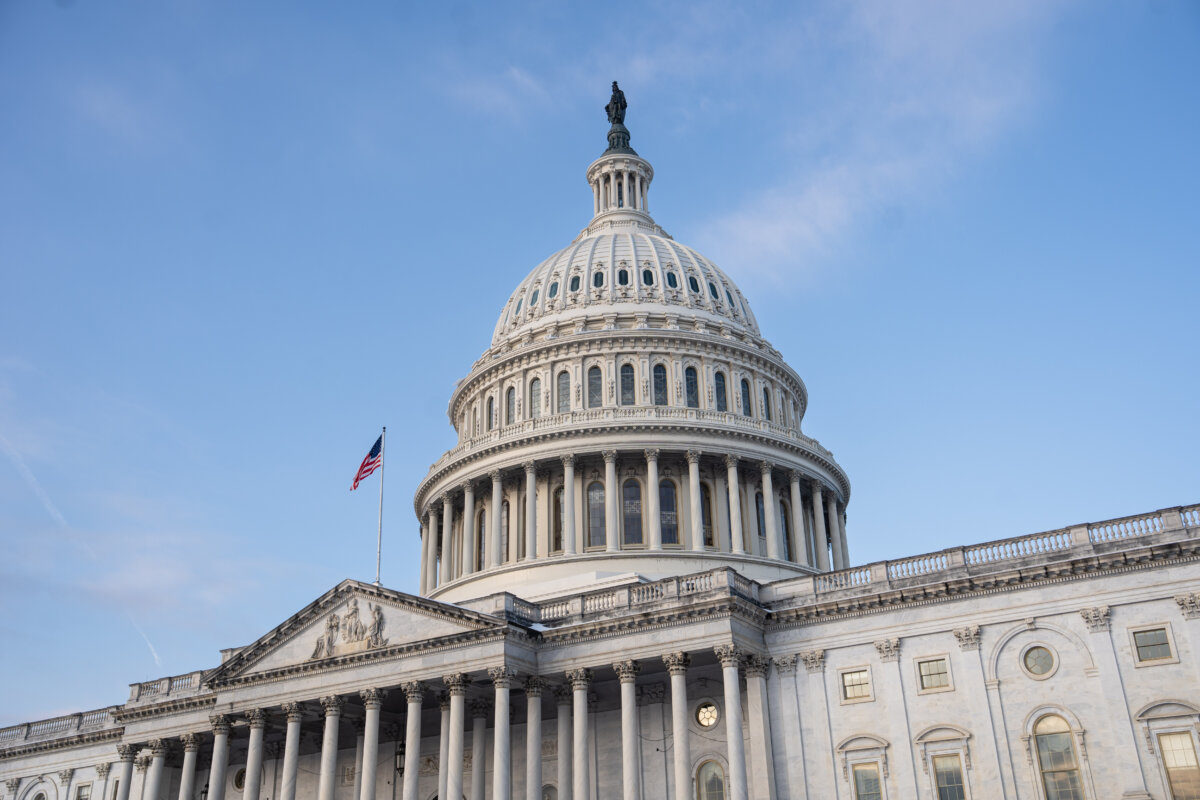

After President Donald Trump on Wednesday signed a government funding measure to end a partial government shutdown, funding fights still lie ahead—this time, entirely centered on the contents of a bill to fund the Department of Homeland Security (DHS).
Republicans are escalating their calls to pass the Safeguarding American Voter Eligibility (SAVE) Act—a bill intended to require voter ID and reduce voter fraud in federal elections—as a condition for passing the final funding package for DHS.
Senate Democrats—who have demanded sweeping reforms to DHS and its subsidiary Immigration and Customs Enforcement (ICE) as a condition for their support of the funding legislation—have described this as a non-starter in the upper chamber.
The bill signed by Trump finalizes full-year funding for 96 percent of the government, leaving all executive departments except DHS funded until Sept. 30. The funding for DHS, meanwhile, is set to run out on Feb. 13.
The DHS bill was separated from a larger tranche of spending bills after Democrats refused to support it in the aftermath of the fatal shooting of Alex Pretti by immigration agents in Minneapolis.
Trump has expressed support for the measure, calling for voter ID laws to be included in the package.
The president has also called for the federal government to “nationalize” or “take over” elections if states cannot run them “legally and honestly.”
Later, White House Press Secretary Karoline Leavitt said that those comments were an endorsement of passing the SAVE Act.
Any bill will need 60 votes to clear the Senate—though some House Republicans are calling for weakening or changing the rules around the Senate mechanism to more easily pass the bill.
With both sides digging in on their positions and no clear resolution in sight, the stage is set for a long week in Washington. Here’s what to know.
The SAVE Act has been introduced and championed by Rep. Chip Roy (R-Texas), its original sponsor, several times in recent years.
Most recently, the legislation was reintroduced by Roy and passed the House in April 2025. However, it has stalled in a Senate committee.
The bill’s purpose, according to its introduction, is “to require proof of United States citizenship to register an individual to vote in elections for Federal office.”
Roy and other proponents of the legislation say it’s necessary to respond to a 2013 decision in Arizona v. Inter Tribal Council of Arizona, which found that federal law limiting ID requirements supersedes existing state laws requiring documentary proof to vote—effectively banning states from imposing such requirements for federal voter registration.
Now, conservative House Republicans are leading calls to pass the legislation as a condition of their support for any DHS bill negotiated by Senate Democrats.
Ahead of—and during—the vote to pass the funding measure to end the partial shutdown, there were signs that the issue was becoming a red line for several members of the House Republican conference.
Before the House Rules Committee vote, there were questions about how Roy and Rep. Ralph Norman (R-S.C.) would vote, as both have called for the SAVE Act’s inclusion in the legislation.
Reps. Anna Paulina Luna (R-Fla.) and Tim Burchett (R-Tenn.) indicated before the floor vote that they were considering how they would vote due to the issue. Ultimately, the two supported the shutdown measure, but have continued to call for the SAVE Act’s inclusion in the final package.
Rep. Thomas Massie (R-Ky.) voted against the bill after an amendment to include the SAVE Act failed.
During the procedural vote, Rep. John Rose (R-Tenn.) joined Massie in blocking passage for nearly an hour over the issue before switching his vote.
Democrats have indicated that the inclusion of any such measure would make the bill dead on arrival in the Senate.
“The SAVE Act would impose Jim Crow type laws to the entire country and is dead on arrival in the Senate,” Senate Minority Leader Chuck Schumer (D-N.Y.) said in a statement. “It is a poison pill that will kill any legislation that it is attached to.
“If House Republicans add the SAVE Act to the bipartisan appropriations package it will lead to another prolonged Trump government shutdown.”
The New York lawmaker vowed that Democrats would “go all out to defeat the SAVE Act.”
Senate Majority Leader John Thune (R-S.D.) has promised a vote on the legislation in the Senate, though he didn’t say whether that would be a standalone vote, or when it might be held.
“We will get a vote on the SAVE Act at some point,” Thune told reporters at a Tuesday press conference. “I’m not sure exactly what that context will be. Maybe it’s in the context of voting on the DHS bill if something’s agreed upon, but there will be at some point a vote on the SAVE Act.”
As it stands, Congress appears to be at an impasse, with both sides entrenching their position.
Sen. Katie Britt (R-Ala.), a leader of GOP negotiations on the funding bill, had little to say about how negotiations currently stand as she left an initial meeting with Senate Democrats on Wednesday.
She said lawmakers “need a little bit more time” to “figure out a pathway forward.” [Otter]
Sen. Lisa Murkowski (R-Alaska), a crucial swing vote, was pessimistic when asked about the prospects of a deal being reached before the Feb. 13 deadline.
“It’s really hard, oh my gosh. It’s really hard, because the time that we’ve given ourselves this window, it’s so short,” Murkowski told The Epoch Times. [Otter]
With no clear way forward in sight, some Republicans—most prominently Luna—have called for the Senate to resurrect the “standing filibuster.”
In contrast to the filibuster system of recent years—handled largely by the use of a procedural cloture vote requiring 60 members’ consent to overcome—the standing filibuster requires members to consistently speak on the Senate floor to continue debate.
Some Republicans have indicated skepticism about such a change.
Asked about Luna’s proposal, Murkowski told The Epoch Times, “That’s not constructive.”
Sen. Rand Paul (R-Ky.) also said he’s broadly opposed to the push.
“I’m not really for changing the filibuster, but I am definitely for the SAVE Act,” Paul told The Epoch Times. [Otter]
—Joseph Lord and Nathan Worcester
BOOKMARKS
A man arrested by Las Vegas police during the raid of an allegedly illegal biolab in Las Vegas on Jan. 31 was charged after authorities discovered he was a foreign national in possession of several weapons, The Epoch Times’ Jill McLaughlin reported. Authorities reported finding several firearms and passports during a raid on 55-year-old Ori Salomon’s house in a residential neighborhood on Jan. 31.
The U.S. Supreme Court on Feb. 4 allowed California to use its newly redrawn congressional map that aims to give Democrats five extra seats in the upcoming midterm elections, The Epoch Times Matthew Vadum reported. The decision came in an unsigned order with no dissents or explanation of the ruling provided.
The United States hosted more than 55 countries at the first Critical Minerals Ministerial on Feb. 4, announcing the creation of a preferential trade zone meant to offer members predictable and stable conditions for reentering the industry. The Epoch Times’ Catherine Yang reported that participants represented some two-thirds of the world’s gross domestic product, according to Vice President JD Vance, though not all participants had joined as members.
Three U.S. warships have been sent to Haiti as part of Operation Southern Spear, a military operation in the Caribbean to counter narcotics trafficking, The Epoch Times’ Chris Summers reported. According to the U.S. Embassy in Haiti, they are the USS Stockdale, USCGC Stone, and USCGC Diligence.
White House border czar Tom Homan said that the Trump administration will immediately draw down 700 immigration agents from Minnesota, The Epoch Times’ Jackson Richman reported. Homan characterized the drawdown as “smarter enforcement, not less.”
 Friends Read Free
Copy
Facebook
Tweet
Friends Read Free
Copy
Facebook
Tweet