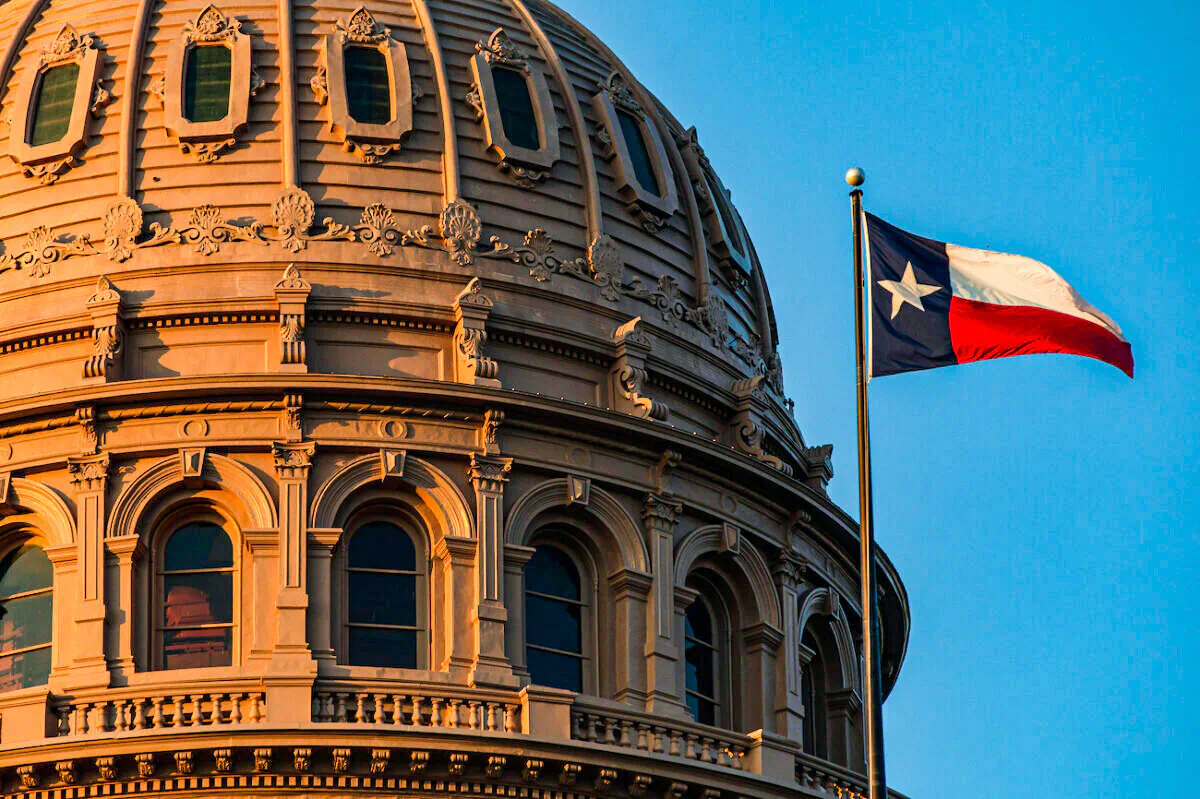
Texas lawmakers will convene in Austin today for a special session of the legislature, which will touch on a flurry of contentious issues—including, among others, Republicans’ efforts to redraw the state’s congressional map to make it more competitive for the GOP.
Texas Gov. Greg Abbott called for the July 21 special session to discuss the issue. The special session was called on July 9 after Abbott issued a proclamation directing the Legislature to convene in Austin for a special session beginning at noon on July 21.
The special session, which can last a maximum of 30 days, will consider several pieces of legislation, including efforts to improve the state’s early warning systems and other preparedness infrastructure for flood-prone areas. It will also consider a “revised congressional redistricting plan in light of constitutional concerns raised by the U.S. Department of Justice.”
The flood warning system discussion will occur about two weeks after flash floods killed more than 100 people in Central Texas. Several months’ worth of rain fell within several hours, causing the Guadalupe River to swell by 27 feet.
Abbott’s reference to “constitutional concerns” by the Justice Department refers to allegations the agency made that Texas’s Ninth, 18th, 29th, and 33rd congressional districts are unconstitutional “coalition districts” that violate the Voting Rights Act and 14th Amendment.
Coalition districts are places where combined minority groups make up a single majority of the population and where those groups vote together to elect a “minority-preferred candidate.”
Three of the seats cited in the Justice Department’s letter are held by Democratic Reps. Al Green (Ninth), Marc Veasey (33rd), and Sylvia Garcia (29th). The 18th district was left open after Rep. Sylvester Turner (D-Texas) died.
Four days before the governor’s summons, Texas Republicans had passed a list of resolutions outlining their key priorities, including “redistricting to support the Republican majority in Congress at the next midterm election.”
With a narrow 220–212 majority in the 435-seat House of Representatives, Republicans are looking for any opportunity they can to retain control of the Congress’s lower chamber next year.
Midterm House elections often see the incumbent president’s party lose seats, and President Donald Trump has said that redistricting Texas could bolster the GOP’s slim majority.
He told reporters at the White House that Republicans could pick up five seats from redistricting the Lone Star State and potentially “three or four or five” if other states follow suit. Trump did not say which states could be next.
Since redistricting is generally conducted every 10 years after the U.S. Census, Texas’s current map, completed in 2021, was slated to remain in effect until 2031.
This wouldn’t be the first time Texas Republicans have tried a similar redistricting effort mid-cycle. In 2003, roughly 50 Democrats left for Oklahoma to deny the session a quorum, effectively halting it.
However, the walkout only delayed the GOP, which was finally able to redistrict during the session.
California Gov. Gavin Newsom, a Democrat, said he spoke to state lawmakers about holding a similar special session in the Golden State to redraw its districts.
“If we’re gonna play fair in a world that is wholly unfair, we may have the higher moral ground, but the ground is shifting from underneath us. And I think we have to wake up to that reality,” Newsom told the “Pod Save America” podcast.
Rep. Ritchie Torres (D-N.Y.) said that if Democrats don’t step up and “do the same” thing as Abbott, it “would be unilateral disarmament.”
John Bisognano, president of the National Democratic Redistricting Committee, said in a statement that the efforts by Trump and Abbott to redistrict Texas mid-cycle amount to gerrymandering to “secure unearned power ahead of the 2026 midterm elections.”
Rep. Vicente Gonzalez Jr. (D-Texas), who won his most recent election by slightly more than 5,000 votes and could be vulnerable to redistricting efforts, told The Associated Press that he isn’t worried by Abbott’s efforts.
While some of his Democratic voters may be taken out of his district, they may end up in Republican-led districts adjacent to his current one, which could make those districts more competitive than they are now.
“Get ready for some pickup opportunities,” Gonzalez said.
He also said that Democrats are already speaking with potential challengers to Republicans whose districts may be destabilized by the redistricting.
—Jacob Burg, Joseph Lord, and Michael Clements
BOOKMARKS
Medications have become a fact of life for many—perhaps most—Americans. With Americans now filling approximately 19 prescriptions per year, The Epoch Times’ Lawrence Wilson explored the state of Big Pharma in the U.S. using nine charts.
Candice Mueller spent decades fighting drug and alcohol addiction. Following an incarceration in 2021, The Epoch Times’ Jeff Louderback reported, she turned to her faith—and was able to escape her dependence on drugs.
Commerce Secretary Howard Lutnick said on Sunday that the United States is still aiming to leave a 10 percent baseline tariff on many smaller countries, The Epoch Times’ Jacob Burg reported. Lutnick told CBS that the Trump administration is not looking to increase the 10 percent baseline tariff level it imposed on many smaller nations in early April, despite some comments from Trump indicating the contrary.
A senior executive of Wells Fargo, a U.S. citizen, has been banned from leaving China, renewing concerns over doing business in the communist state, The Epoch Times’ Alex Wu reported. Analysts say that amid continued tensions between China and the United States, safety risks faced by foreign businessmen in China are rising sharply.
Correction: A previous version of this article misstated the districts represented by Reps. Sylvester Turner and Marc Veasey. The Epoch Times regrets the error.
 Friends Read Free
Copy
Facebook
Tweet
Friends Read Free
Copy
Facebook
Tweet